Elon Musk posted a flat denial on October 7, 2026: Starlink satellite beams are turned off over India, making any claim that the service was used there — for any purpose — impossible. The statement cuts through a swirl of speculation that has followed Starlink's long, complicated road toward operating in the country. Here's the full picture in five points.

1. What Musk Actually Said — and Why the Wording Is Deliberate
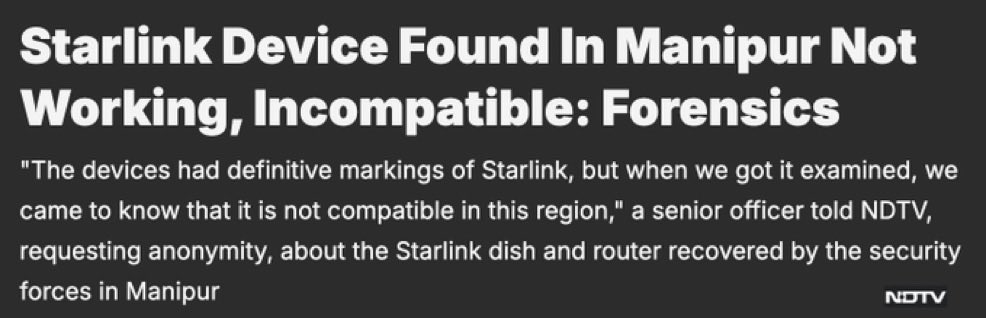
Musk's post didn't hedge: "Starlink beams are turned off over India, so the claim that they were used by anyone for any reason is absolutely false." The phrase "for any reason" is doing significant work here. It forecloses every possible use case — commercial, personal, or otherwise — in a single sentence. This mirrors language Musk used in December 2024, when he said the beams were "never on in the first place" after Indian security forces reportedly seized Starlink hardware in Manipur. The pattern is consistent: SpaceX treats beam activation as a hard regulatory gate, not a gray area.
2. The Regulatory Journey That Got Starlink to This Point
Starlink has spent years navigating India's licensing framework. The company secured a Global Mobile Personal Communication by Satellite (GMPCS) license from India's Department of Telecommunications in June 2025 — valid for 20 years — and followed that with authorization from the Indian National Space Promotion and Authorisation Centre (IN-SPACe) in July 2025, valid through July 2030. According to background reporting, Starlink has also built 20 gateway sites comprising hundreds of antennas across India, and SpaceX VP Lauren Dreyer confirmed the infrastructure is specifically designed to meet Indian data-localization requirements. Licenses are in hand. Infrastructure is in the ground. What's missing are final government clearances to actually turn the beams on.
3. The Seized Hardware Problem — and Why Devices Can Exist Without Service
The recurring confusion stems from a straightforward technical reality: Starlink terminals can be physically present in India without the service being active. Hardware moves across borders; beam activation is controlled from SpaceX's ground systems and is geofenced by region. When devices were reportedly seized in Manipur, that didn't mean the service was live — it meant hardware had entered the country through unofficial channels. Musk's October 7 statement is essentially a reminder that possession of a terminal and access to the Starlink network are two entirely separate things.
4. Where the India Launch Actually Stands
As of October 7, 2026, Starlink officials speaking at the India Mobile Congress 2026 reiterated that the company is operationally ready to serve India once final government clearances arrive. Starlink has signed MoUs with both Airtel and Jio. The Indian government has also opted for administrative spectrum allocation — the method Starlink advocated for — rather than an auction, removing one significant obstacle. Separately, Starlink has reapplied to IN-SPACe for approval of its Gen 2 satellite constellation, which adds direct-to-device connectivity. An earlier Gen 2 application was rejected. Pricing remains officially unannounced; a ₹8,600/month figure that briefly appeared on Starlink's India webpage in December 2025 was attributed to a configuration error.
5. What This Means for the Broader India Opportunity
India represents one of the largest untapped markets for satellite internet globally, with hundreds of millions of people in rural and semi-urban areas underserved by terrestrial broadband. The infrastructure investment — 20 gateway sites, telecom partnerships, two-decade licensing — signals that SpaceX is treating India as a long-term strategic market, not an afterthought. The final clearances are a political and bureaucratic question at this stage, not a technical one. When those clearances arrive, the beams can be switched on relatively quickly. Until then, Musk's message is unambiguous: they're off, and nothing is moving through that network.

The final clearances remain the only variable SpaceX can't control from its own operations. Everything else — the licenses, the ground infrastructure, the carrier partnerships — is already in place. India's satellite internet era isn't a question of if at this point; it's a question of when the last bureaucratic gate opens.
Sources & reporting notes
The links below identify the material source records used for this report.
- @elonmusk on X (2026-10-07T22:30:10.000Z) — Direct source
Source links are preserved as published or accessed. See our editorial standards and corrections policy.
The BASENOR Editorial Desk covers Tesla, SpaceX, and related technology, curating reporting from primary sources — official accounts, regulatory filings, and software release data. Every article passes source-record and fact-checking review before publication. About the newsroom.
This report was curated by the BASENOR Editorial Desk from the sources listed above. Read our editorial standards or email editorial@basenor.com to report an error.