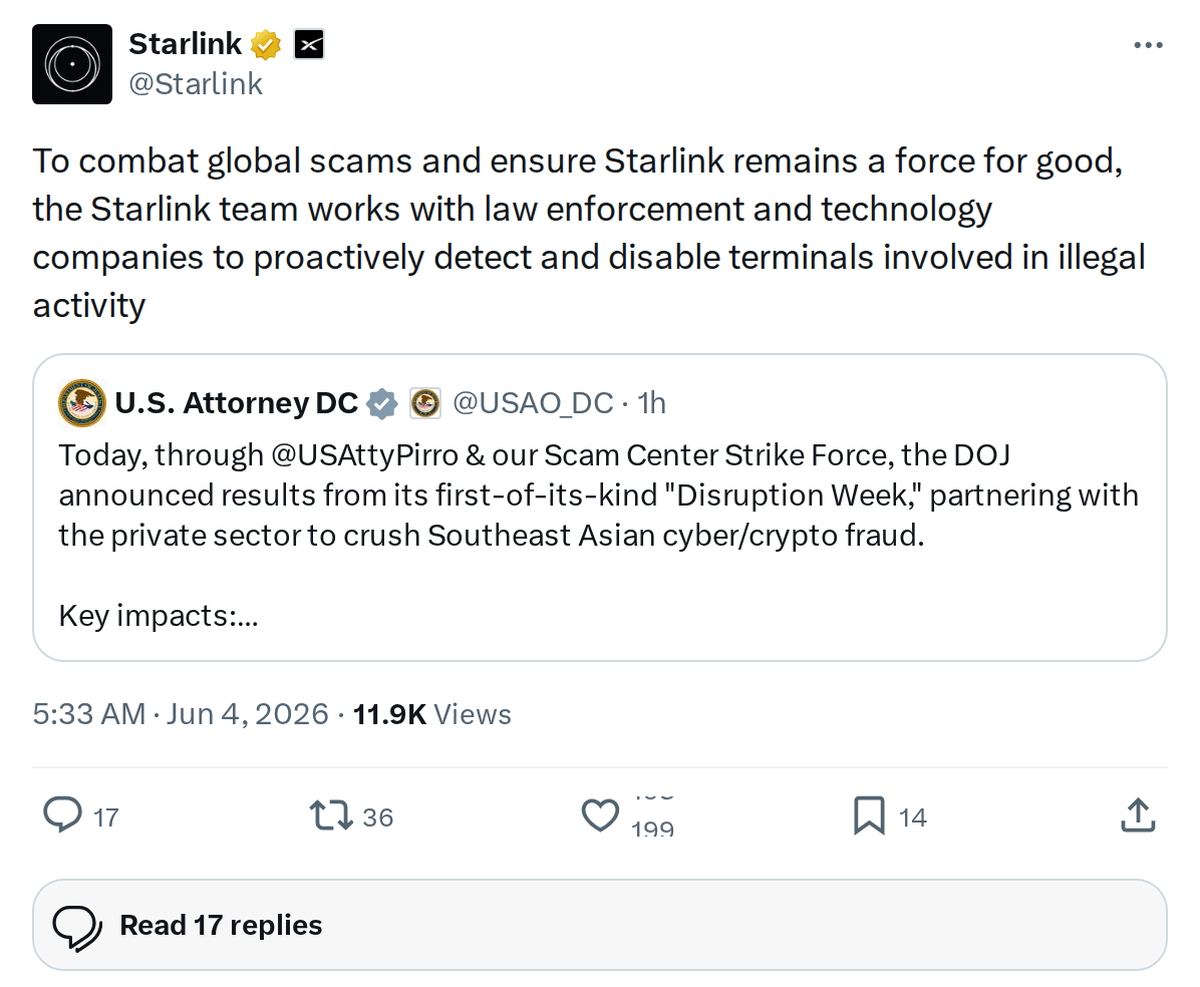
Starlink has gone public with its role in a coordinated global crackdown on online scam networks, confirming it actively works with law enforcement and technology companies to detect and disable terminals used for illegal activity. The announcement, posted on June 3, 2026, puts a face on enforcement actions that have been quietly happening for months — and the scale of what's been accomplished is significant.

What the Operation Actually Achieved
The numbers behind this announcement are substantial. According to reports tied to the June 3 disclosure, a two-week joint operation running from May 18 through June 3, 2026 brought together Starlink, Meta, Microsoft, Coinbase, the U.S. Department of Justice, the FBI, the Royal Thai Police, and other international law enforcement agencies. The results:
- 63 arrests across multiple jurisdictions
- 1.4 million scam-related accounts removed from Facebook and Instagram by Meta
- Thousands of Starlink internet terminals disabled for alleged unlawful use
- $3 million in cryptocurrency frozen by Coinbase linked to criminal networks
- ~20,000 fraudulent accounts suspended by Microsoft
This wasn't a one-off. SpaceX's Vice-President of Starlink business operations, Lauren Dreyer, confirmed earlier that the company had already disabled over 2,500 Starlink kits in the vicinity of suspected scam centers in Myanmar — a country where Starlink is not licensed to operate. That action was taken in direct response to cybercrime networks using the terminals for human trafficking operations and large-scale fraud.
How Starlink Enforces Its Acceptable Use Policy
Starlink's enforcement toolkit is more precise than many users realize. The company can disable individual terminals using their unique ID numbers, or block service across entire geographic areas through geofencing — a capability that proved critical in the Myanmar situation where the terminals were operating outside licensed territory.
SpaceX states it continuously monitors for violations of its Acceptable Use Policy and applicable law, taking action that ranges from individual terminal shutdowns to full cooperation with law enforcement agencies worldwide. The June 3 announcement signals that this enforcement is becoming more proactive and coordinated, rather than reactive.
The Scale of the Problem
The urgency behind these efforts becomes clearer with context. The online scam industry across Southeast Asia alone was estimated to generate approximately $37 billion annually as of 2023, according to available research. Satellite internet has become a tool of choice for criminal networks operating in remote or ungoverned areas precisely because it bypasses traditional infrastructure controls.
Other incidents illustrate how widespread the misuse has become. In March 2026, Honduran security forces found a Starlink antenna inside the Tamara National Penitentiary, raising concerns about inmates coordinating criminal activity from behind bars. Iran's Ministry of Intelligence, as of late May 2026, announced the seizure of hundreds of Starlink devices and declared acquisition or use of such systems a criminal offense under Iranian law.
Why This Matters Beyond Starlink
The June 3 operation represents something relatively new: a private satellite internet provider acting as an active enforcement partner rather than a passive infrastructure layer. Starlink's willingness to disable terminals at scale — and to do so in coordination with federal law enforcement across multiple countries — sets a precedent for how satellite connectivity providers handle misuse at a global level.
For the broader Starlink subscriber base, the message is straightforward: the network has both the technical capability and the institutional willingness to cut off service when terminals are linked to illegal activity. The question now is whether this level of coordinated enforcement becomes a permanent operational posture, or whether it remains tied to specific high-profile operations. Given the scale of the scam economy it's targeting, the former seems more likely.
Sources & reporting notes
The links below identify the material source records used for this report.
- @Starlink on X (2026-06-03T21:33:19.000Z) — Direct source
Source links are preserved as published or accessed. See our editorial standards and corrections policy.
The BASENOR Editorial Desk covers Tesla, SpaceX, and related technology, curating reporting from primary sources — official accounts, regulatory filings, and software release data. Every article passes source-record and fact-checking review before publication. About the newsroom.
This report was curated by the BASENOR Editorial Desk from the sources listed above. Read our editorial standards or email editorial@basenor.com to report an error.