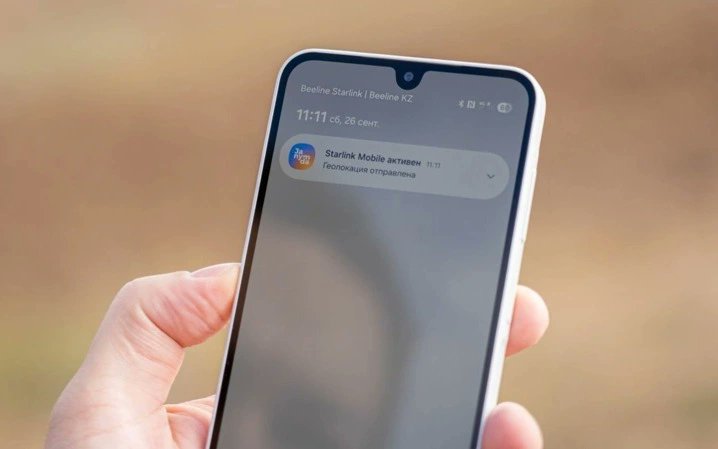
SpaceX's Starlink Mobile service officially launched in Kazakhstan on September 28, 2026, marking the first deployment of Direct-to-Cell satellite technology in Central Asia. The rollout, backed by a partnership with local carrier Beeline Kazakhstan, is designed to extend mobile connectivity into the country's vast remote regions where ground infrastructure simply doesn't reach.

How It Works — and Why Kazakhstan First
Direct-to-Cell is the technology underneath this launch. Unlike traditional satellite internet that requires a dedicated dish or terminal, it allows a compatible smartphone to connect directly to a Starlink satellite overhead — no external antenna, no special hardware. The satellite handles what a cell tower normally would.
Kazakhstan is a logical early market for this. The country spans roughly 2.7 million square kilometers, making it the ninth-largest nation on earth by area, yet large stretches of its steppe, mountain ranges, and highway corridors have little to no terrestrial mobile coverage. According to reporting from qazinform.com and el.kz, the groundwork for this launch was laid during President Kassym-Jomart Tokayev's official visit to the United States in 2025. A formal memorandum between Kazakhstan's Ministry of Artificial Intelligence and Digital Development and Beeline Kazakhstan followed in November 2025, with practical trials conducted in December 2025.

What the Service Actually Offers at Launch
At the initial stage, users can send and receive messages and access basic internet services. It is not a full broadband replacement — the positioning is explicitly complementary to terrestrial networks, kicking in when ground coverage disappears. According to caspianpost.com, the service is currently available on compatible Android devices, with support for additional operating systems planned down the line.
To activate it, Beeline Kazakhstan subscribers need to update the Janymda application to its latest version, enable Starlink within the app, and turn on data roaming. When terrestrial coverage drops out, the phone can manually select the satellite network labeled "Beeline Starlink" — which may also appear in network menus as "401 04."
Pricing during the promotional launch period: free of charge for Beeline Kazakhstan subscribers.
The Bigger Picture for SpaceX's Global Expansion
This launch matters beyond Kazakhstan's borders. Central Asia has been a notable gap in Direct-to-Cell's footprint, and getting a government-backed carrier partnership across the finish line here demonstrates that SpaceX can navigate the regulatory and commercial complexity of markets outside Western Europe and North America.
The use case also broadens the Direct-to-Cell argument. Early deployments have leaned heavily on emergency communications framing — coverage when disaster damages ground infrastructure. Kazakhstan adds a routine daily-use angle: highways, mountain passes, and agricultural regions where dead zones are the norm, not the exception. That's a different kind of proof point for carriers in similarly large, sparsely connected countries watching this rollout closely.
For SpaceX's SpaceX coverage watchers, the Kazakhstan launch is a data point in a pattern: Direct-to-Cell is moving from trials to live commercial deployments at an accelerating pace. How quickly Beeline Kazakhstan scales beyond the initial Android-only, messaging-and-basic-internet tier will be worth tracking — that trajectory will say a lot about whether the service can graduate from connectivity safety net to everyday utility.
Sources & reporting notes
The links below identify the material source records used for this report.
- @SawyerMerritt on X (2026-09-28T11:40:05.000Z) — Direct source
Source links are preserved as published or accessed. See our editorial standards and corrections policy.
The BASENOR Editorial Desk covers Tesla, SpaceX, and related technology, curating reporting from primary sources — official accounts, regulatory filings, and software release data. Every article passes source-record and fact-checking review before publication. About the newsroom.
This report was curated by the BASENOR Editorial Desk from the sources listed above. Read our editorial standards or email editorial@basenor.com to report an error.