📌 UPDATE — September 28, 2026
Flight 14 completed 2 orbits (not 1 as initially reported) before Ship 41 performed its deorbit burn at the 2h12m mark, per orbital analyst Jonathan McDowell. The vehicle successfully executed a textbook bellyflop, flip-and-burn, and splashdown in the North Pacific Ocean — with SpaceX confirming splashdown at 15:58 UTC. Notably, NSF noted the splashdown was followed by "the expected explosion," suggesting a controlled vehicle loss rather than a recovery attempt, consistent with this being a pathfinder mission. Sawyer Merritt noted the precision of the flip maneuver has observers speculating a tower catch could be attempted on Flight 15. Today also marks an extraordinary historical symmetry: exactly 18 years to the day after Falcon 1 first reached orbit on September 28, 2008, Starship has now done the same.
SpaceX (@SpaceX) · Sep 28, 2026
"Splashdown confirmed. Congratulations to the entire SpaceX team on the first orbital flight of Starship!"
View on X ↗
📌 UPDATE — September 28, 2026
Elon Musk has officially confirmed that all 26 Starlink V3 satellites deployed during Starship Flight 14 are now operating nominally. The confirmation came via Musk's post on X roughly two hours after deployment, providing the first direct acknowledgment that the payload mission was a full success despite the vehicle's early return. This marks the first operational Starlink V3 satellites in the constellation, a significant milestone for SpaceX's next-generation broadband network. The successful deployment validates Starship's payload delivery capability even under anomalous flight conditions.
@elonmusk · Sep 28, 2026
"All 26 Starlink V3 operational satellites deployed and operating nominally"
View on X ↗
SpaceX crossed a threshold this morning that had eluded Starship across 13 previous test flights: it reached orbit. Flight 14 lifted off from Starbase at 8:49 a.m. EDT on Monday, September 28, 2026, completed its orbital insertion burn, and deployed 26 upgraded Starlink V3 satellites — the vehicle's first operational payload delivery. But the mission also ended earlier than planned, with SpaceX's flight team electing to fire the deorbit burn after roughly one orbital checkpoint rather than the six orbits originally on the flight plan.
Elon Musk marked the moment on X with a single line: "First orbital flight of Starship successful!"

What Actually Happened
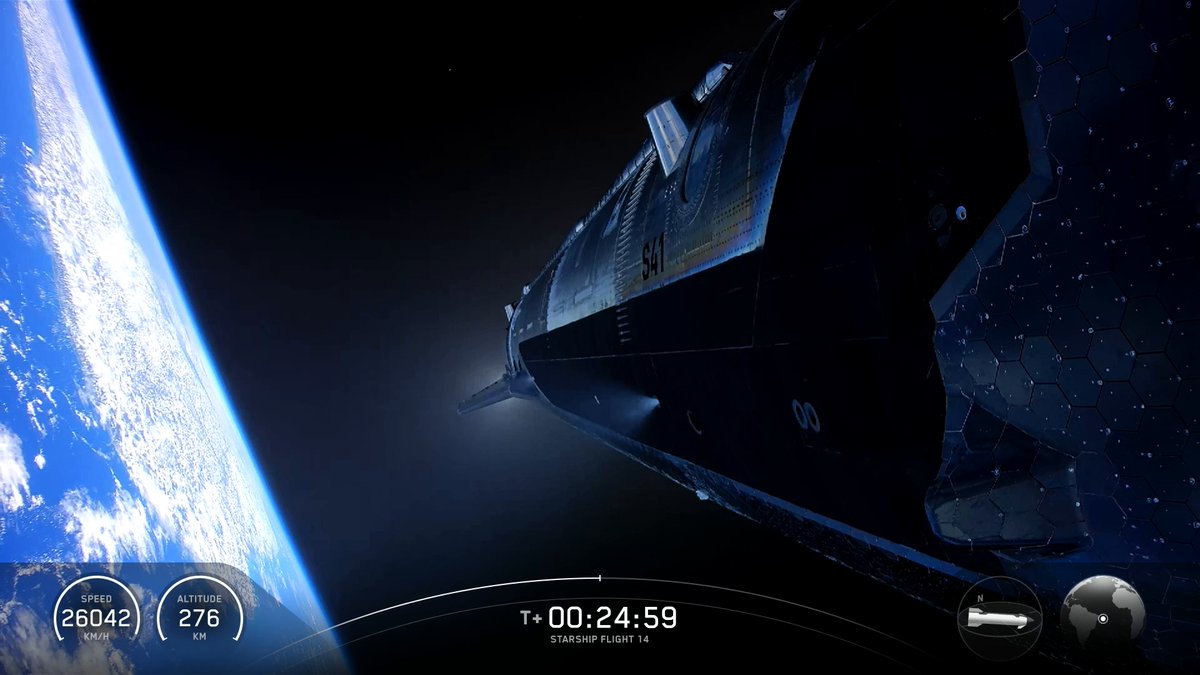
Flight 14 used Ship 41 and Super Heavy Booster 21, both Block 3 vehicles — the latest iteration of the stack designed specifically to carry operational payloads rather than serve as a test article. According to space.com and payloadspace.com, the ascent was not entirely clean: one of the six Raptor engines on the Starship upper stage shut down early during the climb, initially placing the vehicle on a suborbital trajectory. The flight control team assessed the spacecraft as healthy and proceeded with orbital insertion anyway, ultimately reaching an altitude of approximately 170 miles (275 km).
Once on orbit, Starship deployed all 26 Starlink V3 satellites. This is a meaningful operational data point on its own — each V3 satellite is designed to add roughly 1 Tbps of network capacity, a significant leap over the V2 Mini generation currently flown on Falcon 9. Getting a full V3 stack to orbit on the first Starship orbital attempt is exactly the outcome SpaceX needed to justify the switch of the V3 constellation build-out from Falcon 9 to Starship.
Then, roughly two hours into what was supposed to be a nearly 10-hour, six-orbit mission, SpaceX's team executed the deorbit burn early. Aerospace journalist Jeff Foust flagged the change in real time:
The nominal splashdown target had been the Pacific off the coast of Chile. The actual splashdown occurred in the Northern Pacific, consistent with the truncated flight profile.
Key Figures
| Metric | Flight 14 Result |
|---|---|
| Launch time | 8:49 a.m. EDT, Sept 28, 2026 |
| Vehicle stack | Ship 41 + Booster 21 (Block 3) |
| Peak altitude | ~170 miles (275 km) |
| Planned orbits | 6 (~10 hours) |
| Actual mission length | ~1 orbital checkpoint before deorbit |
| Payload | 26 Starlink V3 satellites (deployed) |
| Raptor engines nominal | 5 of 6 upper-stage engines (1 early shutdown) |
| Super Heavy recovery | Controlled Gulf of Mexico splashdown |
Why the Early Return Isn't the Story People Think It Is
The instinct is to read "returned early" as a partial failure. That framing misses what Flight 14 was actually built to prove. The four hard milestones SpaceX needed to clock — orbital insertion, payload deployment, on-orbit survival long enough to validate the operational profile, and a controlled reentry — all appear to have been met on the abbreviated timeline. According to Forbes and Aviation Week, the six-orbit plan was primarily a stress test for heat shield longevity, thermal soak, and communications continuity. Once one Raptor shut down early and the team completed the orbital insertion under a non-nominal ascent, coming home after the first orbital checkpoint is the textbook engineering decision: bank the data you have, keep the vehicle intact, and don't roll the dice on eight more hours of thermal cycling with a stack that already showed one anomaly.
The Super Heavy booster's controlled splashdown in the Gulf of Mexico is the other quiet win here. Booster recovery has been a known-quantity capability across recent flights, and Flight 14 keeps that streak intact even while the upper stage was pushing new territory.
How We Got Here
Every one of Starship's previous 13 flights was suborbital — either intentionally, to test the heat shield and reentry profile, or unintentionally, when the vehicle didn't survive ascent. The FAA issued license authorization for Flight 14's launch and reentry operations on September 26, 2026, two days before liftoff, per the Federal Aviation Administration's public filings referenced by satnews.com and keeptrack.space. That regulatory clearance specifically covered orbital operations, distinguishing it from the suborbital licenses that governed Flights 1 through 13.
The Block 3 vehicle configuration is also new. Block 3 was designed around operational Starlink V3 deployment — the payload bay, the Pez-style dispenser mechanism, and the upper-stage plumbing were all validated on this flight for the first time in a real orbital environment. That's why the successful deployment of all 26 satellites matters more than the shortened orbital coast: it de-risks the entire near-term Starlink V3 build-out schedule.
What to Watch Next
- Post-flight review timeline. Expect SpaceX to publish a mission summary within days. The Raptor early-shutdown root cause is the most important open question.
- Flight 15 cadence. With Block 3 now flight-proven for orbital operations, the interval between orbital flights becomes the metric that matters. SpaceX has historically compressed cadence quickly once a configuration succeeds.
- Starlink V3 deployment ramp. Watch for the next Starship-launched V3 batch and whether SpaceX begins retiring V3 flights from Falcon 9's manifest.
- Full six-orbit attempt. The mission profile that got truncated today will need to fly successfully before SpaceX can credibly move to crewed or higher-energy missions.
Editor's View
Flight 14 is the kind of milestone that gets messy in the retelling. "First orbital flight successful" and "returned early after one orbit" are both true, and both matter. What Starship needed to prove today was that the vehicle can reach orbit, deploy real payloads, and come home under control. It did all three. The six-orbit plan was aspirational; the operational payload deployment was the actual assignment. On that assignment, SpaceX cleared the bar.
🚀 Following the Starship program? See every test flight, official outcome and the next launch window in our SpaceX Starship Tracker.
Sources & reporting notes
The links below identify the material source records used for this report.
- @elonmusk on X (2026-09-28T14:01:26.000Z) — Direct source
- @jeff_foust on X (2026-09-28T14:16:47.000Z) — Direct source
Source links are preserved as published or accessed. See our editorial standards and corrections policy.
The BASENOR Editorial Desk covers Tesla, SpaceX, and related technology, curating reporting from primary sources — official accounts, regulatory filings, and software release data. Every article passes source-record and fact-checking review before publication. About the newsroom.
This report was curated by the BASENOR Editorial Desk from the sources listed above. Read our editorial standards or email editorial@basenor.com to report an error.