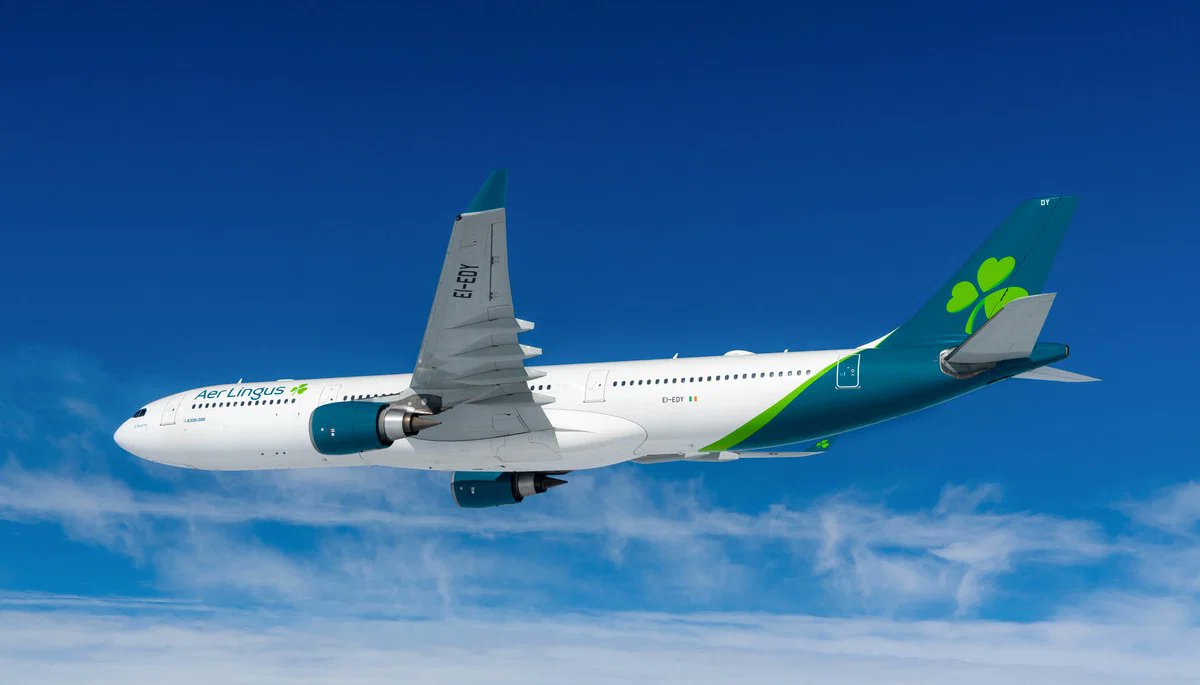
Aer Lingus has extended its Starlink Aviation rollout to all transatlantic flights operating through Shannon Airport, giving passengers free high-speed broadband at 35,000 feet. The expansion builds on an initial launch that began with a single Airbus A330 in March 2026 — and the numbers coming out of the program are hard to ignore.

1. Shannon Is Now Fully Covered — Dublin Came First
Aer Lingus first put Starlink in the air on March 29, 2026, when flight EI105 departed Dublin for New York JFK aboard an Airbus A330 (registration EI-EIN). That was the proof-of-concept. The Shannon expansion announced this week means every transatlantic route through Ireland's second major international gateway is now Starlink-equipped. According to futuretravelexperience.com, the airline is targeting 100% long-haul fleet coverage by the end of 2026 or Q1 2027.
2. It's Free for Every Passenger in Every Cabin
No paywalls, no premium tier, no login codes handed out in business class only. Starlink connectivity on Aer Lingus is complimentary across all cabins — economy included. That's a meaningful differentiator at a time when many carriers still charge per-session or per-hour fees for far slower legacy satellite systems. The airline has framed this as a baseline amenity, not an upsell.
3. The Speeds Are Genuinely Transatlantic-Grade
Advertised download speeds reach 500+ Mbps. Real-world performance observed on equipped flights typically lands between 150–450 Mbps down and 20–70 Mbps up, according to seatwifi.com. To put that in context: streaming 4K video, joining a video call, or downloading a large file mid-Atlantic is no longer a pipe dream. The Aer Lingus quote shared by @SawyerMerritt describes speeds as "equivalent, if not better" than what passengers are used to on the ground — and the data backs that up.
4. Passengers Are Actually Using It — 85% Connection Rate Per Flight
Adoption numbers tell the real story. According to businesstravelexecutive.com, an average of 85% of passengers connect to Starlink during each equipped flight. Some individual flights have recorded collective data usage of up to 950GB — a figure that would have been unthinkable on previous-generation aviation Wi-Fi. The airline also reports a 27-point improvement in connectivity satisfaction scores on Starlink-equipped aircraft versus the prior system.
5. Installations Are Done In-House at Dublin Airport
Aer Lingus isn't outsourcing the hardware work. Starlink antenna installations are carried out by the airline's own maintenance and engineering teams at Hangar 6 at Dublin Airport. That in-house capability matters for rollout pace — it removes a third-party scheduling bottleneck and gives the airline direct control over how quickly it can retrofit the remaining long-haul fleet ahead of the 2026/Q1 2027 target.
6. Short-Haul Routes Are Next — But Not Until 2027
The current rollout is focused entirely on long-haul aircraft, where the connectivity gap versus ground-based internet has always been most painful. Short-haul European routes are on the roadmap, but Aer Lingus has indicated those aircraft won't receive Starlink until 2027. For now, if you're flying transatlantic through Dublin or Shannon on an equipped aircraft, you're covered. For the Dublin–London or Dublin–Amsterdam crowd, the wait continues.
The Aer Lingus rollout is one of the more data-rich public case studies for Starlink Aviation to date — 85% passenger adoption and 950GB per-flight usage figures are the kind of metrics that tend to accelerate competitor decisions. Whether other European carriers move to match it on pricing (free) as well as technology will be worth watching over the next 12 months. For more on Starlink's expanding aviation and connectivity footprint, see our SpaceX coverage.
Sources & reporting notes
The links below identify the material source records used for this report.
- @SawyerMerritt on X (2026-08-17T14:38:32.000Z) — Direct source
Source links are preserved as published or accessed. See our editorial standards and corrections policy.
The BASENOR Editorial Desk covers Tesla, SpaceX, and related technology, curating reporting from primary sources — official accounts, regulatory filings, and software release data. Every article passes source-record and fact-checking review before publication. About the newsroom.
This report was curated by the BASENOR Editorial Desk from the sources listed above. Read our editorial standards or email editorial@basenor.com to report an error.