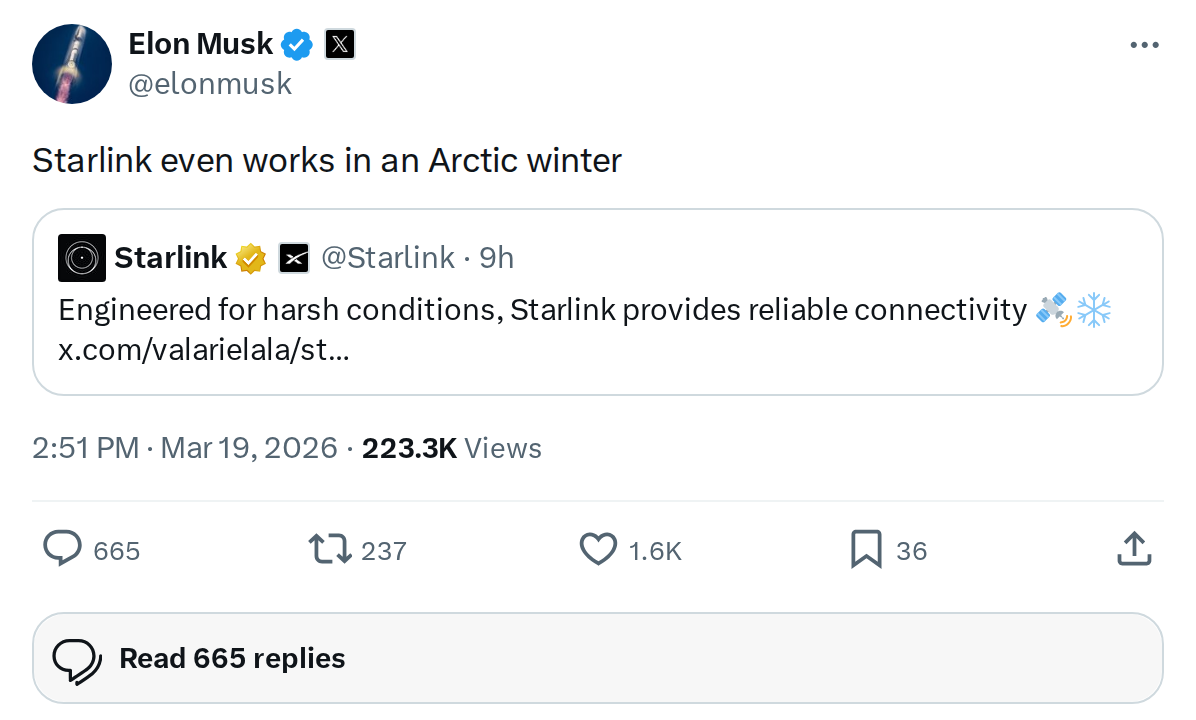
The News: Elon Musk confirmed Starlink operates reliably even in harsh Arctic winter conditions, sharing visual proof of a dish functioning in a snow-covered environment.
Why It Matters: For Tesla owners in northern climates — and anyone relying on connectivity in extreme environments — this is a direct signal that Starlink's infrastructure is built for conditions most networks simply cannot handle.
Source: @elonmusk on X

It's a simple post — seven words and an image — but it carries real weight. When Elon Musk says "Starlink even works in an Arctic winter," the emphasis is on even. The Arctic is not a fringe use case. It's the most demanding connectivity environment on the planet: sub-zero temperatures, heavy snowfall, polar winds, and geographic isolation that leaves communities with zero alternatives. Starlink working there isn't a bonus feature. It's proof of concept for truly global internet.
📊 Key Figures
| Metric | Value | Context |
|---|---|---|
| Operating Temperature Range | -30°C to +50°C | -22°F to +122°F |
| Wind Resistance | 75 mph | Category 1 hurricane threshold |
| Snow Melt Power Draw | 20–40W avg | Automatic activation |
| Arctic Satellites (active) | 200+ | Polar orbit dedicated coverage |
| U.S. Median Download Speed | ~200 Mbps | Peak hour, mid-2025 data |
| U.S. Median Latency | 25.7 ms | All U.S. customers |
| Total Constellation Size | ~10,000 satellites | Operational as of 2025 |
| Military Arctic Trial Duration | 9 months | U.S. military, concluded June 2023 |
The Engineering Behind Arctic-Ready Starlink
Starlink dishes are not just passive antennas. They're purpose-built outdoor hardware rated for conditions that would kill most consumer electronics. The dish's operating range of -30°C to +50°C (-22°F to +122°F) covers virtually every inhabited location on Earth, including the Alaskan interior and Scandinavian high north.
The most critical cold-weather feature is the built-in snow melt system. When snowfall or ice accumulation is detected, the dish automatically activates internal heating elements — drawing an average of 20 to 40 watts — to clear the aperture and maintain signal quality. This happens without any user intervention. You don't configure it. You don't enable it. It just works.
Wind resistance is rated to 75 mph, which puts it at the lower threshold of a Category 1 hurricane. Arctic storms regularly produce sustained winds in that range, and the dish is engineered to hold its pointing angle through them.
The Polar Orbit Expansion
Arctic performance didn't happen by accident. SpaceX has been systematically deploying satellites into polar orbits specifically to improve high-latitude coverage. Over 200 satellites now provide dedicated Arctic coverage, and SpaceX has been targeting more than 400 additional polar-inclination satellites by the end of 2025. The impact has already been measurable: median peak-hour download speeds for Alaskan customers have nearly doubled as a result of this expansion.
The U.S. military validated this independently. A nine-month Arctic trial concluded in June 2023 found Starlink to be a "reliable and high-performance communications system in the Arctic, including on-the-move applications." That's not a marketing quote — that's a DoD assessment.
🔭 The BASENOR Take
Timeline: Arctic capability has been built incrementally since 2021, with polar orbit launches accelerating through 2024–2025. The next major step is Gen 3 satellite deployment, targeted for H1 2026, which will add over 1 Tbps of downlink capacity per satellite.
Impact Level: High — Particularly for northern-latitude markets where no terrestrial broadband alternative exists.
Confidence: Very High — Military-verified, hardware-spec confirmed, real-world deployment data supports the claim.
Musk's tweet is brief, but it's doing something specific: it's addressing the most common objection to Starlink adoption in high-latitude markets. The question isn't whether Starlink works in California. The question is whether it works when the temperature drops to -25°C, the wind is gusting at 60 mph, and there's 8 inches of fresh snow on the dish. The answer, backed by both engineering specs and military testing, is yes.
What's coming next makes the current performance look like a baseline. SpaceX is planning to lower its entire constellation from approximately 550 km to 480 km altitude over the course of 2026 — a move designed to reduce latency and improve signal strength. Simultaneously, Gen 3 satellites launching in H1 2026 will deliver more than 1 terabit per second of downlink capacity each. And the next-generation Starlink Mobile (V2) system, confirmed for mid-2027, is projected to deliver 20x greater link performance with user speeds up to 150 Mb/s.
For Tesla owners specifically, the Starlink trajectory matters because SpaceX and Tesla share infrastructure ambitions. Reliable high-latitude connectivity is a prerequisite for autonomous vehicle operations in remote and northern regions — and the same satellite network that keeps an Arctic dish online is the one that will eventually support connected vehicle services far beyond current cellular coverage maps. The Arctic isn't the edge case. It's the proving ground.
Sources & reporting notes
The links below identify the material source records used for this report.
- @elonmusk on X (2026-03-19T06:51:13.000Z) — Direct source
Source links are preserved as published or accessed. See our editorial standards and corrections policy.
The BASENOR Editorial Desk covers Tesla, SpaceX, and related technology, curating reporting from primary sources — official accounts, regulatory filings, and software release data. Every article passes source-record and fact-checking review before publication. About the newsroom.
This report was curated by the BASENOR Editorial Desk from the sources listed above. Read our editorial standards or email editorial@basenor.com to report an error.