SpaceX's Starlink has entered the American Customer Satisfaction Index for the first time — and it didn't arrive quietly. The satellite internet service scored a 76 out of 100 in the ACSI Telecommunications Study 2026, landing third among 12 major non-fiber providers and finishing ahead of every traditional cable and DSL service in the country. For a technology that didn't exist commercially a decade ago, that's a meaningful statement about where the internet industry is heading.

1. The Score: 76 Out of 100 on First Appearance
Starlink's debut ACSI score of 76 is notable not just for the number but for the context. The ACSI study evaluates ISPs across a wide range of factors — internet speed, reliability, streaming quality, bill clarity, call center performance, mobile app quality, Wi-Fi security, and more. Scoring 76 across all those dimensions on a first appearance, without years of brand familiarity or legacy infrastructure, signals that Starlink's core product is genuinely satisfying customers rather than merely impressing early adopters.
2. Third Place — But the Top Two Are Both 5G Home Services
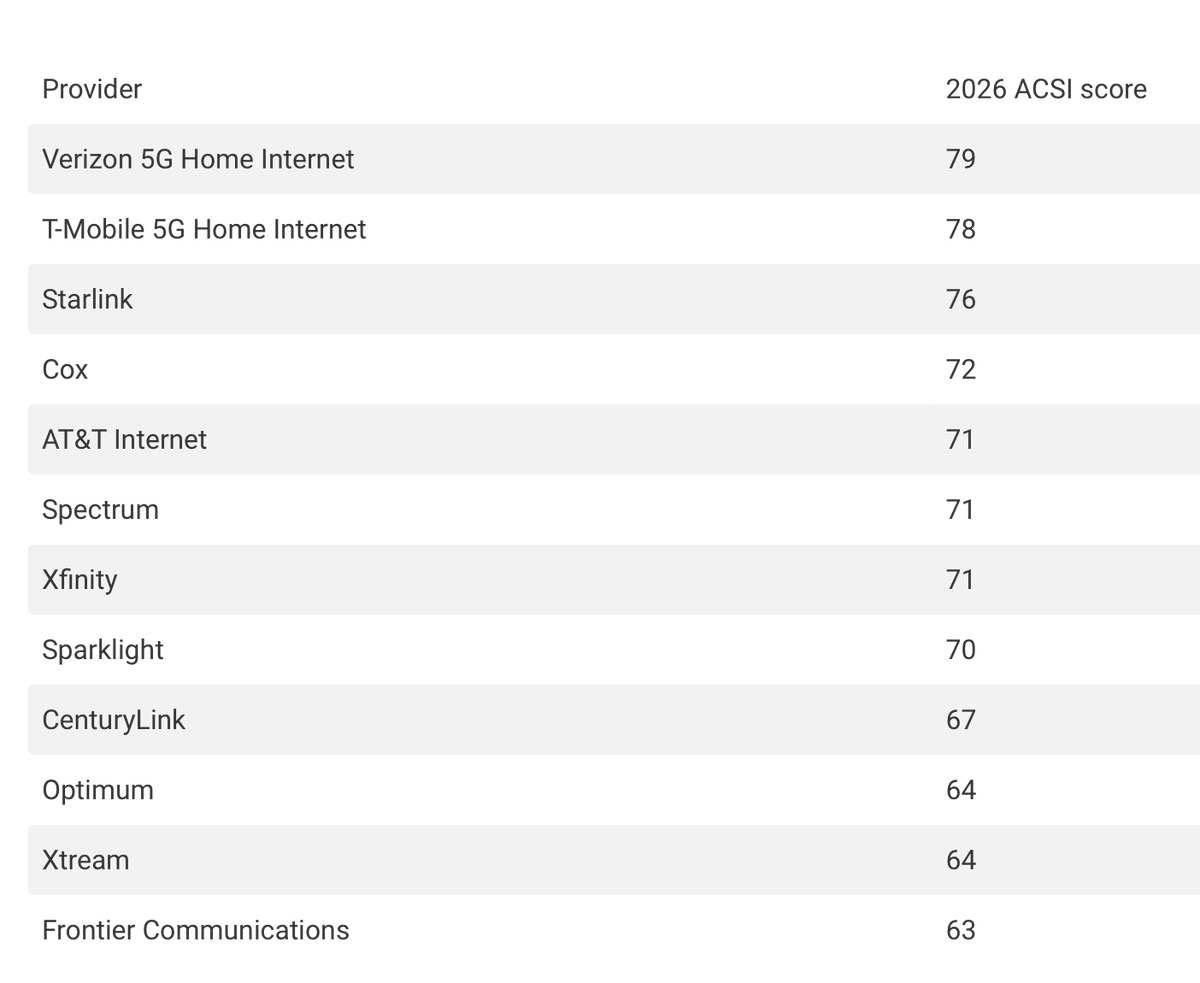
Starlink finished behind Verizon 5G Home Internet (79) and T-Mobile 5G Home Internet (78), according to the ACSI study. That context matters: the two services ranked above Starlink are fixed 5G products that depend on existing terrestrial cell tower infrastructure. Starlink operates a low-Earth orbit satellite constellation — a fundamentally different and far more capital-intensive architecture. Finishing within three points of both on customer satisfaction is a stronger result than the raw ranking suggests.
3. Every Cable and DSL Provider Finished Behind It
Cox, AT&T Internet, Xfinity, Spectrum — names that have dominated American broadband for decades — all ranked below Starlink's 76. This is the headline finding. Cable and DSL providers have long benefited from geographic monopolies and limited consumer choice, which historically suppresses the incentive to improve customer experience. Starlink's ability to outperform all of them on its first ACSI appearance reflects both the strength of its product and the accumulated dissatisfaction customers have with legacy providers.
4. Other Surveys Tell a Consistent Story — With One Caveat
The ACSI result doesn't stand alone. According to PCMag's Readers' Choice 2026 survey, Starlink earned a 9.2 for both overall satisfaction and likelihood to recommend — its fifth consecutive year winning the Readers' Choice award for satellite service. CableTV.com's 2026 Internet Customer Satisfaction Survey also placed Starlink among the top major ISPs. The one recurring weak spot across surveys: customer service and pricing. Allconnect's August 2026 customer reviews gave Starlink a 3.9 out of 5 overall, but only 2.8 out of 5 for customer service and 3.4 out of 5 for price. Strong product, room to improve on support and value perception.
5. Ten Million Subscribers and Growing — the Scale Behind the Score
Starlink's ACSI debut comes at a moment of significant scale. According to SpaceX, the service surpassed 10 million subscribers in February 2026, after adding over 4.6 million new active customers during 2025 and expanding to 35 additional countries and markets. Residential plans start at $55 per month. That subscriber base means the ACSI sample reflects a broad, diverse pool of customers — not just enthusiasts or early adopters in remote areas. A satisfaction score of 76 across 10 million-plus users is a harder number to dismiss than a niche survey of a few thousand.
The ACSI result is a single data point, but it lands at a moment when Starlink is transitioning from a rural connectivity lifeline into a mainstream broadband competitor. Whether the customer service scores improve as the subscriber base grows will be the real test of whether that third-place ranking holds — or climbs. For more on SpaceX's broader trajectory, see our SpaceX coverage.
Sources & reporting notes
The links below identify the material source records used for this report.
- @SawyerMerritt on X (2026-08-30T15:33:59.000Z) — Direct source
Source links are preserved as published or accessed. See our editorial standards and corrections policy.
The BASENOR Editorial Desk covers Tesla, SpaceX, and related technology, curating reporting from primary sources — official accounts, regulatory filings, and software release data. Every article passes source-record and fact-checking review before publication. About the newsroom.
This report was curated by the BASENOR Editorial Desk from the sources listed above. Read our editorial standards or email editorial@basenor.com to report an error.