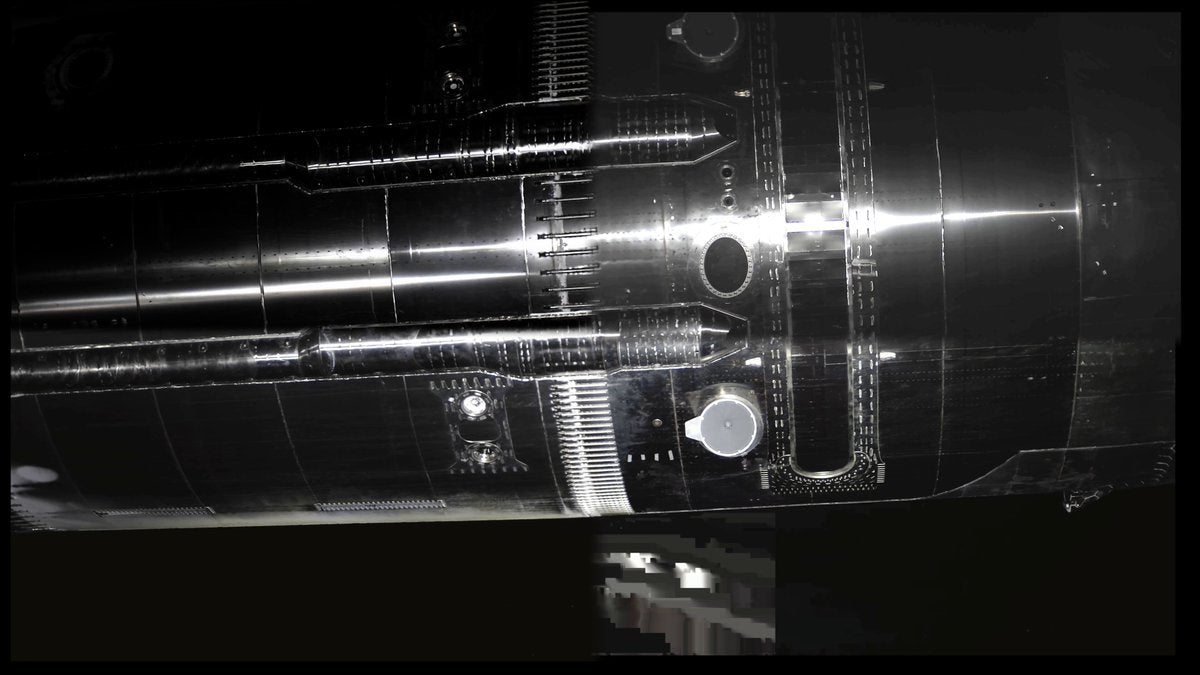
SpaceX released two sets of imagery from Starship Flight 13 this week — one a technical composite built from four cameras on a single Starlink V3 satellite, the other a cinematic video set to Beethoven's Moonlight Sonata. Together they reveal something more significant than a photo op: a functional, satellite-based inspection system that SpaceX is quietly maturing flight by flight. Here's what the imagery actually shows, and why it matters for Starship's path to full reusability.

1. The composite image came from four cameras on a single satellite
The striking view of Starship floating against the black of space isn't a single photograph — it's a composite stitched together from four separate cameras mounted on one Starlink V3 satellite. That multi-camera architecture gives operators a wider field of view and more coverage angles than any single lens could provide, which is exactly what you need when you're trying to document the condition of a 70-meter rocket from hundreds of kilometers away.
2. Six Starlink V3 satellites were dedicated to the inspection role
Of the 20 Starlink V3 satellites deployed during Flight 13, six were specifically equipped with cameras to scan Starship's heat shield. That's nearly a third of the payload assigned to an inspection function rather than a commercial communications role. According to SpaceX, these satellites transmitted their imagery directly down to operators — meaning the data pipeline from satellite camera to ground team was live during the flight, not retrieved after the fact.
3. White-painted tiles were planted as deliberate test targets
SpaceX didn't just point cameras at Starship and hope for useful data. According to background research, the team painted specific heat-shield tiles white to simulate missing or damaged tiles, giving the inspection cameras known targets to lock onto. That's a controlled-experiment approach: if the system can reliably flag the white tiles, it can be trusted to flag actual anomalies on future flights. It's a small detail that signals how methodically SpaceX is validating this capability before relying on it operationally.
4. The heat shield survived reentry from over Mach 20 at temperatures above 1,400°C
Flight 13 wasn't just a camera test — Starship itself was under real stress. According to SpaceX, the vehicle withstood a higher dynamic pressure ascent than previous flights and reentry temperatures exceeding 1,400 degrees Celsius, decelerating from above Mach 20 to subsonic speeds before a controlled splashdown in the Indian Ocean. The inspection data collected by the Starlink satellites feeds directly into understanding how that heat shield held up, informing tile design and placement decisions for future vehicles.
5. This is groundwork for return-to-launch-site missions
The longer-term purpose of this inspection system is explicitly tied to catching Starship at the launch tower — the same way SpaceX now catches Super Heavy boosters with the mechazilla arms at Starbase. Before that can happen reliably, engineers need high-confidence data on heat shield integrity after every flight. A satellite-based inspection capability that operates autonomously during the mission, without requiring a separate chase aircraft or post-landing inspection window, is a meaningful step toward that operational cadence.

Flight 13 marked the first time Starship deployed operational Starlink V3 satellites — so the inspection capability was embedded into a mission that was already commercially productive. That dual-use approach is characteristic of how SpaceX tends to develop new systems: prove the technology in a real operational context rather than on a dedicated test flight. The imagery released this week is the public-facing output of that work, but the more consequential data is what operators are now analyzing to inform Ship 41 and beyond. For more on SpaceX's Starship program, see our SpaceX coverage.
🚀 Following the Starship program? See every test flight, official outcome and the next launch window in our SpaceX Starship Tracker.
Sources & reporting notes
The links below identify the material source records used for this report.
- @SpaceX on X (2026-07-31T21:01:06.000Z) — Direct source
- @SpaceX on X (2026-07-31T23:36:00.000Z) — Direct source
Source links are preserved as published or accessed. See our editorial standards and corrections policy.
The BASENOR Editorial Desk covers Tesla, SpaceX, and related technology, curating reporting from primary sources — official accounts, regulatory filings, and software release data. Every article passes source-record and fact-checking review before publication. About the newsroom.
This report was curated by the BASENOR Editorial Desk from the sources listed above. Read our editorial standards or email editorial@basenor.com to report an error.