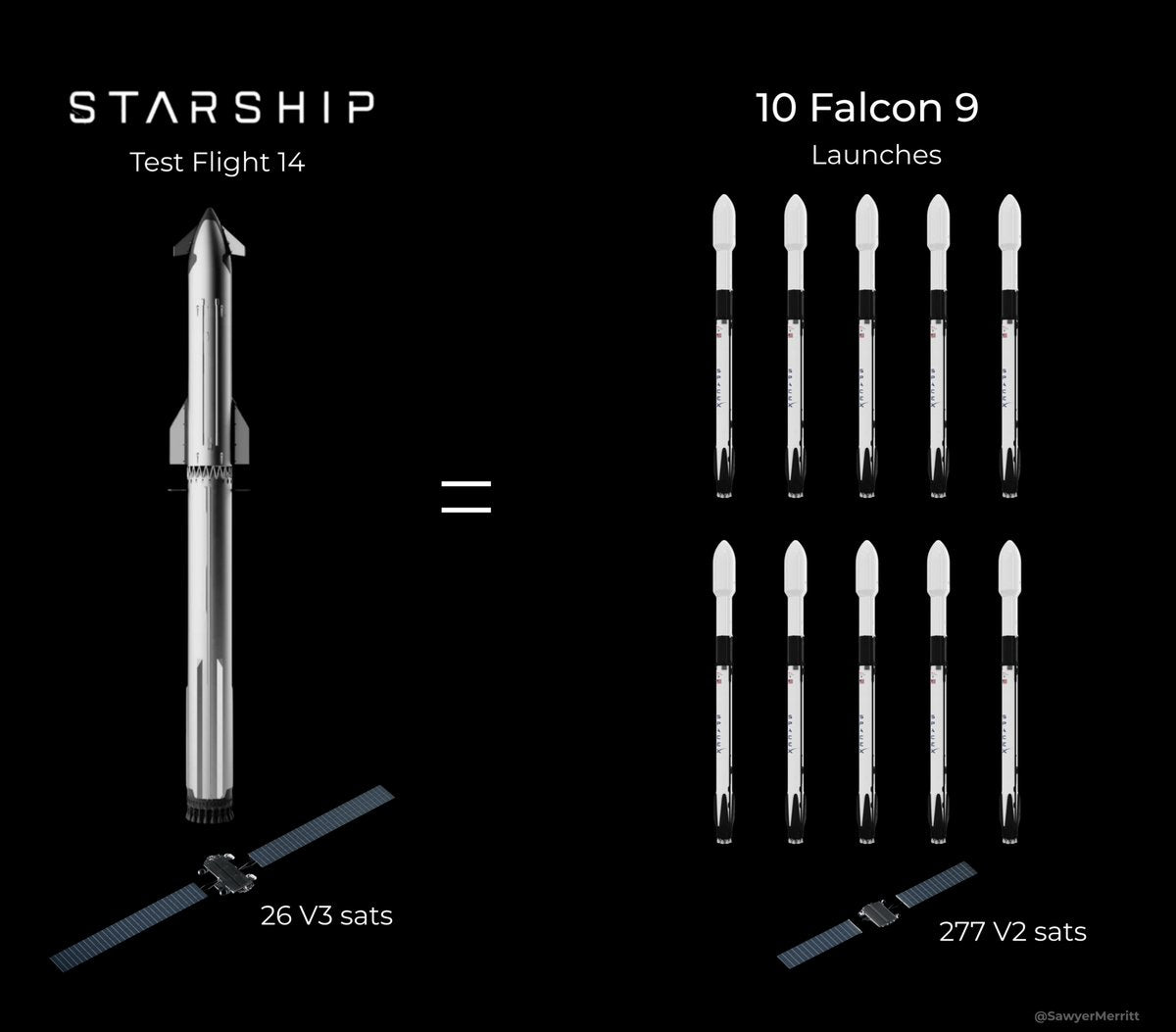
A single Starship launch is about to do what would otherwise take ten Falcon 9 missions. SpaceX is targeting Tuesday, September 22, 2026, for Starship's 14th test flight — a mission that will deploy 26 Starlink V3 satellites and, according to figures shared on X by Sawyer Merritt, boost the entire Starlink constellation's capacity by roughly 3% in one go. It's the first operational Starlink V3 deployment, the first Starship mission to place its upper stage into a stable orbit, and arguably the clearest demonstration yet of why SpaceX has been racing to get Starship into service.

The Numbers Behind the 3% Claim
Each Starlink V3 satellite is designed to add approximately 1 terabit per second (Tbps) of capacity to the network. Twenty-six of them on a single Starship translates to roughly 26 Tbps of new downlink capacity added in one mission. According to SpaceX's own published figures, that is about 10 times the capacity delivered by a Falcon 9 flight carrying V2 Mini satellites — which is why Merritt notes it would take 10 Falcon 9 launches and 277 V2 satellites to match the throughput gain from a single Starship deployment.
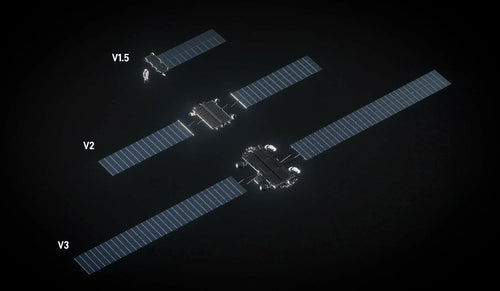
The 3% headline figure has not been formally confirmed by SpaceX in public documentation, but it lines up with the math against a constellation of roughly 11,000 operational satellites, most of them earlier-generation V1.5 and V2 Mini units with far lower per-satellite throughput.
Key Figures
| Metric | Value |
|---|---|
| Target launch date | September 22, 2026 (pending regulatory approval) |
| Launch window opens | 7:15 a.m. CT / 12:15 GMT |
| Launch site | Starbase, Texas |
| Payload | 26 Starlink V3 satellites |
| Per-satellite capacity | ~1 Tbps |
| Total mission capacity | ~26 Tbps |
| Constellation capacity boost | ~3% in a single launch |
| Falcon 9 equivalent | 10 launches / 277 V2 Mini satellites |
| Orbit altitude | ~275 km |
| Mission duration | ~10 hours, six orbits, Pacific splashdown |
Why Starship Was Non-Negotiable for V3
Starlink V3 satellites are physically too large to fit inside a Falcon 9 fairing. That is not a marketing detail — it is the entire reason Starship's operational debut has been on SpaceX's critical path. Without Starship, V3 does not fly. Without V3, the constellation's capacity is capped by the incremental throughput gains SpaceX can wring out of V2 Mini hardware on Falcon 9, which is running near the top of its production cadence already.
Elon Musk has previously stated that the full V3 constellation will eventually deliver more than 100 times the bandwidth of today's roughly 11,000-satellite network. Flight 14 is the first data point on that curve, and the 3% jump from a single launch is a preview of how quickly the numbers can move once Starship enters a regular deployment cadence.
The Mission Profile
Flight 14 is also the first Starship mission designed to place its upper stage into a stable orbit — every prior test flight has been suborbital. According to space.com and SpaceX's own mission overview, the ship will fly at roughly 275 km, complete about six orbits, and splash down in the Pacific Ocean west of Chile after nearly 10 hours of flight. The Super Heavy booster is scheduled to attempt a landing burn at an offshore point in the Gulf rather than returning to the launch tower.
This is the third generation of the Starship and Super Heavy hardware, and the mission is designed to validate on-orbit satellite deployment mechanics — a capability SpaceX will need to prove reliably before Starship can take over the bulk of Starlink launches.
How We Got Here
SpaceX has spent the past three years iterating through progressively more ambitious Starship test flights, moving from short suborbital hops to full-stack test flights with booster catches. Flight 14 represents the transition point from development testing to operational payload delivery. If it succeeds, the economics of the Starlink network shift materially: instead of measuring capacity growth in Falcon 9 batches of 20-something V2 Mini satellites, SpaceX will be measuring it in Starship batches of 25+ V3 satellites, each roughly 10x more capable per unit.
The consumer-side implications land months later — Starlink customers will see the capacity flow through as reduced congestion in dense service areas, higher peak speeds, and the ability for SpaceX to expand cellular direct-to-device service, which requires substantially more available bandwidth than the existing constellation can sustainably provide.
What to Watch Next
- Regulatory clearance — the September 22 date is still pending FAA approval. Any slip pushes the entire V3 deployment schedule.
- Deployment mechanism — this is the first time Starship will release satellites in orbit. The dispenser design and separation dynamics are new.
- Booster recovery outcome — the offshore landing attempt (rather than a tower catch) suggests SpaceX is prioritizing mission risk isolation over booster reuse on this flight.
- Cadence signals — how quickly SpaceX schedules Flight 15 and subsequent V3 deployment missions will indicate whether Starship is ready to enter operational rotation or needs additional test flights first.
Editor's View
The 3% figure is striking precisely because it is not a marketing number — it is a byproduct of physics. Bigger fairing, bigger satellites, more antennas per satellite, more throughput per launch. If Flight 14 works, the constellation stops being a Falcon 9 story and starts being a Starship story, and the growth curve steepens accordingly. Watch the deployment sequence carefully next Tuesday. That is the moment Starlink's second act actually begins.
🚀 Following the Starship program? See every test flight, official outcome and the next launch window in our SpaceX Starship Tracker.
Sources & reporting notes
The links below identify the material source records used for this report.
- @SawyerMerritt on X (2026-09-16T05:47:24.000Z) — Direct source
Source links are preserved as published or accessed. See our editorial standards and corrections policy.
The BASENOR Editorial Desk covers Tesla, SpaceX, and related technology, curating reporting from primary sources — official accounts, regulatory filings, and software release data. Every article passes source-record and fact-checking review before publication. About the newsroom.
This report was curated by the BASENOR Editorial Desk from the sources listed above. Read our editorial standards or email editorial@basenor.com to report an error.