
📌 UPDATE — November 14, 2026
It's official: Mechazilla has caught Ship 42. At approximately 21:21 UTC — after more than 22 hours in orbit — the Starship upper stage completed its reentry, executed a banking maneuver on final approach to Starbase, and was snagged by the tower's chopstick arms. SpaceX confirmed the catch moments later, marking the first time in history an orbital-class upper stage has been recovered in this manner. The catch GO call was issued just two minutes before contact, with teams monitoring Ship 42's approach in real time.
This milestone caps a flight that began with Super Heavy B22 being diverted due to a low-fuel alarm, meaning Ship 42 carried the RTLS attempt entirely on its own. The successful catch validates the core premise of Starship's rapid reusability architecture — catching, not splashing.

Sources: @SpaceX · @LabPadre · @RGVaerialphotos
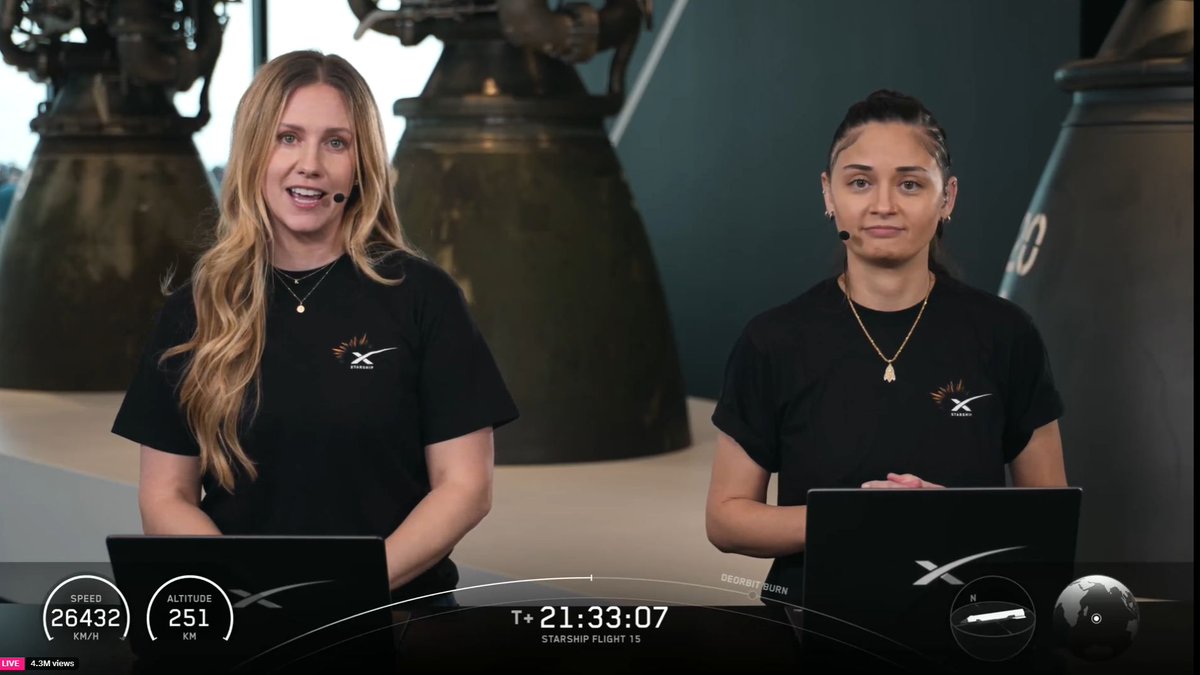
SpaceX is attempting its most ambitious Starship milestone yet. After more than 21 hours in orbit and 14 trips around the planet, Ship 42 has completed a successful deorbit burn and is reentering Earth's atmosphere, targeting the first-ever return-to-launch-site catch by the Starbase tower's chopstick arms. The mission comes with a split outcome on the booster side: Super Heavy Booster 22 autonomously diverted from its own catch earlier in the flight after a low fuel mass alarm cut its boostback burn short.
If the Ship catch succeeds, SpaceX will have demonstrated something no one has ever done — bringing an orbital upper stage back to its launch pad intact.

Where Flight 15 Stands Right Now
Flight 15 launched Friday, November 13, 2026 at 5:47 p.m. EST from Starbase, Texas, according to Spaceflight Now. The mission profile called for Ship 42 to deploy a payload of 26 Starlink V3 satellites into low Earth orbit at roughly 275 km altitude — three of them carrying cameras — then loiter in orbit before an RTLS catch attempt back at Starbase.
Per SpaceX's own updates, the deorbit burn fired cleanly at approximately 3:23 p.m. EST on November 14. The company confirmed the heat shield was in "good posture for a reentry and return to the launch site." As of this writing, Ship 42 is in the thick of entry heating, with the tower catch scheduled for roughly one hour after the deorbit burn — approximately 22.5 hours after liftoff.
Flight controllers made the "go" decision for the Starbase catch mid-mission, after evaluating Ship 42's systems in orbit. The alternative — a splashdown off the coast of Chile — was waved off.

Booster 22: Autonomous Abort, Then Explosion
The Super Heavy side of the flight did not go to plan. Booster 22's boostback burn — the maneuver that reverses the booster's trajectory to return it to the launch site — terminated early due to a low fuel mass alarm. LabPadre's Kate Tice summary, reported mid-flight, noted that the booster then autonomously concluded it was in the wrong position for a tower catch and diverted to an offshore splashdown.

SpaceX later clarified a key nuance: the Guidance, Navigation, and Control (GNC) system performed exactly as designed. It detected the booster was not in a geometrically correct position for a tower catch and initiated an automated abort to send it to the Gulf of Mexico instead. The booster subsequently exploded on impact with the water.
This is an important distinction for anyone parsing the flight. The abort was not a GNC failure — it was GNC working correctly in response to a propellant anomaly earlier in the burn sequence. Which specific system or event caused the low fuel mass reading is the question SpaceX engineers will be chasing in the post-flight review.
Key Figures
| Metric | Value |
|---|---|
| Launch time | Nov 13, 2026 — 5:47 p.m. EST |
| Orbits before deorbit | 14 |
| Deorbit burn | Nov 14 — ~3:23 p.m. EST |
| Target catch time | Nov 14 — ~4:16 p.m. EST |
| Starlink V3 satellites deployed | 26 (3 with cameras) |
| Deployment altitude | ~275 km |
| Booster 22 outcome | Autonomous diversion → offshore splashdown → explosion on impact |
Why This Attempt Matters
SpaceX has caught Super Heavy boosters at the tower multiple times, but a Ship catch is categorically harder. The upper stage reenters from orbital velocity — roughly 17,500 mph — not the lower sub-orbital speeds of a returning booster. That means significantly more heating on the thermal protection system, a longer high-energy descent, and tighter guidance margins when the vehicle finally transitions to the landing burn and lineup over the chopsticks.
Every previous Ship landing has been a soft splashdown over water. A successful tower catch today would mark the first time an orbital-class upper stage has returned intact to its launch pad — the operational foundation SpaceX needs for the rapid reuse model that underpins both Starlink V3 deployment cadence and eventual crewed lunar missions.
It also raises the stakes for pad infrastructure. Catching a Ship means landing a hot, propellant-residue-bearing vehicle directly over the launch tower — a configuration SpaceX has openly described as requiring significant hardware iteration to survive routinely.
What to Watch Next
A few specific things worth tracking in the hours and days after this flight:
- The catch itself. Terminal descent, landing burn ignition, and the final lineup over the chopsticks. SpaceX's livestream carries the definitive feed.
- Post-flight statement on B22's propellant anomaly. What specifically triggered the low fuel mass alarm — a leak, an engine performance issue, a sensor miscalibration, or a planning margin error — will shape the next booster's flight.
- Tower condition. Even a nominal Ship catch will stress the chopstick arms and tower structure in new ways. Expect inspection imagery to leak from Starbase in the following days.
- Flight 16 cadence. SpaceX has been pushing toward higher flight rates. Whether Flight 15's outcome accelerates or slows that timeline will be the clearest signal of program health.
For now, the picture is unusually bifurcated: a textbook Ship return in progress, and a booster sitting at the bottom of the Gulf. The next hour decides which half of that story leads the headlines.
🚀 Following the Starship program? See every test flight, official outcome and the next launch window in our SpaceX Starship Tracker.
Sources & reporting notes
The links below identify the material source records used for this report.
- @SpaceX on X (2026-11-14T20:16:36.000Z) — Direct source
- @LabPadre on X (2026-11-14T20:22:03.000Z) — Direct source
- @SpaceX on X (2026-11-14T20:25:50.000Z) — Direct source
- @LabPadre on X (2026-11-14T20:26:28.000Z) — Direct source
- @SpaceX on X (2026-11-14T20:58:27.000Z) — Direct source
Source links are preserved as published or accessed. See our editorial standards and corrections policy.
The BASENOR Editorial Desk covers Tesla, SpaceX, and related technology, curating reporting from primary sources — official accounts, regulatory filings, and software release data. Every article passes source-record and fact-checking review before publication. About the newsroom.
This report was curated by the BASENOR Editorial Desk from the sources listed above. Read our editorial standards or email editorial@basenor.com to report an error.