📌 UPDATE — November 15, 2026
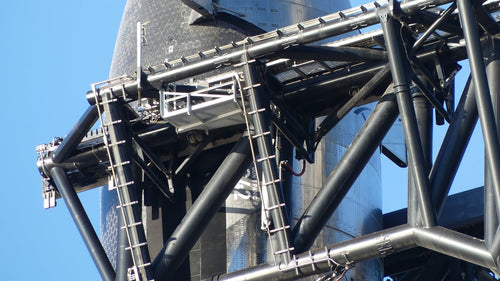
Post-catch imagery and on-the-ground reports from Starbase are now confirming the remarkable condition of Ship 42 following its historic recovery. Close-up views of the aft section show the Raptor Vacuum engines looking virtually pristine — observers on site noted they appeared "like they haven't even been used." This is the first time a second-stage orbital vehicle has ever been fully recovered in the history of spaceflight, validating the core premise of Starship's full reusability architecture. Post-catch ground operations are now underway at the tower.

📸 @CSI_Starbase — RVac engines showing minimal wear after orbital flight

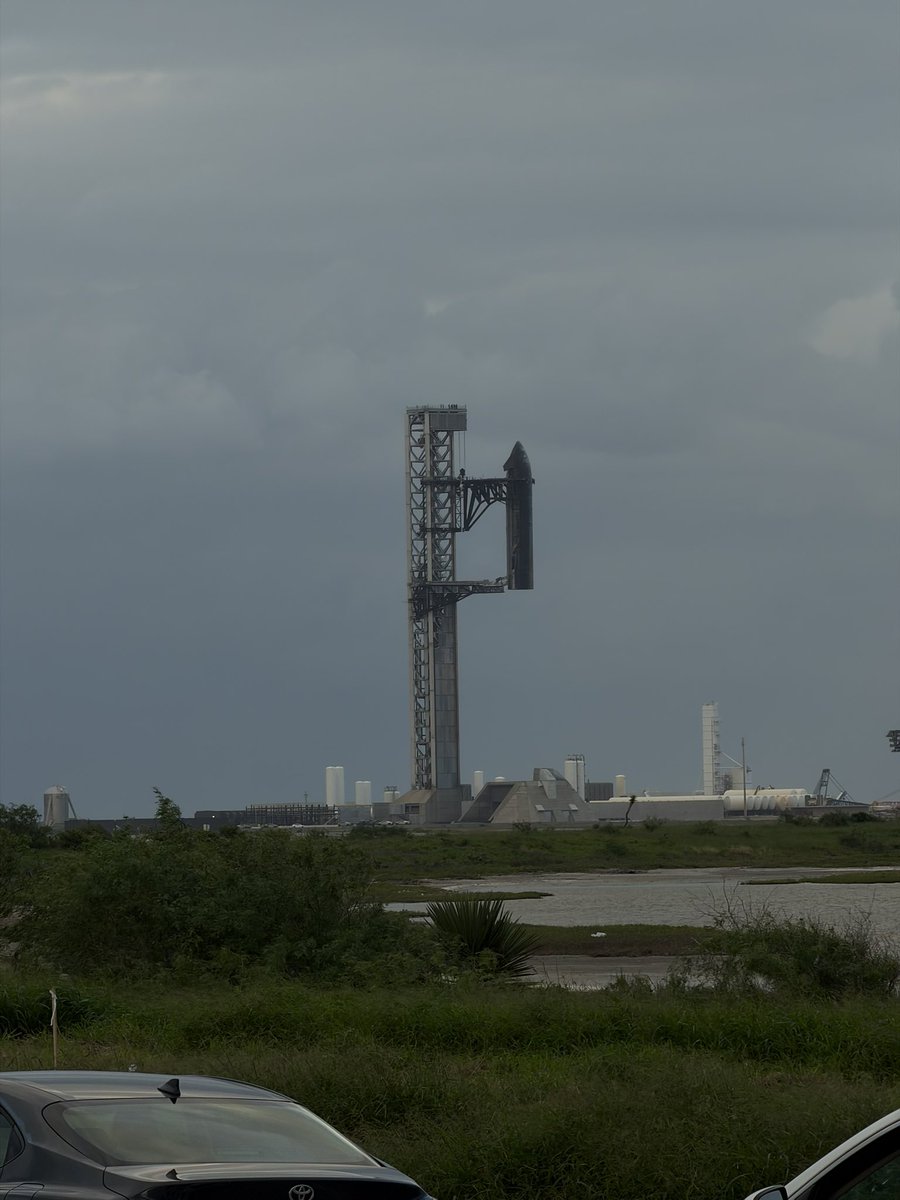
📸 @CSI_Starbase — The first second stage vehicle ever fully recovered
"Render vs reality!!! The math maths. The engineering engineered. It happened!"
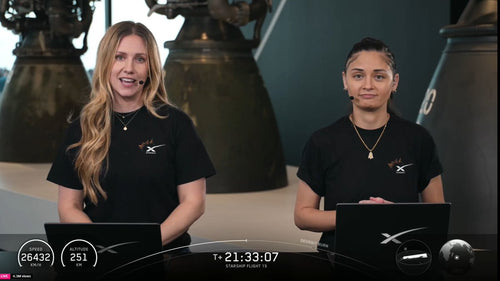
SpaceX's Starship Ship 42 returned to Starbase on November 14, 2026, after completing 14 Earth orbits, deploying 26 next-generation Starlink V3 satellites, and spending roughly 22 hours in space. The ship was caught in mid-air by the launch tower's chopstick arms — the first time a rocket's upper stage has been recovered upright after reaching orbit. Elon Musk, posting from Starbase minutes after the catch, credited the SpaceX team and said the vehicle itself "looks great." For a program that was still exploding over the Gulf of Mexico 18 months ago, this is the jump from experimental hardware to operational reusable spaceflight.

What Happened
Flight 15 lifted off from Orbital Launch Pad 2 at Starbase, Texas, on November 13 at 22:47 UTC, according to Spaceflight Now and SpaceX's own mission timeline. Both stages — Super Heavy Booster 22 and Ship 42 — were Block 3 vehicles, the newest generation of Starship hardware. The FAA issued the launch license, including authorization for the return of both stages, on the day of liftoff.
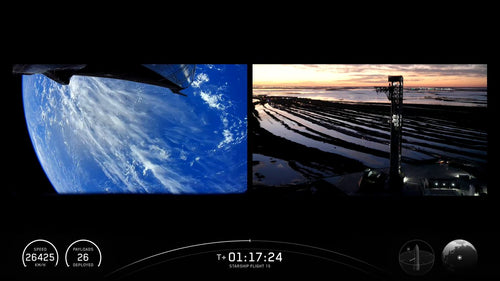
Ship 42 reached low Earth orbit, something no previous Starship had attempted operationally. Over the course of 14 orbits, the vehicle deployed 26 Starlink V3 broadband satellites — the first time Starship has carried out its stated core mission of mass-deploying Starlink hardware. Three of those satellites, according to reporting from Space.com, carried cameras aimed back at Ship 42 to monitor the heat shield in orbit.
The ship then re-entered the atmosphere and was caught by the chopstick arms at 21:20 UTC on November 14, closing out a mission of roughly 22 hours and 32 minutes — the longest Starship flight to date.

Key Figures
| Metric | Flight 15 |
|---|---|
| Mission duration | ~22h 32m |
| Earth orbits completed | 14 |
| Starlink V3 satellites deployed | 26 |
| In-orbit heat shield cameras | 3 (on Starlink V3 sats) |
| Ship recovery | Tower catch at OLP-2 |
| Booster recovery | Aborted catch, offshore splashdown |
The Heat Shield Finally Delivered
Every previous Starship re-entry has, in some form, been a conversation about tiles — missing ones, loose ones, patches of plasma leaking through. On Flight 15, the heat shield did its job. Observers at Starbase, including Whole Mars Catalog's Omar Qazi, documented Ship 42 up close after landing and reported the shield "held up really well." The in-orbit camera coverage from the three outfitted Starlink V3 satellites, per Space.com, corroborated that view — the shield remained in good condition through re-entry.

That matters more than any single flight metric. A rapidly reusable Starship is unworkable if the heat shield needs major refurbishment between missions. A clean return on Block 3 hardware is the first real data point suggesting the architecture might survive the turnaround cadence SpaceX has promised customers and NASA.
The Booster Is the Asterisk
Super Heavy Booster 22 did not share Ship 42's day. According to Spaceflight Now, the booster began its catch attempt but aborted the maneuver after onboard systems detected it wasn't correctly positioned for a safe tower return. It diverted to an offshore splashdown in the Gulf of Mexico and lost structural integrity shortly before impact.
That outcome is being treated as a controlled anomaly rather than a failure — the abort logic worked as designed and kept the vehicle away from the tower. But it does mean Flight 15 is a half-reuse demonstration, not a full one. The next flight will need to prove the booster side of the equation.
How We Got Here
The first four Starship flights, through 2023 and early 2024, all ended in loss of vehicle. Flight 5 in October 2024 was the first successful booster catch. Flights 7 through 9 struggled with upper-stage reliability through 2025, with multiple ships lost during ascent or coasting. Flight 14, earlier in 2026, completed a longer orbital test but did not attempt a Starlink deployment or an upright catch of the ship.
Flight 15 is the mission that collapses several remaining unknowns at once: can Starship reach orbit with real payload, can it deploy that payload, can it survive re-entry, and can it be caught like Super Heavy. The answer on all four counts was yes.

What It Unlocks
The immediate operational consequence is Starlink V3. The V3 satellites are larger and higher-bandwidth than the V2 Mini generation currently launched on Falcon 9, and they were explicitly designed around Starship's payload envelope. Flight 15 confirms that pipeline is live: Starship can now begin eating into the Starlink launch manifest that has, until today, been Falcon 9's responsibility.
Longer term, tower-caught upper stages are the prerequisite for the reuse economics that justify Starship's existence — lunar Human Landing System missions for NASA, point-to-point cargo, eventual Mars architecture. None of that works if the ship is expendable. Today's catch is the first evidence that it doesn't have to be.
What to Watch Next
- Flight 16 booster catch: SpaceX needs to recover a Block 3 booster at the tower to return to full dual-recovery status.
- Ship 42 post-flight inspection: How much refurbishment the heat shield actually needs between flights will dictate turnaround time — the public claim is "rapid," the reality has yet to be tested.
- Starlink V3 service rollout: Watch for when the 26 newly deployed satellites begin carrying commercial traffic, and how quickly SpaceX ramps subsequent V3 launches on Starship.
- NASA HLS schedule: Artemis III's lunar lander depends on Starship. A successful ship catch is a real data point NASA can now point to when defending that timeline.
Ship 42 is now sitting on the ground at Starbase, surrounded by crowds, intact. That sentence has never been true before.
🚀 Following the Starship program? See every test flight, official outcome and the next launch window in our SpaceX Starship Tracker.
Sources & reporting notes
The links below identify the material source records used for this report.
- @wholemars on X (2026-11-14T23:05:42.000Z) — Direct source
- @wholemars on X (2026-11-14T23:16:58.000Z) — Direct source
- @elonmusk on X (2026-11-14T23:18:36.000Z) — Direct source
- @elonmusk on X (2026-11-14T23:25:32.000Z) — Direct source
- @JoeTegtmeyer on X (2026-11-14T23:47:44.000Z) — Direct source
- @wholemars on X (2026-11-14T23:53:01.000Z) — Direct source
Source links are preserved as published or accessed. See our editorial standards and corrections policy.
The BASENOR Editorial Desk covers Tesla, SpaceX, and related technology, curating reporting from primary sources — official accounts, regulatory filings, and software release data. Every article passes source-record and fact-checking review before publication. About the newsroom.
This report was curated by the BASENOR Editorial Desk from the sources listed above. Read our editorial standards or email editorial@basenor.com to report an error.