📌 UPDATE — July 27, 2026
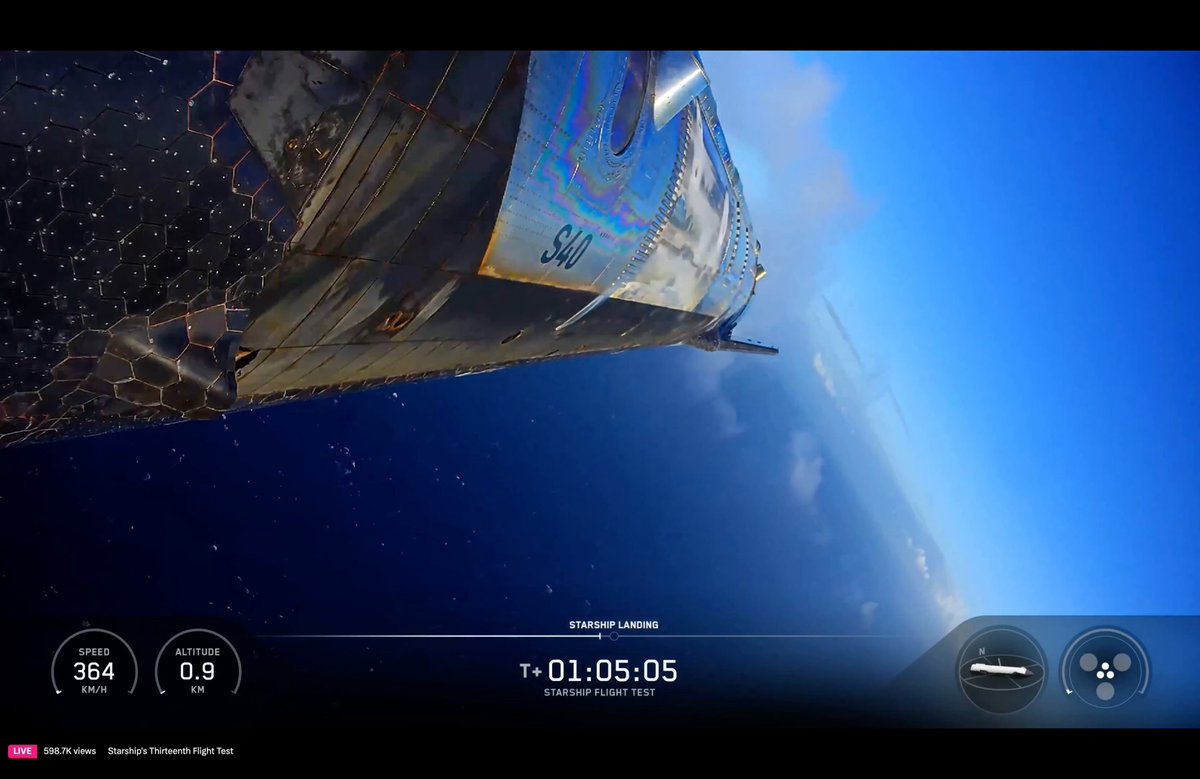
Speculation is mounting that Ship 40 may be recovered following its Flight 13 splashdown. Everyday Astronaut, who initially dismissed the idea during the live stream, says he's now reconsidering — noting the vehicle appears to still be intact on the ocean surface and that recovery vessel GO Australia has remained in the vicinity. If the ship were towed back to port, it would mark an unprecedented recovery of a Starship upper stage. No official confirmation from SpaceX has been issued at this time. 🔍

📌 UPDATE — July 26, 2026
Beyond the satellite deployment, Flight 13 also showcased a major leap in onboard cinematography. Starship V3 carries a record 50 cameras, delivering crisp 4K footage from entirely new angles not seen on previous flights. Starlink connectivity served as the backbone for streaming those high-quality visuals to the ground in real time — a fitting demonstration of the very satellites the vehicle just deployed. SpaceX's production and camera teams drew widespread praise online for the broadcast quality.

Starship just had the flight SpaceX has been chasing for years. On the second flight of the V3 configuration, the vehicle deployed 20 next-generation Starlink V3 satellites — the first real payload deployment in the program's history — flew a clean flip maneuver, and settled into what teams on the ground are calling a 'floating ship' touchdown in the Indian Ocean. For a program whose entire purpose is rapid iteration, this was the mission that finally connected every dot.
The launch went off at 5:51 p.m. CT on Friday, July 24, 2026 from Starbase in South Texas, after prior scrubs for an engine ignition issue and weather, according to universetoday.com and space.com. Roughly two and a half hours later, SpaceX's official account confirmed the outcome.

The First Real Starlink Deployment
Every prior Starship test carried either no payload or a Starlink mass simulator. This one didn't. According to universetoday.com and space.com, Starship released 20 Starlink V3 satellites on a suborbital trajectory. The satellites extended their solar arrays and antennas, and — critically — all 20 successfully linked to the existing Starlink constellation via high-capacity inter-satellite laser terminals before burning up on re-entry roughly 20 minutes after deployment.
That last detail matters more than it sounds. The V3 satellites weren't meant to stay in orbit; the mission's purpose was to validate that Starship can act as a working satellite bus and that V3-class hardware can integrate with the operational fleet in real time. Both boxes got checked on the first try.
The V3 satellites are the class Starlink needs to scale bandwidth per user without proportionally scaling the number of birds in orbit. Starship is the only vehicle in SpaceX's lineup capable of lofting them at the cadence and mass needed. Until today, that pairing was theoretical.
Booster Separation, From an Angle No One Has Seen
SpaceX released a new camera view showing the Super Heavy booster peeling away from Starship post-hot-staging — a shot the program has never publicly shared before.

The booster (Booster 20) executed a directional flip maneuver in the intended orientation this time — a callout from CSI Starbase's Zack Golden, who noted the previous V3 attempt had flipped the wrong way. It then attempted a controlled splashdown in the Gulf of Mexico. Per universetoday.com, not all engines fired as planned for the final soft-landing burn, but the flip and descent profile were nominal enough to count as a data win.

Starship, As Seen From Starlink
Elon Musk shared a view that captures why today's flight is a strategic inflection point rather than just another test: Starship as seen from the Starlink constellation itself.

The imagery is a soft flex, but the underlying capability is not. Starlink imaging Starship in flight means the constellation is being used as a distributed observation network for SpaceX's own launch operations — the kind of vertical integration that competitors don't have any equivalent to.
Key Figures
| Metric | Value |
|---|---|
| Mission | Starship Flight 13 (second V3 flight) |
| Launch | July 24, 2026 · 5:51 p.m. CT · Starbase, TX |
| Vehicle height | 408 ft (124 m) |
| Payload | 20 Starlink V3 satellites |
| Laser link success | 20 of 20 satellites linked to constellation |
| Payload deorbit | ~20 minutes after deployment (as planned) |
| Booster outcome | Hot-staging + intended-direction flip; partial engine light on final burn |
Why This Flight Actually Matters
The first V3 flight in May 2026 proved the vehicle could fly. This one proved the vehicle can do the job it was built for. That's a very different milestone.
Three things happened today that hadn't happened before on a Starship mission: a real payload left the vehicle, that payload talked back to the operational constellation, and the flip-and-descent profile executed the way the flight software actually wanted it to. Add the 'floating ship' touchdown — as Joe Tegtmeyer put it in his post-flight congratulations — and this is the first Starship flight where nearly every regime graded out.

What to Watch Next
The obvious next question is cadence. SpaceX's stated ambition has always been to fly Starship at aircraft-like tempo, and the V3 configuration was designed with that in mind. With Flight 13's data — particularly on payload dispense, booster recovery mechanics, and heat-shield performance during the flip — SpaceX now has the empirical baseline it needs to push toward orbital Starlink V3 deployments rather than suborbital tests.
The other watch item is booster catch. Today's splashdown was intentional, but the flip-in-the-right-direction result is a prerequisite for eventually returning the booster to the launch tower. Every flight from here builds toward that.
For now, though, SpaceX has a working satellite bus that also happens to be the largest rocket ever built — and 20 Starlink V3 satellites that spent their brief lives proving it.
🚀 Following the Starship program? See every test flight, official outcome and the next launch window in our SpaceX Starship Tracker.
Sources & reporting notes
The links below identify the material source records used for this report.
- @JoeTegtmeyer on X (2026-07-25T01:16:25.000Z) — Direct source
- @SpaceX on X (2026-07-25T01:26:30.000Z) — Direct source
- @SawyerMerritt on X (2026-07-25T01:33:57.000Z) — Direct source
- @elonmusk on X (2026-07-25T01:56:48.000Z) — Direct source
- @CSI_Starbase on X (2026-07-25T01:57:27.000Z) — Direct source
Source links are preserved as published or accessed. See our editorial standards and corrections policy.
The BASENOR Editorial Desk covers Tesla, SpaceX, and related technology, curating reporting from primary sources — official accounts, regulatory filings, and software release data. Every article passes source-record and fact-checking review before publication. About the newsroom.
This report was curated by the BASENOR Editorial Desk from the sources listed above. Read our editorial standards or email editorial@basenor.com to report an error.