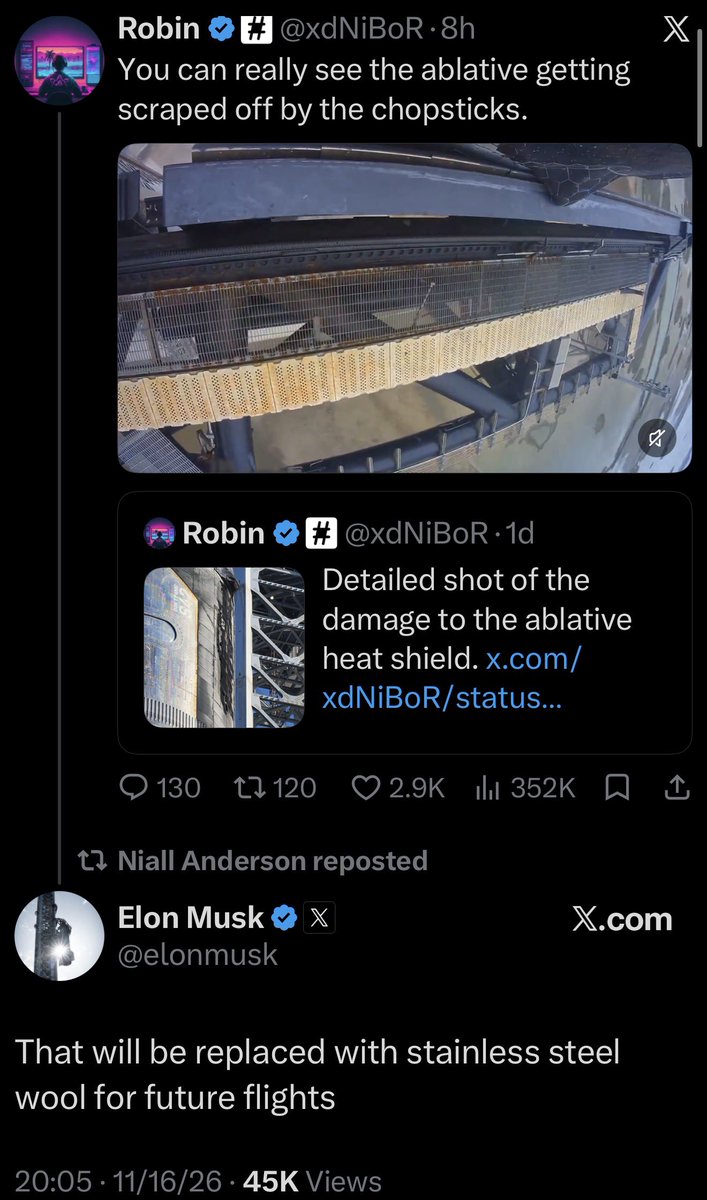
Elon Musk confirmed late Sunday that Starship's current ablative side layers — the black backup heat shield material lining the vehicle's flanks — will be replaced with stainless steel wool on future flights. It's a quiet but significant materials engineering shift, and it directly addresses one of the more stubborn weak points in SpaceX's reusability stack.

1. What the Ablative Layer Actually Does
Starship's thermal protection system is built in layers. The windward side is covered in hexagonal ceramic tiles — the primary heat shield. Beneath those tiles, on the vehicle's sides, sits an ablative sublayer: a black material, likely pyron, similar to carbon composites. Its job is to act as a last line of defense if tiles are lost during re-entry. The problem, as Musk has previously acknowledged, is that this ablative material doesn't survive tile loss gracefully — once compromised, it requires replacement, which cuts directly against the rapid reusability SpaceX is chasing.
2. Why Stainless Steel Wool Makes Sense Here
Starship's primary structure is already stainless steel — a deliberate choice because the alloy maintains high strength at cryogenic temperatures and can tolerate temperatures up to roughly 820–870°C. Stainless steel wool extends that material philosophy into the thermal protection layer itself. Unlike the ablative pyron material, steel wool is inherently non-consumable: it doesn't ablate away. It can absorb and dissipate heat without being destroyed in the process, which means it should survive re-entry cycles without needing to be swapped out between flights.
3. The Catch Mechanic Adds a New Stress Case
The ablative layer isn't only stressed during re-entry. SpaceX's mechazilla tower catch system — where the booster and Ship are snagged by mechanical arms — introduces a new physical contact scenario that the original thermal protection design wasn't fully optimized for. Community observers had been asking specifically about how the ablative sheets hold up during catches, and Musk's confirmation of the steel wool switch appears to address that concern directly. A metallic fiber layer is considerably more robust against mechanical contact than a composite ablative sheet.
4. This Fits a Broader Pattern of Iterating Toward All-Metal Construction
SpaceX has consistently pushed Starship toward materials that can be inspected quickly, repaired in the field, and reused without extensive refurbishment. Stainless steel was chosen over carbon fiber for the hull for exactly these reasons. Replacing an organic ablative composite with a metallic wool continues that logic. It also keeps the vehicle's material stack more homogeneous — stainless steel structure, stainless steel wool insulation — which simplifies inspection and reduces the risk of mismatched thermal expansion causing delamination or cracking over repeated flight cycles.
5. Timeline and Specifics Are Still Open
Musk's confirmation came as a reply on X and didn't include a specific flight number, implementation date, or detailed specs on the wool's density, weave, or attachment method. As of now, those details are still emerging. What's confirmed is the direction: ablative layers out, stainless steel wool in, for future Starships. Given SpaceX's production cadence at Starbase, it's reasonable to expect the change to appear on vehicles already in fabrication — but no official timeline has been published.
The shift is another data point in SpaceX's relentless push to make Starship behave less like a spacecraft and more like a commercial airliner: land it, inspect it, fly it again. Replacing a consumable material with a durable metallic one is exactly the kind of unglamorous engineering decision that compounds into real operational leverage over hundreds of flights. Follow our SpaceX coverage as more implementation details emerge.
🚀 Following the Starship program? See every test flight, official outcome and the next launch window in our SpaceX Starship Tracker.
Sources & reporting notes
The links below identify the material source records used for this report.
- @elonmusk on X (2026-11-17T02:05:26.000Z) — Direct source
- @JoeTegtmeyer on X (2026-11-17T02:43:25.000Z) — Direct source
Source links are preserved as published or accessed. See our editorial standards and corrections policy.
The BASENOR Editorial Desk covers Tesla, SpaceX, and related technology, curating reporting from primary sources — official accounts, regulatory filings, and software release data. Every article passes source-record and fact-checking review before publication. About the newsroom.
This report was curated by the BASENOR Editorial Desk from the sources listed above. Read our editorial standards or email editorial@basenor.com to report an error.