📌 UPDATE — July 31, 2026
New reporting from aerial observer Joe Tegtmeyer (@JoeTegtmeyer) connects the Taylor, Texas Terafab facility directly to AI5 chip production, with those chips expected to enter manufacturing and be integrated into Tesla Optimus humanoid robots — and potentially other Tesla products — starting in 2027. This is the clearest public link yet between the accelerating Terafab construction activity and a specific chip generation tied to Optimus. Given that Tesla's Fremont line is already being converted to Optimus robot production, the Taylor fab's 2027 AI5 timeline would align with a significant ramp in robot output. The tweet's source text appears partially truncated, suggesting additional context may follow.

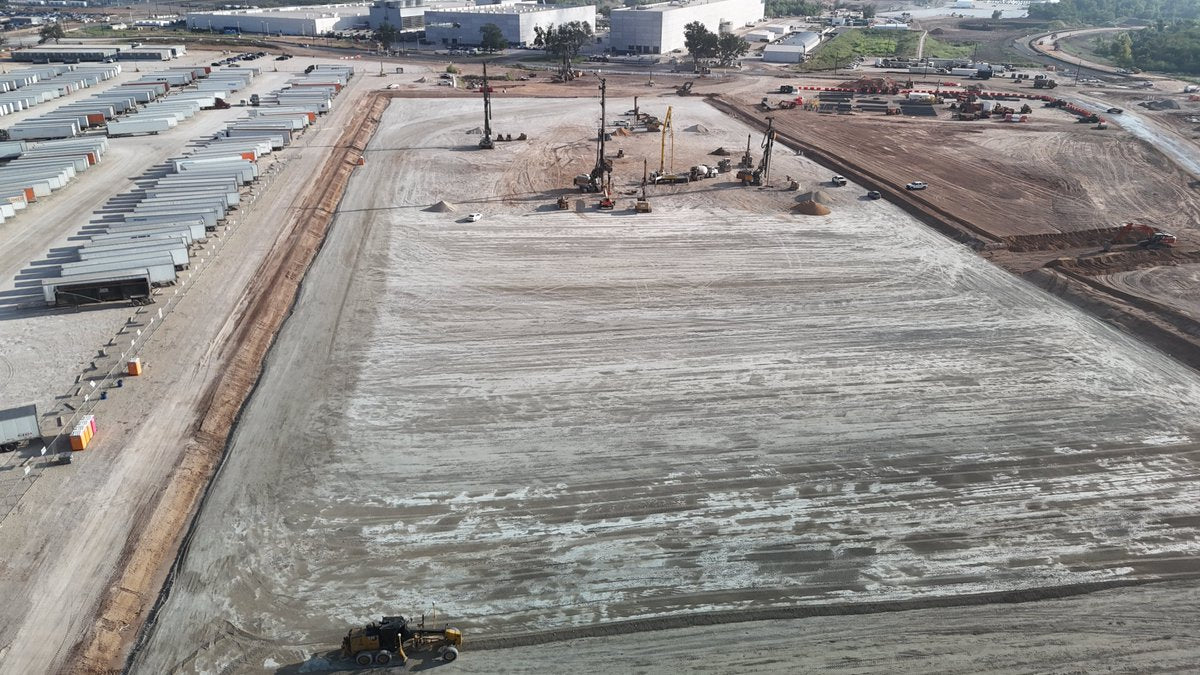
The foundation at Terafab — the joint Tesla, SpaceX, and xAI advanced chip fabrication facility in Texas — is growing faster than observers expected. Aerial footage captured this week shows the footprint expanding southward, a sign that construction timelines are holding or even pulling ahead.

Drone tracker Joe Tegtmeyer, who has been documenting the site since groundbreaking, noted that the foundation is not only taking shape but has extended further south than the original architectural renders suggested. One detail still unresolved: the beveled corners visible in early design renderings have not yet appeared in the poured concrete, leaving open the question of whether the final geometry has changed or whether that phase of construction simply hasn't begun.
What Terafab Actually Is
Terafab is arguably the most ambitious industrial project currently under construction in the United States. Announced by Elon Musk on March 21, 2026, it is a three-way joint venture between Tesla, SpaceX, and xAI — the AI company SpaceX recently acquired. The facility has two planned locations in Texas: a prototype operation at the North Campus of Giga Texas in Austin, and a full-scale manufacturing complex in Grimes County.
The strategic logic is straightforward: all three companies are currently dependent on outside foundries for their most critical chips. Terafab is designed to eliminate that dependency entirely by consolidating chip design, lithography, and packaging under one roof, targeting 2-nanometer process technology.
The Numbers Behind the Ambition
| Metric | Figure |
|---|---|
| Initial investment (SpaceX estimate, May 2026) | $55 billion |
| Total investment if all phases built | Up to $119 billion |
| Target computing output | 1 terawatt annually |
| Initial wafer starts per month | 100,000 |
| Full-capacity wafer starts per month | 1 million |
| Annual chip output at full capacity | 100–200 billion chips |
| Process node | 2nm |
Sources: Tesla Q2 2026 update; SpaceX filing, May 2026
To put the terawatt target in context: according to previous reporting, that output would represent roughly 70% of TSMC's entire current global production — from a single facility. Whether Terafab reaches that ceiling is a question for the mid-2030s, but the near-term milestones are more concrete. Small-batch production of the AI5 inference chip — designed for Tesla's Full Self-Driving systems, Cybercab robotaxis, and Optimus robots — is expected before the end of 2026, with volume production projected for 2027.
Two Chips, Two Missions
Terafab is being built to produce two distinct chip families. The first is the AI5, an inference chip optimized for Tesla's autonomous systems — FSD, the Cybercab robotaxi fleet, and Optimus humanoid robots. The second is the D3, a high-power processor hardened for space environments, intended to support SpaceX satellites and orbital AI data centers. The fact that a single fab can serve both terrestrial autonomy and orbital computing reflects how tightly the three companies' roadmaps have become intertwined.
What the Foundation Expansion Signals
The southward growth of the foundation that Tegtmeyer documented is a meaningful construction signal. Foundations don't expand speculatively — they reflect finalized structural engineering decisions. The fact that the footprint is larger than early renders showed could indicate that the initial design was revised upward in scale, or that what was shown publicly was always a conservative representation of the planned build. Either way, it suggests the project is not contracting under financial or logistical pressure.
The unresolved beveled corners are a smaller detail, but worth watching. Architectural features like those are typically added at a later concrete pour phase, so their absence now doesn't indicate a design change — but Tegtmeyer's note that he can't confirm either way is an honest read of what the footage actually shows.
Tesla confirmed in its Q2 2026 update on July 22 that construction and equipment procurement are ongoing. The next visible milestone to watch for: steel superstructure work rising above the foundation, which would give a clearer picture of the building's final scale.
🚕 Following the Robotaxi rollout? See every operating city, launch date and announced market in our Tesla Robotaxi Tracker.
Related Gear
Gear up your Tesla with tested, custom-fit BASENOR accessories — shop Tesla accessories →
Sources & reporting notes
The links below identify the material source records used for this report.
- @JoeTegtmeyer on X (2026-07-27T15:52:33.000Z) — Direct source
Source links are preserved as published or accessed. See our editorial standards and corrections policy.
The BASENOR Editorial Desk covers Tesla, SpaceX, and related technology, curating reporting from primary sources — official accounts, regulatory filings, and software release data. Every article passes source-record and fact-checking review before publication. About the newsroom.
This report was curated by the BASENOR Editorial Desk from the sources listed above. Read our editorial standards or email editorial@basenor.com to report an error.