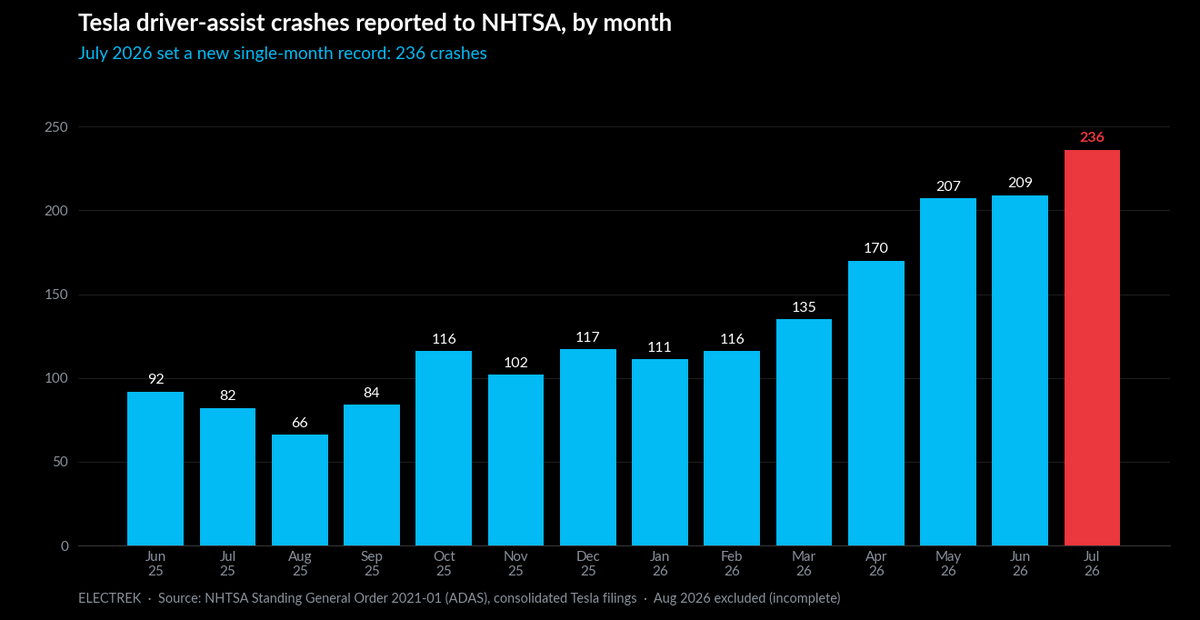
Tesla logged a record month for Autopilot and Full Self-Driving (Supervised) crash reports submitted to the National Highway Traffic Safety Administration, according to NHTSA's latest Standing General Order data reviewed by Electrek. Four of the incidents were fatal, resulting in seven deaths. Tesla redacted the majority of the underlying details, but reporter Fred Lambert says Electrek was able to match the limited unredacted fields to publicly known crashes.
This is not a recall, and there is no new NHTSA investigation attached to the report — yet. But if you drive with Autopilot or FSD (Supervised) engaged, there are concrete steps worth taking today to reduce your own risk and to make sure any incident you're involved in is properly documented.

What the NHTSA Data Actually Says
Under the Standing General Order first issued in 2021, automakers are required to report crashes involving Level 2 driver-assistance systems (like Autopilot and FSD Supervised) or higher automation within specified time windows. Tesla files the most reports of any manufacturer, largely because it has by far the largest deployed Level 2 fleet.
According to Electrek's review of the latest data drop:
- The most recent reporting month set a new high for Tesla Autopilot/FSD-involved crashes.
- Four of those crashes were fatal.
- Seven people died across those four incidents.
- Tesla redacted large portions of each submission, citing confidential business information — a practice Tesla has used consistently since the Standing General Order took effect.
Because of the redactions, the public dataset does not disclose which specific software version was engaged, the exact location, or the sequence of events in most cases. Electrek reports it cross-referenced the unredacted fields (date, general geography, vehicle model) against publicly reported crashes to identify at least some of the incidents.
What This Means for Tesla Owners Right Now
A record month of reported crashes does not automatically mean the systems are getting worse — the deployed fleet using FSD (Supervised) has grown substantially, and more miles under supervision statistically produce more incidents. But it does mean the absolute number of serious events is climbing, and it reinforces something Tesla itself states in the owner's manual and in every FSD engagement prompt: Autopilot and FSD (Supervised) require the driver's full attention at all times.
Here's a practical action plan.
Action Plan: 6 Things to Do This Week
1. Re-read the driver-monitoring rules for your car
Open the owner's manual on your center screen (Controls → Service → Owner's Manual) and search for "Autopilot" and "Full Self-Driving." The manual is explicit that the driver is responsible for the vehicle at all times, must keep hands on the wheel where required, and must be prepared to take over immediately. If you have not read this section in the last year, read it now — the wording has been updated multiple times.
2. Confirm cabin-camera monitoring is enabled
On vehicles equipped with a cabin camera above the rearview mirror, Tesla uses it to detect driver inattention while Autopilot or FSD is engaged. Go to Controls → Autopilot → Cabin Camera Analytics (naming varies slightly by software version) and confirm it is on. Disabling it does not disable the driver-attention requirement — it just removes one of the systems that helps catch you if you look away.
3. Set a personal rule: no phone when Autopilot or FSD is engaged
Every publicly investigated fatal Autopilot crash to date has involved some form of driver inattention. The system is designed as a driver-assistance tool, not an autonomous one — the word "Supervised" was added to FSD's name in 2024 specifically to reinforce that. Treat engaged Autopilot the same way you'd treat cruise control on a two-lane highway: eyes up, hands ready.
4. Know how to disengage instantly
You can disengage Autopilot or FSD three ways: tap the brake, tap the accelerator, or move the steering wheel with meaningful force. Practice all three in a safe setting so muscle memory takes over in an emergency. Do not rely on the stalk in older Model 3/Y or the screen in stalk-less vehicles as your primary disengagement method during a hazard.
5. Save your dashcam footage after any incident
Tesla's built-in dashcam and Sentry Mode footage can be overwritten. If you have any Autopilot or FSD-related incident — even a near-miss — pull the USB drive immediately and save the relevant clips to a separate device. This footage has been decisive in multiple public Autopilot cases, both for and against Tesla.
6. Report incidents to NHTSA yourself
Owners can file their own complaints directly at nhtsa.gov/report-a-safety-problem. Owner-filed complaints are separate from Tesla's Standing General Order submissions, are not redacted the same way, and are part of the record NHTSA uses when deciding whether to open a formal investigation.
The Redaction Problem
The recurring frustration with this dataset — flagged again by Electrek in the latest report — is that Tesla redacts fields that other automakers routinely disclose, including narrative descriptions and software version. NHTSA has previously acknowledged the limitation but has not compelled Tesla to release the redacted material publicly. For owners, this means the public record is not a reliable way to judge whether a particular FSD build is safer or less safe than the one before it. You are, in practical terms, the data point.
What to Watch Next
Three things worth tracking in the coming weeks:
- NHTSA's ongoing FSD investigation. The agency opened a probe into FSD in October 2024 following several crashes in low-visibility conditions. A record fatal month could accelerate that timeline.
- Tesla's next FSD release notes. Watch for language changes around low-visibility handling, driver monitoring thresholds, or new geofences.
- Any recall or software remedy notice. Tesla has issued OTA-based recalls tied to Autopilot behavior before (most notably the December 2023 driver-monitoring recall). A similar action is a possible outcome if NHTSA determines the data warrants it.
If you use FSD (Supervised) regularly, the most useful thing you can do this week is treat the system exactly the way its name says to: as supervised. The NHTSA data is a reminder that the human in the driver's seat is still the final safety layer.
Related Gear
Gear up your Tesla with tested, custom-fit BASENOR accessories — shop Tesla accessories →
Sources & reporting notes
The links below identify the material source records used for this report.
- @FredLambert on X (2026-09-15T14:13:25.000Z) — Direct source
Source links are preserved as published or accessed. See our editorial standards and corrections policy.
The BASENOR Editorial Desk covers Tesla, SpaceX, and related technology, curating reporting from primary sources — official accounts, regulatory filings, and software release data. Every article passes source-record and fact-checking review before publication. About the newsroom.
This report was curated by the BASENOR Editorial Desk from the sources listed above. Read our editorial standards or email editorial@basenor.com to report an error.