The News: Analysis of 2025 sales data argues that Tesla's brand has proven far more resilient than critics predicted, with its sales decline running at roughly half the rate of competitor Rivian.
Why It Matters: For Tesla owners, a resilient brand means stronger resale values, continued software investment, and a company with the financial footing to deliver on its roadmap.
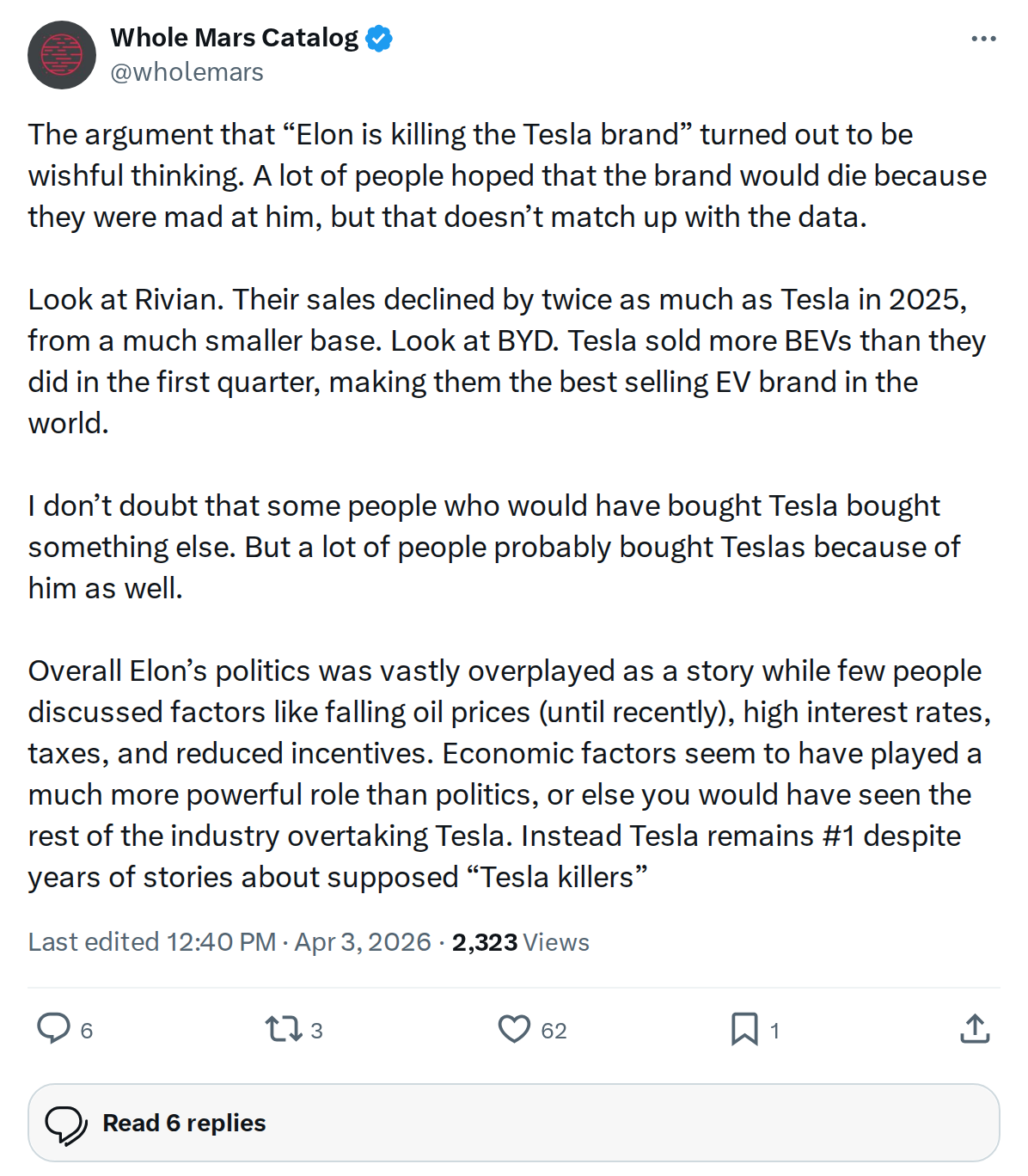
Source: @wholemars on X
The 'Elon Is Killing Tesla' Narrative vs. The Numbers
For the better part of 2025, a persistent narrative circulated across social media and financial commentary: that Elon Musk's public profile was actively damaging the Tesla brand, driving away buyers, and accelerating the company's decline. It made for compelling headlines. But the actual sales data tells a more complicated — and for Tesla owners, more reassuring — story.

Whole Mars Catalog, one of the more data-focused voices in the Tesla community, put it plainly: the argument that Elon is killing the Tesla brand 'turned out to be wishful thinking.' The key data point? Rivian's sales declined by roughly twice as much as Tesla's in 2025 — a comparison that reframes the entire narrative around Tesla's performance.
📊 Key Figures
| Metric | Value | Context |
|---|---|---|
| Tesla 2025 Global Deliveries | ~1.64M vehicles | ~9% decline vs. 2024 |
| Tesla 2025 U.S. Sales | 589,000 vehicles | ~7% decline vs. 2024 |
| Tesla Q3 2025 Deliveries | 497,099 vehicles | All-time quarterly record |
| Tesla Q4 2025 Deliveries | 418,227 vehicles | 15.6% YoY decline |
| Rivian 2025 Sales Decline | ~2x Tesla's rate | Per @wholemars analysis |
| Consecutive Years of Declining Sales | 2 | First time in Tesla history |
🔭 The BASENOR Take
Timeline: Full-year 2025 data, with Q3 2025 as the standout quarter
Impact Level: Medium — reinforces long-term owner confidence, not an immediate operational change
Confidence: High — delivery figures are sourced from Tesla's own quarterly reports
There are two things that can be true at once here, and it's worth holding both of them clearly. Yes, Tesla posted its second consecutive year of declining annual deliveries in 2025 — a first in the company's history, and not something to wave away. A 9% global decline and a 7% U.S. decline are real numbers with real implications for revenue and market share.
But the framing that Tesla's brand was uniquely damaged — that buyer sentiment had turned against Tesla specifically because of its CEO — doesn't hold up well against the broader EV market context. Rivian, which carries none of the same political baggage in the narrative, saw its sales fall at roughly double Tesla's rate. That's a significant data point. It suggests that much of what's being attributed to brand damage is actually broader EV market softness: interest rate sensitivity, slower-than-expected charging infrastructure adoption, and a used EV market that's made new purchases harder to justify for budget-conscious buyers.
The Q3 2025 figure is particularly telling. Tesla delivered 497,099 vehicles in a single quarter — an all-time record — right in the middle of the period when the 'brand is dying' narrative was at its loudest. That's not the trajectory of a brand in freefall.
What does this mean for owners? Brand health directly affects resale value, the pace of software investment, and Tesla's ability to fund its longer-term roadmap — including Full Self-Driving development, the Cybercab rollout, and next-generation vehicle platforms. A company that's holding its market position relative to competitors, even in a difficult year, is one that's better positioned to deliver on those commitments. The data, at minimum, suggests the obituaries were premature.
Related Gear
Gear up your Tesla with tested, custom-fit BASENOR accessories — shop Tesla accessories →
Sources & reporting notes
The links below identify the material source records used for this report.
- @wholemars on X (2026-04-03T04:40:18.000Z) — Direct source
Source links are preserved as published or accessed. See our editorial standards and corrections policy.
The BASENOR Editorial Desk covers Tesla, SpaceX, and related technology, curating reporting from primary sources — official accounts, regulatory filings, and software release data. Every article passes source-record and fact-checking review before publication. About the newsroom.
This report was curated by the BASENOR Editorial Desk from the sources listed above. Read our editorial standards or email editorial@basenor.com to report an error.