📌 UPDATE — September 3, 2026
Launch day is here. The Tesla Cybercab launch event is underway in Austin today, with the official reveal expected later this evening. Ahead of the festivities, aerial photographer Joe Tegtmeyer shared fresh footage of the rapidly expanding Optimus Factory at Giga Texas — a reminder that tonight's event is about more than just the Cybercab, with Tesla's broader physical AI ambitions, including Optimus, very much in the spotlight. The Giga Texas Optimus facility has grown noticeably since recent prior flyovers, signaling aggressive production ramp preparations.
@JoeTegtmeyer · Sep 3, 2026
"Happy Cybercab Launch Event Day! To help get us ready for the excitement later today, here's an updated look as the quickly growing Optimus Factory at Giga Texas … a very important new addition to @Tesla and the expansion of physical AI products the company will be introducing"
View on X →
📌 UPDATE — September 3, 2026
Right on launch day, Tesla has pushed Robotaxi app version 26.8.0 to iOS, with a changelog entry explicitly noting support for Cybercab in Austin, Texas. The update went live early this morning, hours before the anticipated September 3 launch event, and confirms the app infrastructure is ready for live Cybercab operations in the city. Users in Austin should update the Robotaxi app on their iPhone to access the service as it rolls out today.


📌 UPDATE — September 3, 2026
It's launch day. Cybercabs are hitting Austin streets this morning, with Elon Musk teasing a "Storm of Cybercabs" flooding the city within hours and a broader US expansion to follow in the coming weeks. Early videos show the Cybercab's RGB front light bar cycling through purple, orange, turquoise, and green, butterfly doors swinging open, and the in-ride UI in action. Tesla has also officially added Cybercab-specific terms of service to the Robotaxi app — notably, minors under 13 are not permitted in a Cybercab (compared to age 8 for the Model Y robotaxi variant).


| Detail | Cybercab | Model Y Robotaxi |
|---|---|---|
| Minimum passenger age | 13 | 8 |
📌 UPDATE — September 3, 2026
Just hours into Cybercab's launch day, Elon Musk took to X to tease what appears to be a major deployment wave. In back-to-back posts at 4:12–4:13 AM UTC, Musk wrote "A Storm of Cybercabs" — a phrase that quickly racked up over 1.2 million views and 8,000+ likes — strongly implying a rapid, large-scale rollout of the robotaxi service beyond the initial Austin launch. In a separate reply, he also noted that public cost comparisons don't yet account for the "operational efficiency of Cybercab," hinting that the autonomous, driverless model gives Tesla a structural cost advantage over traditional ride-hailing that hasn't been fully priced into the conversation.
"A Storm of Cybercabs"
— @elonmusk, Sept. 3, 2026 · 1.29M views
The tweets suggest Tesla may be preparing to scale Cybercab deployments in Austin significantly faster than initially anticipated, though no specific fleet numbers or expansion cities have been confirmed yet.
📌 UPDATE — September 2, 2026
Tesla has now officially confirmed the exact timing for tomorrow's Cybercab launch event: Thursday, September 3 at 4:45 PM CT in downtown Austin, Texas. The specific start time is the key new detail here — earlier coverage had the date locked in, but the 4:45 PM kickoff is now confirmed. Attendees and livestream viewers should plan accordingly as the event is less than 24 hours away.

📡 @TeslaNewswire · Sep 2, 2026
📌 UPDATE — September 1, 2026
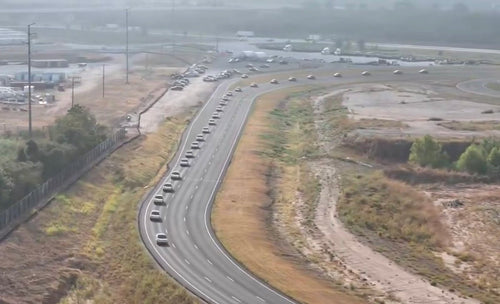
Just two days before the Austin launch, a convoy of 17 Tesla Cybercabs was spotted undergoing large-scale testing in Bellevue, Washington — notably including at least one unit equipped with an integrated Starlink antenna. The Starlink hardware suggests Tesla is planning always-on satellite connectivity as a core infrastructure layer for its robotaxi service, potentially enabling more reliable data transmission and remote monitoring in areas with limited cellular coverage. The large convoy size points to Tesla ramping up real-world fleet testing at pace ahead of the September 3 debut.
📌 UPDATE — August 31, 2026
New passive safety details have emerged for the Cybercab ahead of its September 3 Austin launch. According to Whole Mars Catalog, the autonomous two-seater will be equipped with front, knee, and side airbags — a full complement of passive restraints despite the vehicle having no steering wheel or traditional driver controls. This confirms Tesla has engineered conventional occupant protection into the Cybercab's purpose-built platform, addressing a key safety question for the robotaxi design.

📣 @wholemars · Aug 31, 2026
📌 UPDATE — August 31, 2026
Tesla has officially registered 7 Cybercabs with the Texas DMV as part of its Robotaxi fleet — a jump of 6 vehicles added in a single day — making them the first dedicated Cybercabs to join the 270 Model Ys already on the state's robotaxi registry. Tracker @SawyerMerritt notes this almost certainly signals preparation for Thursday's September 3 launch event, and strongly suggests attendees will be offered rides in Cybercabs on public Austin roads. To be clear, the vehicles are not yet available to the general public — this is event-specific deployment ahead of the official launch.

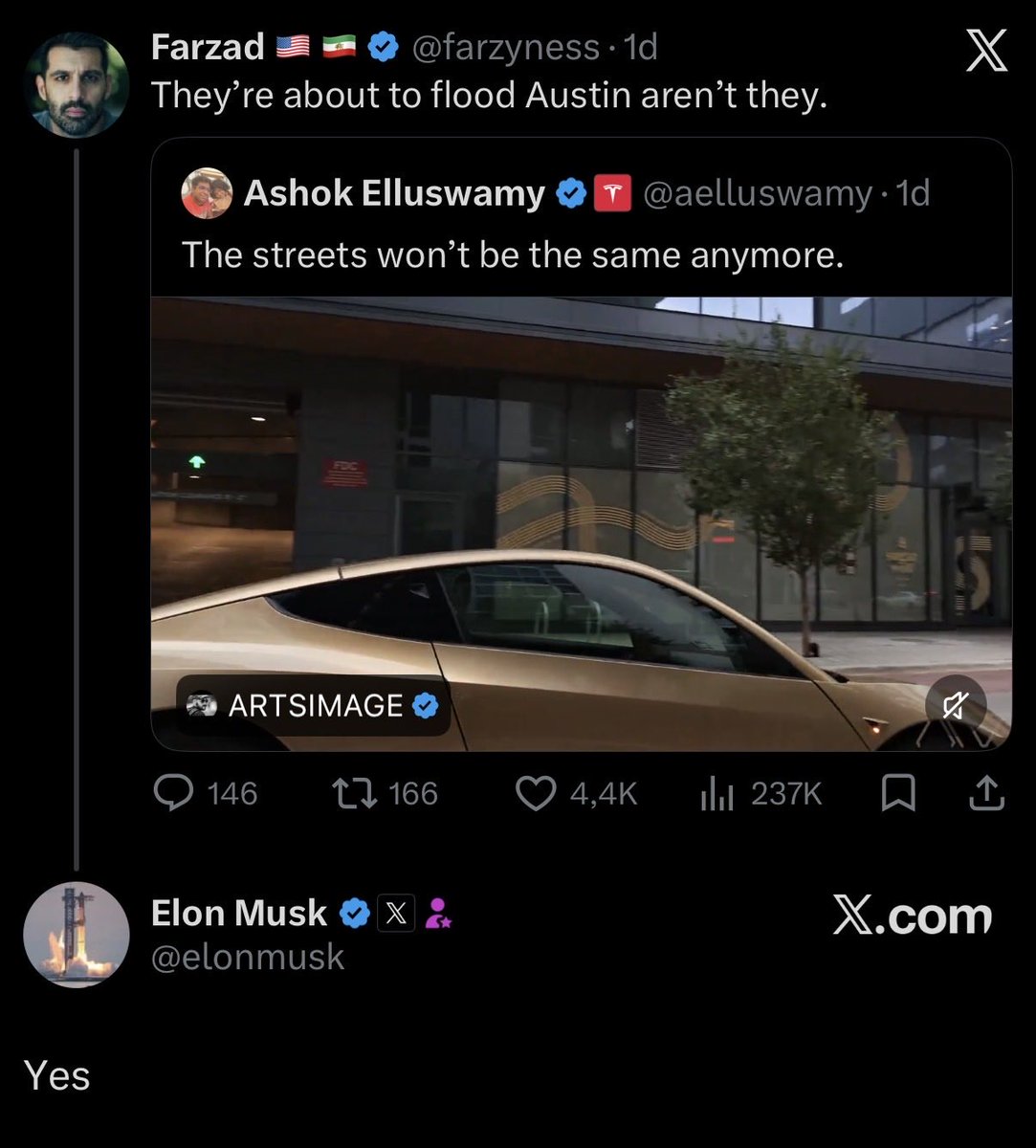
Tesla's Cybercab is arriving in Austin on September 3, just four days from now, according to a post from Elon Musk amplified by @TeslaNewswire. Musk's phrasing — that Cybercabs are 'about to flood Austin' — suggests Tesla intends to deploy the purpose-built two-seater at meaningful scale from day one, marking the first commercial deployment of a steering-wheel-free vehicle in Tesla's Robotaxi fleet.
The event, which multiple reports describe as invite-only with a public livestream, comes roughly seven months after pilot production began at Gigafactory Texas and one year after the concept's Hollywood-style reveal. For Tesla's autonomy roadmap, September 3 is the date the theoretical becomes commercial.

What's Actually Launching
The Cybercab is not a modified Model Y with the steering wheel removed. It is a purpose-built vehicle designed from the ground up for autonomous ride-hailing, with no steering wheel, no pedals, and seating for two passengers. According to specs surfaced by Teslarati and Teslaoracle, the production Cybercab runs a single AC 3-phase permanent magnet motor producing 163 kW (219 hp), draws power from a 47.6 kWh lithium-ion pack, and drives the front wheels — an unusual configuration for a Tesla.
Range is where the numbers get interesting. The unadjusted range figure is 418 miles, though the real-world EPA-adjusted number is expected to land closer to 290 to 300 miles, according to specs reported across multiple outlets. Curb weight comes in at 3,113 lbs (1,412 kg), lighter than any Model 3 or Y variant, which explains how a modestly-sized battery pulls off that range figure. The vehicle is also expected to support inductive (wireless) charging — a natural fit for a fleet that needs to redock without human intervention.
Under the hood of the autonomy stack, the Cybercab runs Tesla's Hardware 4.0 sensor suite paired with FSD version 14.3.3, targeting SAE Level 4 operation within a geofenced service area, according to reporting from Teslarati and Electrek.
Key Figures
| Spec | Figure |
|---|---|
| Launch Date | September 3, 2026 (Austin, TX) |
| Motor Output | 163 kW / 219 hp (front-wheel drive) |
| Battery | 47.6 kWh, 326V nominal |
| Range (unadjusted) | 418 miles (EPA-adjusted ~290–300 mi) |
| Curb Weight | 3,113 lbs (1,412 kg) |
| Autonomy Stack | Hardware 4.0 + FSD v14.3.3 (Level 4 target) |
| Vehicle Price | $25,000 starting (unchanged from 2024 reveal) |
| Fleet Safety Record | 380,000+ unsupervised miles, no notable incidents |
How We Got Here
Tesla unveiled the Cybercab concept at the 'We, Robot' event in October 2024 at Warner Bros. Studios in Los Angeles. Pilot production began at Gigafactory Texas in February 2026, according to Teslarati. In the interim, Tesla launched its Robotaxi service in Austin using modified Model Y vehicles running FSD with safety monitors, gradually expanding the service area and, more recently, removing the monitors on some routes. The fleet has logged more than 380,000 unsupervised miles without a notable incident, per Tesla's own disclosures cited across outlets including Electrek and Teslarati.
The September 3 event is the moment the dedicated hardware finally joins the software. According to reporting from Teslarati and Teslahubs, riders in Austin may be able to hail a Cybercab through the existing Robotaxi app as early as the week following the event — meaning this is a commercial deployment, not a demonstration.
What It Means for Owners and the Broader Fleet
For current Tesla owners, the Cybercab launch matters in three concrete ways. First, it validates the FSD v14 branch as production-ready for unsupervised operation in a geofenced environment — meaningful context for owners who paid for FSD on their personal vehicles and are waiting for the promised unsupervised capability. Second, the Cybercab's inductive charging support hints at where the broader Supercharger and home-charging ecosystem is heading; wireless pads at Supercharger stalls would be a logical next step for a fleet that needs to self-charge. Third, the $25,000 price point remains the elephant in the room. If Tesla can actually manufacture and sell the Cybercab at that number to individual buyers — Musk has said individual sales will follow the fleet rollout — it resets the affordability floor for the entire EV market.
Tesla's stated goal, according to earnings-call commentary cited by Seeking Alpha and Electrek, is to have Cybercabs operating in ten cities by the end of 2026 and to achieve positive unit economics at scale by mid-2027. Whether September 3 opens with a handful of vehicles or the 'flood' Musk describes will be the first real data point on how aggressive that timeline actually is.
What to Watch on September 3
- Fleet size at launch — Does 'flood' mean dozens, hundreds, or a symbolic handful? The gap between rhetoric and reality will define the story.
- Service area map — How much of Austin does the Cybercab geofence cover on day one, and does it match or exceed the current Model Y Robotaxi zone?
- Pricing structure — Per-mile? Per-minute? Subscription? Tesla has not yet disclosed how it will charge riders, and this determines whether the service undercuts Uber and Lyft or matches them.
- Safety monitor status — Is the Cybercab launching fully driverless from day one, or will Tesla staff shadow the initial rides remotely?
- Individual sales timing — Musk has hinted the $25,000 vehicle will eventually be sold to private buyers. Any concrete window announced at the event would be a major signal.
Frequently Asked Questions
Can I ride in a Cybercab on September 3?
The launch event itself is invite-only, but according to Teslarati, public rides through the Robotaxi app may open as soon as the following week in Austin. You will need the Tesla Robotaxi app and be within the service area.
Can I buy a Cybercab for personal use?
Not yet. Initial deployment is a Tesla-operated fleet only. Musk has previously indicated individual sales will follow at a $25,000 starting price, but no consumer order timeline has been officially confirmed.
Does the Cybercab replace the Model Y Robotaxis in Austin?
No — the Cybercab joins the existing fleet. Tesla will continue to operate modified Model Y vehicles alongside the purpose-built Cybercabs, according to multiple reports.
Will FSD v14.3.3 come to my personal Tesla?
The Cybercab-specific stack is tuned for geofenced Level 4 operation with no driver present. Personal vehicles receive their own FSD build track. That said, learnings from Cybercab operation are expected to flow back into the consumer FSD branch — historically the pattern with Tesla's fleet learning.
September 3 is either the day Tesla's autonomy vision becomes commercial reality or the day its timeline slips again in public. Either way, it is the most consequential product event on Tesla's calendar since Cybertruck deliveries began — and unlike Cybertruck, this one arrives with the entire ride-hailing industry watching.
🚕 Following the Robotaxi rollout? See every operating city, launch date and announced market in our Tesla Robotaxi Tracker.
Related Gear
Gear up your Tesla with tested, custom-fit BASENOR accessories — shop Tesla accessories →
Sources & reporting notes
The links below identify the material source records used for this report.
- @TeslaNewswire on X (2026-08-30T15:17:01.000Z) — Direct source
Source links are preserved as published or accessed. See our editorial standards and corrections policy.
The BASENOR Editorial Desk covers Tesla, SpaceX, and related technology, curating reporting from primary sources — official accounts, regulatory filings, and software release data. Every article passes source-record and fact-checking review before publication. About the newsroom.
This report was curated by the BASENOR Editorial Desk from the sources listed above. Read our editorial standards or email editorial@basenor.com to report an error.