Tesla launched commercial Cybercab robotaxi service in Austin on September 3, 2026 — and federal regulators responded the same day. Now, with a formal Special Order on the table and a hard deadline approaching, the certification question hanging over the Cybercab is coming to a head. Here's what you need to know.

What exactly did NHTSA open, and why?
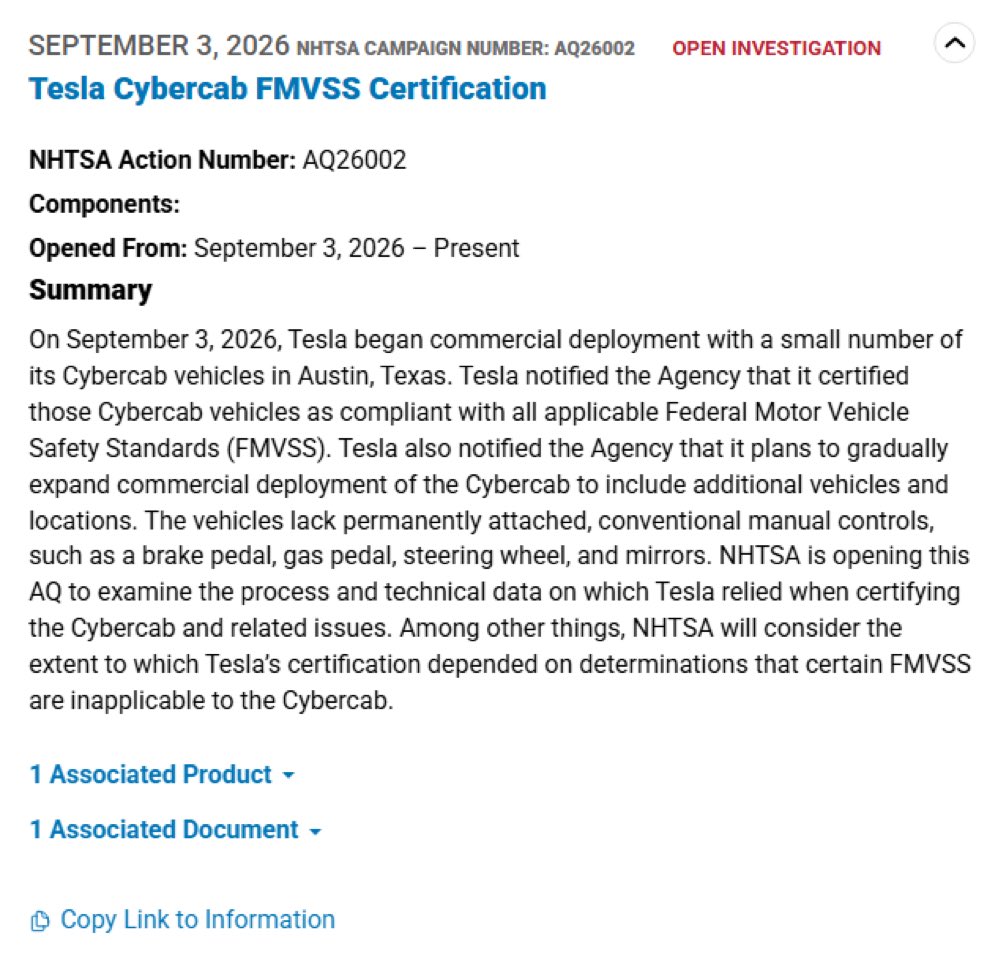
According to public records, NHTSA opened Audit Query AQ26002 on September 3, 2026 — the same day Tesla began taking paid Cybercab fares in Austin. The agency is scrutinizing Tesla's self-certification of the vehicle, which means Tesla declared the Cybercab compliant with all applicable Federal Motor Vehicle Safety Standards (FMVSS) without seeking prior government approval. The audit is NHTSA's mechanism for verifying whether that self-certification holds up.
What is the Special Order, and how serious is it?
On September 10, NHTSA escalated from an audit query to a formal Special Order — a significantly more serious instrument. Under a Special Order, Tesla is required to provide proof of Cybercab compliance under oath. It's not a recall or a ban, but it is a legally binding demand for documentation. Failure to respond fully and truthfully carries potential penalties of up to $139 million, according to NHTSA's published guidelines.
What's the core regulatory problem with the Cybercab?
The Cybercab has no steering wheel, no foot pedals, and no traditional mirrors — by design. The issue is that many existing FMVSS were written with human-operated vehicles in mind. FMVSS No. 135, for example, mandates a foot-activated service brake. Tesla's position is that certain standards simply don't apply to a fully autonomous vehicle. NHTSA is demanding Tesla explain, on the record, exactly which standards it deemed inapplicable and on what legal basis.
Why didn't Tesla pursue an exemption the way other AV companies have?
Other autonomous vehicle developers have used a different regulatory pathway: the Part 555 exemption, which allows the sale of up to 2,500 vehicles per year for a two-year period while operating outside certain FMVSS requirements. Tesla chose self-certification instead — a faster route, but one that places the burden of proof entirely on the manufacturer. That choice is now the central question regulators are pressing on.
When does Tesla have to respond, and what happens after?
Tesla's deadline to respond to NHTSA's Special Order is September 30, 2026. What comes next depends on the quality of that response. If NHTSA finds Tesla's compliance arguments credible, the audit query could close without further action. If the agency isn't satisfied, it could escalate to a formal investigation, demand a recall, or pursue civil penalties. The Cybercab service in Austin is currently operating while this process plays out.
Should current Cybercab riders or Tesla owners be concerned?
NHTSA has not issued a safety defect finding or ordered Tesla to halt operations. The audit and Special Order are regulatory compliance processes, not emergency safety actions. That said, the outcome of Tesla's September 30 response will be a significant signal — either validating Tesla's self-certification approach as a viable model for future AV deployments, or forcing a course correction that could affect how quickly the Cybercab fleet scales beyond Austin.
The September 30 deadline makes this one of the more consequential regulatory moments in Tesla's history. How Tesla frames its compliance arguments — and whether NHTSA accepts them — will shape the legal template for every no-pedal, no-wheel autonomous vehicle that follows.
🚕 Following the Robotaxi rollout? See every operating city, launch date and announced market in our Tesla Robotaxi Tracker.
Related Gear
Gear up your Tesla with tested, custom-fit BASENOR accessories — shop Tesla accessories →
Sources & reporting notes
The links below identify the material source records used for this report.
- @wholemars on X (2026-09-15T21:00:48.000Z) — Direct source
Source links are preserved as published or accessed. See our editorial standards and corrections policy.
The BASENOR Editorial Desk covers Tesla, SpaceX, and related technology, curating reporting from primary sources — official accounts, regulatory filings, and software release data. Every article passes source-record and fact-checking review before publication. About the newsroom.
This report was curated by the BASENOR Editorial Desk from the sources listed above. Read our editorial standards or email editorial@basenor.com to report an error.