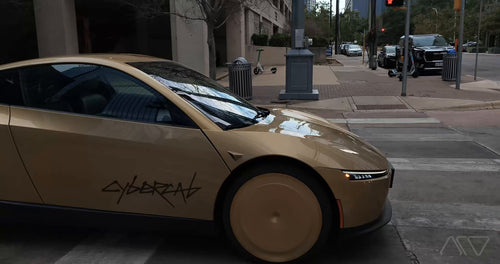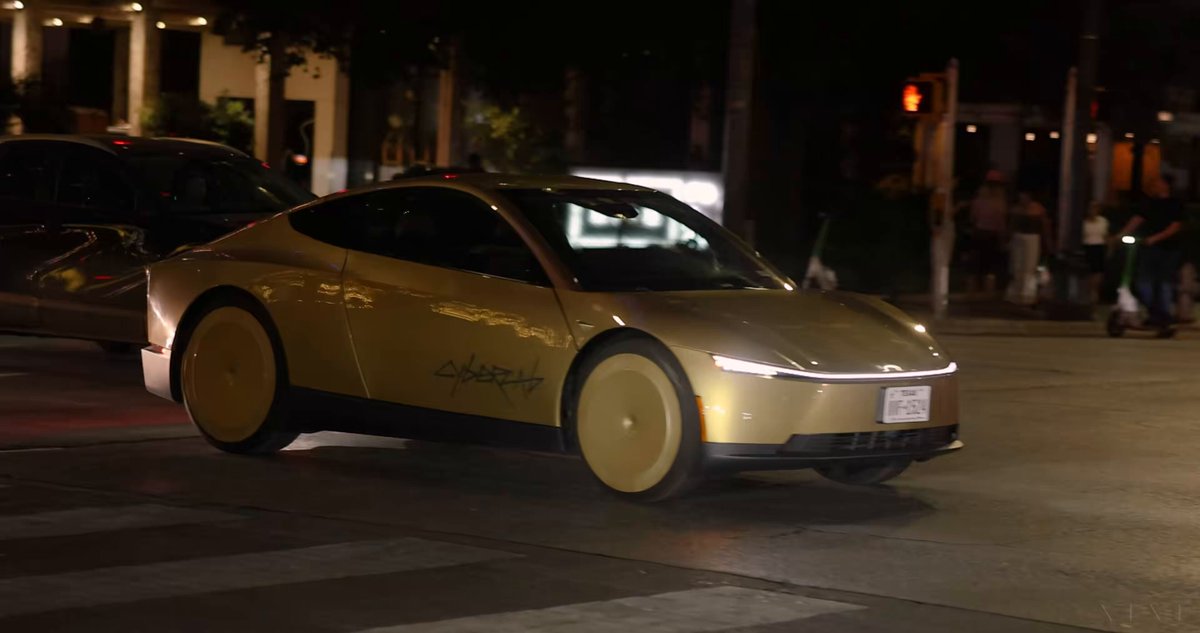
A Tesla Cybercab has been filmed operating on public roads in Austin, Texas at night with no steering wheel, no pedals, no driver, and no safety monitor onboard — the clearest public demonstration yet of the two-seat autonomous vehicle Tesla unveiled in October 2024. The footage, shared late Friday by @TeslaNewswire, marks a meaningful escalation from the driver-monitored Model Y Robotaxi rides that have been operating in Austin since June.
If validated by additional sightings, it is the first widely circulated video of a purpose-built Cybercab — the vehicle Tesla has repeatedly said will not ship with manual controls — running unsupervised in a real-world urban environment rather than on a closed lot.

Why This Sighting Matters
Every Robotaxi ride Tesla has run publicly in Austin so far has used a retrofitted Model Y with a Tesla employee in the passenger seat acting as a safety monitor. The vehicle has a steering wheel. The monitor has an emergency stop button. Regulators, insurers, and the public have a human failsafe to point to.
The Cybercab has none of that. It was designed from a blank sheet with no steering wheel and no pedals — meaning there is no physical path for a human occupant to take over. Putting that vehicle on a public street at night, without a safety monitor, is a categorically different bet than what has been on display in Austin for the past several months.
The Austin Context
Tesla launched its geofenced Robotaxi service in Austin in June 2026, initially with invited riders and Model Y vehicles carrying front-seat safety monitors. Over subsequent months the company has been reported to expand the service area, add vehicles, and — according to owner and rider posts on X — gradually reduce the monitor's level of intervention. Austin has served as Tesla's primary proving ground because Texas gives autonomous operators broad latitude to test and deploy without the pre-approval regime that California requires.
A Cybercab operating unsupervised in that same city suggests Tesla is now running the purpose-built hardware alongside the Model Y fleet, likely still in a testing capacity rather than in revenue service. The observed nighttime run also implies Tesla is confident enough in the vehicle's perception stack to take on lower-visibility conditions without a human in the loop.
What Whole Mars Is Signaling
The same evening, longtime Tesla commentator @wholemars posted a short note framing the moment in broader terms: "Millions of personally owned autonomous vehicles in the United States. It is inevitable. The stage is set."
That framing matters because it points at the piece of the Cybercab story that often gets lost. Tesla's autonomy pitch has never been solely about a company-owned robotaxi fleet. Elon Musk has repeatedly argued that individual owners will one day be able to add their vehicles to the network, earning revenue while they sleep. A Cybercab running driverless in Austin is the hardware proof point for that argument — and, indirectly, for the FSD-equipped Model 3, Model Y, and Cybertruck already in customer hands.
What This Does Not Confirm
Some caveats are worth naming clearly. The footage does not confirm that the Cybercab is in revenue service, that it is available to public riders, or that Tesla has received any expanded regulatory clearance beyond what the Austin operation already has. It is also not clear from the video alone whether the vehicle was on a mapped test route, whether remote operators were monitoring the drive, or whether other Cybercabs are running in the same fashion.
Tesla has historically shown production and pre-production vehicles operating on public roads well before formal launch — the Cybertruck did the same for months before deliveries began. Treat this as evidence that the Cybercab program is real, running, and further along than the last set of on-lot demos suggested, not as evidence that a commercial Cybercab service is imminent.
What to Watch Next
- Frequency of sightings. If Cybercabs start appearing regularly in Austin over the coming weeks, it points to a structured public-road validation program rather than a one-off demonstration.
- Rider access. Whether Tesla opens Cybercab rides to the existing Robotaxi invite list — and how quickly — will indicate how close the vehicle is to revenue service.
- Geographic expansion. Tesla has publicly discussed bringing Robotaxi service to additional cities. A Cybercab appearing outside Austin would be a strong signal of readiness.
- Production timeline updates. Musk has previously targeted volume Cybercab production in 2026. Any refreshed guidance around that timeline in the wake of these sightings will matter for the broader autonomy story.
For Tesla owners, the more immediate question is what a validated Cybercab platform means for the FSD software running on their own cars. The same neural networks, the same training data, and increasingly the same hardware generation underpin both — and every mile a Cybercab runs unsupervised in Austin is a mile that feeds back into the stack every FSD-equipped Tesla relies on.
🚕 Following the Robotaxi rollout? See every operating city, launch date and announced market in our Tesla Robotaxi Tracker.
Related Gear
Gear up your Tesla with tested, custom-fit BASENOR accessories — shop Tesla accessories →
Sources & reporting notes
The links below identify the material source records used for this report.
- @wholemars on X (2026-08-29T22:08:13.000Z) — Direct source
- @TeslaNewswire on X (2026-08-29T22:08:43.000Z) — Direct source
Source links are preserved as published or accessed. See our editorial standards and corrections policy.
The BASENOR Editorial Desk covers Tesla, SpaceX, and related technology, curating reporting from primary sources — official accounts, regulatory filings, and software release data. Every article passes source-record and fact-checking review before publication. About the newsroom.
This report was curated by the BASENOR Editorial Desk from the sources listed above. Read our editorial standards or email editorial@basenor.com to report an error.