📌 UPDATE — September 1, 2026
Sweden's government has officially declared its support for EU-wide approval of Tesla FSD (Supervised), stating: "It is the Government's position and ambition that an EU-wide approval of advanced driver-assistance systems such as Tesla FSD (Supervised) should take place." This marks a significant diplomatic signal ahead of the October 6 EU vote, with a founding EU-adjacent Nordic nation explicitly backing the measure. Sweden joins the growing list of member-state governments aligning behind a unified approval framework rather than fragmented national rulings. The official statement adds meaningful political weight to Tesla's recently published safety dashboard, which was widely seen as a pre-vote lobbying effort.

Tesla Europe has published the most detailed public safety dataset it has ever released for Full Self-Driving (Supervised), timed weeks before the EU Technical Committee on Motor Vehicles vote that could unlock the system for all 27 member states. The dashboard covers more than 100 million kilometers driven by over 70,000 European customers, and the headline claim is that FSD Supervised is 4.1x less likely to be involved in a crash than a Tesla driven manually.
The release lands at a delicate moment. FSD Supervised is already approved in five EU countries — the Netherlands, Denmark, Belgium, Estonia and Lithuania — under a provisional type approval issued by the Dutch RDW in April 2026. To convert that into an EU-wide green light, Tesla needs support from at least 15 member states representing 65% of the population. According to fsd-eu-tracker.de, that TCMV vote is currently expected on October 6, 2026, with several large markets — France in particular — still publicly skeptical.

What Tesla published
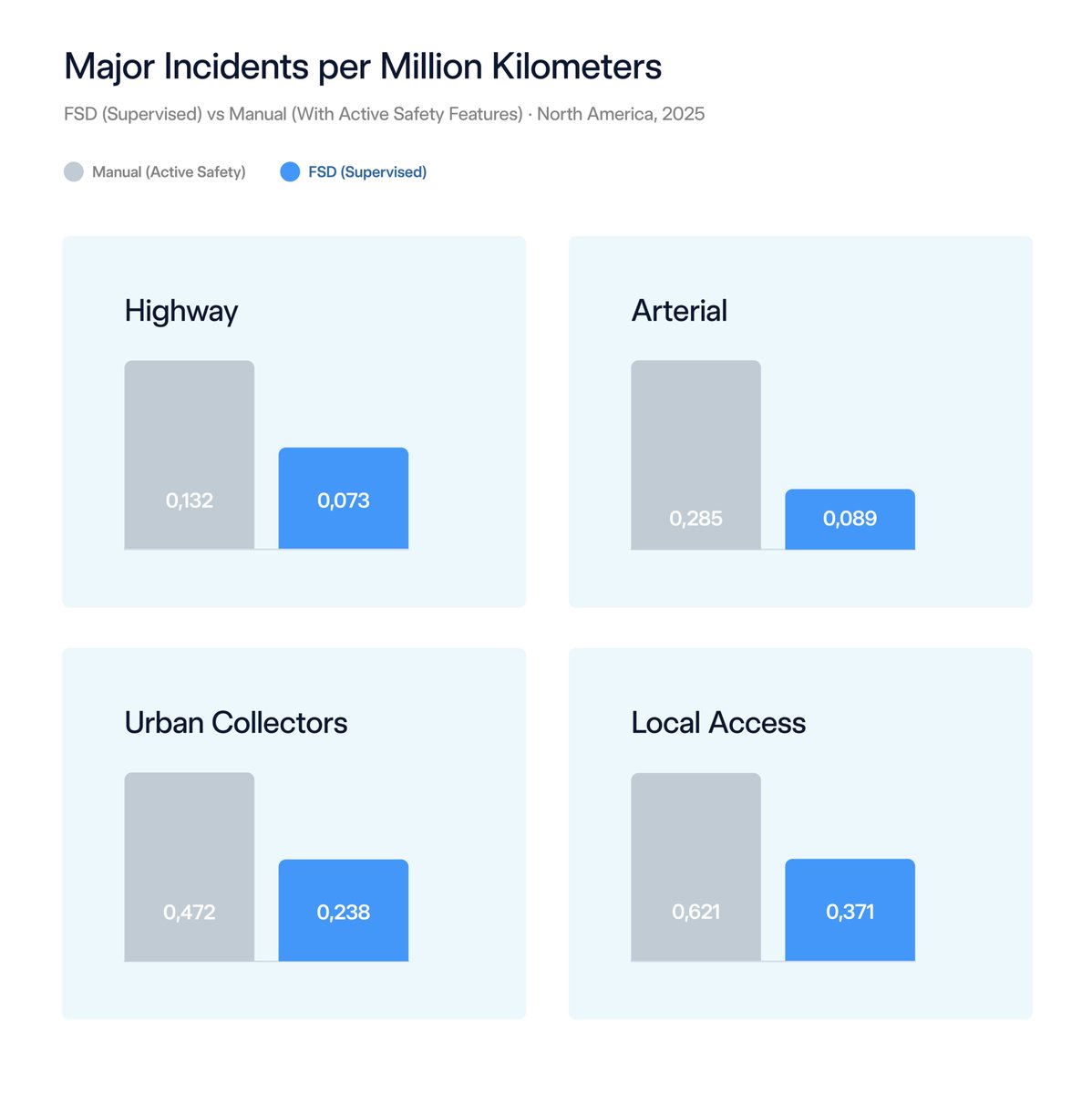
The new evidence dashboard is broken into four claim areas, each backed by a different slice of the fleet data. According to Tesla Europe's own posts, the numbers are drawn from roughly 3 billion kilometers of Tesla driving in 2025 (manual and FSD combined) and 100 million kilometers of FSD Supervised specifically on public EU roads.

Key figures
| Metric | FSD Supervised vs Manual |
|---|---|
| Overall crash likelihood (100M km EU) | 4.1x lower |
| Major crashes — highway | 45% fewer |
| Major crashes — arterial roads | 69% fewer |
| Major crashes — city | 50% fewer |
| Major crashes — local roads | 40% fewer |
| Automatic Emergency Braking activations | up to 84% fewer |
| Driver fatigue | ~66% lower |
| Fleet size / usage | 70,000+ drivers, >1M km/day |
The AEB and lane-change figures are the ones regulators are likely to focus on. Tesla claims FSD Supervised triggers automatic emergency braking up to 84% less often than the same drivers do manually — a proxy for how many near-collisions the system quietly resolves before AEB is even needed. It also claims to eliminate almost all collisions caused by lane changes, which is one of the most common highway crash categories in European insurance data.


How we got here
The path to this vote has been unusually long. According to fsd-eu-tracker.de, the RDW spent more than 18 months and over 250,000 km of testing before issuing a provisional EU type approval on April 10, 2026. That single Dutch approval is what allowed FSD Supervised to go live for customers in the Netherlands, and it was then adopted in sequence by Lithuania (May 20), Estonia (May 29), Denmark (June 9) and Belgium (June 10).
Tesla's own European safety statistics have escalated alongside that rollout. An interim dataset covering April 10 to July 26, 2026 — reported by eleport.com — put FSD Supervised at 5.2x less collision-prone than manual driving across 65 million kilometers, with zero highway collisions over 16.6 million km in the Netherlands alone. The new dashboard uses a larger and more diverse sample (100M km across five countries), which produces a slightly lower but arguably more defensible 4.1x figure.

The regulatory subtext
The reason Tesla is dumping this much data into public view now is that the technical file it submitted to regulators is not public. The RDW has repeatedly declined to release detailed FSD safety data and testing methodology, citing trade-secret protections requested by Tesla, according to reporting summarized on notanfsdtracker.com. A June 2026 Reuters investigation also argued that some of Tesla's earlier safety comparisons — benchmarking FSD-related airbag deployments against a broader U.S. crash-rate baseline that includes less severe accidents and older vehicles — were not apples-to-apples.
By publishing a European-only, road-class-segmented dataset ahead of the October 6 vote, Tesla is trying to answer both criticisms in one move: the comparison is now Tesla-vs-Tesla (same fleet, same drivers, FSD on vs off), and it's segmented by highway, arterial, city and local roads rather than lumped together. Whether that satisfies member states like France and Finland — both of which have flagged concerns about the system's operational design and driver re-engagement behavior — is the open question.
What it means for European Tesla owners
For the 70,000+ drivers already using FSD Supervised in the five approved countries, nothing changes today; the system continues to operate under the existing national approvals. For owners in the other 22 EU countries, October 6 is the date that matters. A yes vote at TCMV would trigger a rollout timeline across the bloc, likely with country-by-country activation as Tesla's mapping and localization catches up. A no vote — or a decision to defer — would leave the Dutch provisional approval intact but stall wider expansion, and in a worst-case scenario could put the provisional status itself at risk, since it can technically lapse if the Commission rejects the system.
What to watch next
- October 6, 2026 — TCMV vote on EU-wide type approval. Requires 15 of 27 member states representing 65% of EU population.
- France's position — Publicly the most skeptical major market. A French abstention rather than a no vote would be a meaningful softening.
- Third-party validation — Whether any EU regulator or independent body corroborates Tesla's 4.1x figure using its own methodology.
- Fleet growth — Tesla's dashboard is a living document. Watch whether the sample size (currently 100M km) and the road-class deltas hold up as usage scales.
Mini-FAQ
Is FSD Supervised the same as robotaxi or unsupervised FSD?
No. FSD Supervised requires the driver to keep hands on the wheel and eyes on the road at all times, and the driver remains legally responsible. It is a driver-assistance system, not autonomous driving. The EU approval process being voted on covers the Supervised version only.
Which cars would get FSD if the EU vote passes?
Tesla vehicles sold in Europe with the required hardware — in practice, HW4-equipped Model 3, Model Y, and existing Model S/X owners' cars — would become eligible, subject to Tesla's software rollout schedule and per-country activation. Owners still need to purchase or subscribe to the FSD package separately.
How does the 4.1x safety claim compare to Tesla's US data?
Tesla's US Vehicle Safety Report typically compares FSD-engaged miles to the overall US crash-rate baseline, which has been criticized as an unfair comparison. The new European dashboard compares FSD Supervised to manual Tesla driving on the same roads, which is a much tighter methodology — and produces a lower multiplier than some of Tesla's earlier US figures.
Could the provisional Dutch approval be revoked?
Yes, in theory. The RDW's April 2026 approval is provisional, and if the European Commission ultimately rejects the system at the EU level, the national approvals derived from it could lapse. That is why the October vote matters even for countries where FSD is already live.
The dashboard is Tesla's most substantive public safety disclosure to date for FSD in Europe, and it's a clear attempt to move the debate from methodology arguments to raw numbers. In five weeks, we'll find out whether 27 governments agree.
Related Gear
Gear up your Tesla with tested, custom-fit BASENOR accessories — shop Tesla accessories →
Sources & reporting notes
The links below identify the material source records used for this report.
- @teslaeurope on X (2026-09-01T05:40:09.000Z) — Direct source
- @teslaeurope on X (2026-09-01T05:40:10.000Z) — Direct source
- @wholemars on X (2026-09-01T06:04:30.000Z) — Direct source
- @wholemars on X (2026-09-01T06:05:51.000Z) — Direct source
- @wholemars on X (2026-09-01T06:06:38.000Z) — Direct source
- @wholemars on X (2026-09-01T06:07:18.000Z) — Direct source
- @TeslaNewswire on X (2026-09-01T06:08:42.000Z) — Direct source
Source links are preserved as published or accessed. See our editorial standards and corrections policy.
The BASENOR Editorial Desk covers Tesla, SpaceX, and related technology, curating reporting from primary sources — official accounts, regulatory filings, and software release data. Every article passes source-record and fact-checking review before publication. About the newsroom.
This report was curated by the BASENOR Editorial Desk from the sources listed above. Read our editorial standards or email editorial@basenor.com to report an error.