30-Second Brief
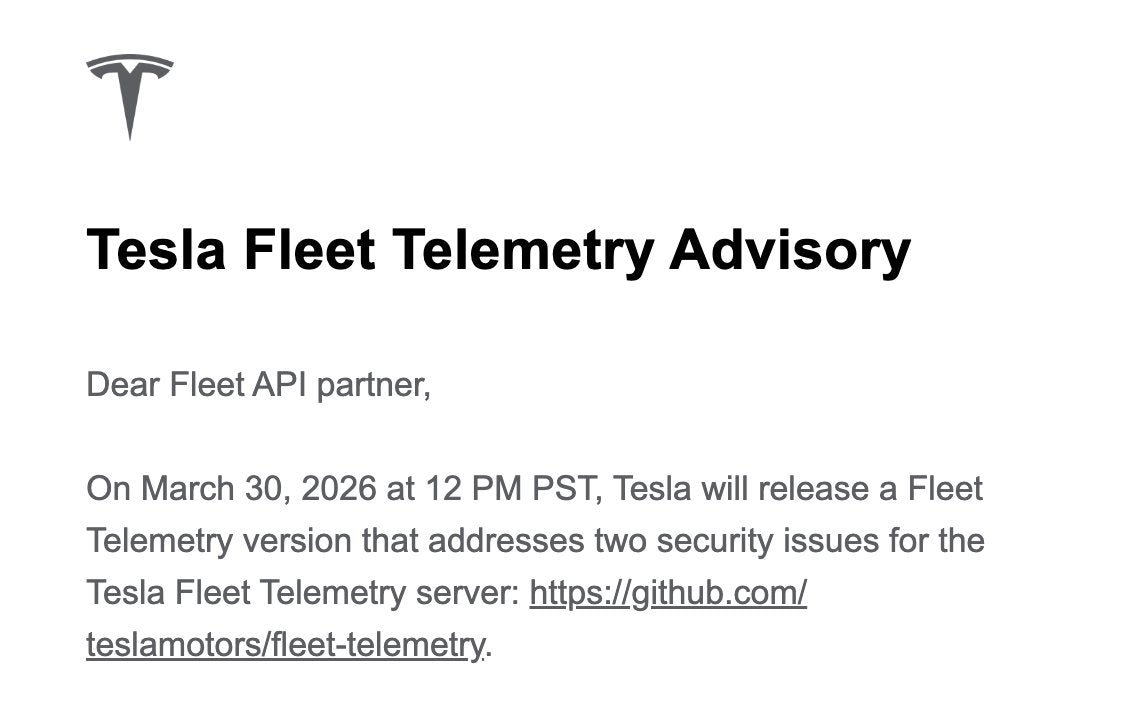
The News: Tesla has notified all Fleet Telemetry developers of two upcoming server-side security fixes — rated low and medium severity — scheduled for release on March 30, 2026.
Why It Matters: While the issues technically allow vehicle impersonation and usage-pattern inference on third-party servers, Fleet Telemetry is read-only — meaning no Tesla owner data, vehicle controls, or personal information can be compromised.
Source: @teslascope on X
Tesla Proactively Flags Fleet Telemetry Vulnerabilities Before Patch Day
Tesla has taken a notably transparent step in its developer relations: emailing all Fleet Telemetry integrators ahead of a scheduled security patch on March 30, 2026. The advance notice gives third-party developers — including popular Tesla data services — time to prepare their own patches and infrastructure updates before Tesla's fix goes live.
The disclosure covers two separate vulnerabilities, both rated in the low-to-medium severity range. Critically, Teslascope — one of the most widely used Tesla data platforms — has confirmed that no Tesla owner data or third-party customer information is at risk from either issue.

Breaking Down the Two Vulnerabilities
Issue 1: Vehicle Impersonation (Medium Severity)
The first vulnerability affects all third-party Fleet Telemetry services and would allow a threat actor to impersonate other vehicles on a server. In plain terms: a bad actor could theoretically inject fake vehicle data into a third-party platform's data stream.
However, the key technical constraint here is fundamental to how Fleet Telemetry works — it is strictly read-only. There is no mechanism through Fleet Telemetry to send commands to a vehicle, access personal account information, or retrieve private user data. The real-world worst case is misleading telemetry data on a third-party dashboard, not a vehicle breach.

Issue 2: Usage and Performance Inference (Low Severity)
The second vulnerability is narrower in scope. It allows a threat actor to infer how many vehicles a given server node is processing — essentially revealing rough usage and performance metrics of a third-party operator's infrastructure. This is a server-side operational detail, not owner data.
Teslascope has confirmed their infrastructure is configured in a way that makes them immune to this second issue — their Fleet Telemetry setup does not expose these parameters.

📊 Key Figures
| Detail | Value | Context |
|---|---|---|
| Patch Release Date | March 30, 2026 | 3 days from disclosure |
| Vulnerabilities Disclosed | 2 | Low and medium severity |
| Services Affected | All Fleet Telemetry integrators (Issue 1); subset (Issue 2) | Server-side only, not vehicle-side |
| Owner Data at Risk | None | Fleet Telemetry is read-only |
| Teslascope Patch Plan | Immediate, upon Tesla release | Only Issue 1 applies to them |
Tesla's Transparency Earns Developer Praise
Teslascope explicitly applauded Tesla for proactively communicating these vulnerabilities before the patch shipped. In the security world, advance disclosure to affected parties — rather than a silent patch — is considered best practice and reflects a mature security posture.

🔭 The BASENOR Take
Timeline: Disclosed March 27 → Patch ships March 30 → Third-party services patch immediately after
Impact Level for Owners: 🟢 Minimal — no vehicle controls, no personal data, no account access involved
Confidence: High — disclosure comes directly from Teslascope, a primary Fleet Telemetry operator with direct knowledge of the issues
📰 Deep Dive
Fleet Telemetry is Tesla's server-side data pipeline that allows approved third-party developers to receive real-time vehicle data — things like battery state, speed, and location — directly from a Tesla vehicle to their own servers. It powers apps and services that Tesla owners voluntarily connect to their accounts. The architecture is fundamentally one-directional: data flows out of the vehicle, never in. That design constraint is precisely why these vulnerabilities, while real, carry limited real-world risk.
The vehicle impersonation issue is the more interesting of the two from a technical standpoint. It suggests that Fleet Telemetry's current authentication model doesn't fully prevent a malicious actor from spoofing a vehicle's identity on a third-party server. In practice, this could allow someone to inject fabricated telemetry into a service like a fleet management dashboard. For individual owners using consumer-facing apps, the practical exposure is minimal. For enterprise fleet operators relying on telemetry data for operational decisions, it's a more meaningful concern — which is likely why Tesla rated it medium severity.
The second issue — inferring node-level processing load — is more of an operational intelligence leak than a data breach. Knowing roughly how many vehicles a competitor's server is handling is competitively sensitive information, but it doesn't expose any individual owner's data. Teslascope's confirmation that their infrastructure isn't affected by this one suggests it's a configuration-dependent vulnerability, not a universal flaw in the Fleet Telemetry protocol itself.
What stands out most here is Tesla's communication approach. Giving developers a three-day heads-up before a security patch is a meaningful gesture — it allows services like Teslascope to have their own patches ready to deploy in lockstep, minimizing any window of exposure. For Tesla owners, the bottom line is straightforward: your vehicle, your account, and your personal data are not implicated in either of these issues. Watch for Teslascope and other Fleet Telemetry integrators to confirm patch deployment on or shortly after March 30.
Related Gear
Gear up your Tesla with tested, custom-fit BASENOR accessories — shop Tesla accessories →
Sources & reporting notes
The links below identify the material source records used for this report.
- @teslascope on X (2026-03-27T00:24:39.000Z) — Direct source
- @teslascope on X (2026-03-27T00:24:39.000Z) — Direct source
- @teslascope on X (2026-03-27T00:24:38.000Z) — Direct source
- @teslascope on X (2026-03-27T00:24:38.000Z) — Direct source
Source links are preserved as published or accessed. See our editorial standards and corrections policy.
The BASENOR Editorial Desk covers Tesla, SpaceX, and related technology, curating reporting from primary sources — official accounts, regulatory filings, and software release data. Every article passes source-record and fact-checking review before publication. About the newsroom.
This report was curated by the BASENOR Editorial Desk from the sources listed above. Read our editorial standards or email editorial@basenor.com to report an error.