Tesla has spent years building three seemingly separate things: a self-driving car system, a humanoid robot, and an AI assistant. The convergence of all three is no longer a distant concept — it's the active direction of the company's engineering and product roadmap. Here's what owners and observers actually want to know about where this is heading.

What does "humanoids and autonomous vehicles were made for each other" actually mean?
The idea is that FSD-equipped vehicles and Optimus robots share the same fundamental problem: navigating the physical world autonomously using computer vision and AI decision-making. Tesla's unified AI platform — built around the AI5 chip, its FSD computer-vision architecture, and the Cortex 2.0 supercomputer — powers both. That's not a coincidence. It means the neural network improvements Tesla makes for Cybercab directly benefit Optimus, and vice versa. The two products are training on the same infrastructure and, increasingly, learning from each other's real-world data.
What does it look like in practice to "talk to your car" and ask it to go anywhere?
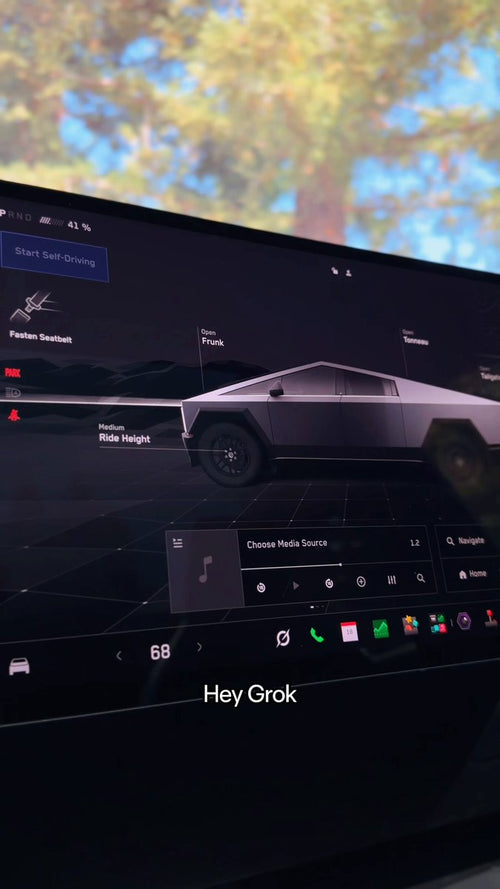
According to Whole Mars Catalog, the vision is conversational: you speak to an AI chatbot interface — powered by Grok — and instruct your autonomous vehicle to navigate somewhere or complete a task, entirely in natural language. Tesla has already integrated Grok into both Cybercab and Optimus for language-related tasks, and FSD Supervised with Grok has been framed internally as akin to having a personal robotaxi. The practical implication for owners is that the interface layer shifts from tapping a screen to having a conversation, with the AI handling the logistics underneath.
Is this a Tesla-only vision, or is the company actually building toward it right now?
Tesla is actively building the infrastructure. The AI5 chip — revealed April 15, 2026 — carries roughly five times the compute of two AI4 chips combined, and initial output is being directed toward Optimus and Tesla's supercomputer clusters. Cortex 2.0, the next-generation training supercomputer, had its Phase 1 (250 MW) come online in April 2026, with full 500 MW capacity targeted for mid-2026. Both Cybercab FSD and Optimus neural networks train on this infrastructure. Tesla is explicitly repositioning itself as an AI and robotics platform — not primarily a car company — and the executive focus reflects that shift.
Where does Optimus fit into the picture for a Tesla owner specifically?
Think of it this way: your Cybercab handles mobility autonomously; Optimus handles physical tasks at the destination. The robot is designed as a general-purpose, bipedal autonomous system for unsafe, repetitive, or tedious work. Gen 3 design is finalized, the supply chain is largely secured, and the first mass-production line is running at Fremont — with full-scale V3 production confirmed to have begun in late July or August 2026. According to supply-chain reports from September 7, 2026, approximately 15,000 Optimus units are being built this year, with a target of around 1,000 units per week by late September. The first units are allocated to Tesla's internal "Optimus Academy" for training, but the production ramp signals that external deployment is not far behind.
What's the realistic timeline for owners to experience this kind of integrated system?
That's the honest unknown. The building blocks — Grok integration, FSD, Optimus production — are all in motion simultaneously, which is unusual for any company. But integrating them into a seamless, consumer-facing experience where you verbally instruct a robot-and-car system to complete real-world tasks involves regulatory, safety, and software layers that don't move on a single team's schedule. What's clear is that Tesla is further along on the underlying infrastructure than most observers realized even a year ago. Whether that translates to a coherent product experience in 2027 or 2029 remains an open question — one that Tesla's own roadmap has historically answered later than initially suggested, and occasionally earlier.
For owners watching our FSD coverage, the most important signal isn't any single feature drop — it's that the AI architecture underpinning your car's autonomy is the same one being trained to run a humanoid robot. That's the convergence worth tracking.
🚕 Following the Robotaxi rollout? See every operating city, launch date and announced market in our Tesla Robotaxi Tracker.
🤖 Tracking Tesla's humanoid robot? See every Optimus production milestone and appearance in our Tesla Optimus Tracker.
Related Gear
Gear up your Tesla with tested, custom-fit BASENOR accessories — shop Tesla accessories →
Sources & reporting notes
The links below identify the material source records used for this report.
- @wholemars on X (2026-09-23T00:39:10.000Z) — Direct source
Source links are preserved as published or accessed. See our editorial standards and corrections policy.
The BASENOR Editorial Desk covers Tesla, SpaceX, and related technology, curating reporting from primary sources — official accounts, regulatory filings, and software release data. Every article passes source-record and fact-checking review before publication. About the newsroom.
This report was curated by the BASENOR Editorial Desk from the sources listed above. Read our editorial standards or email editorial@basenor.com to report an error.