📌 UPDATE — June 9, 2026
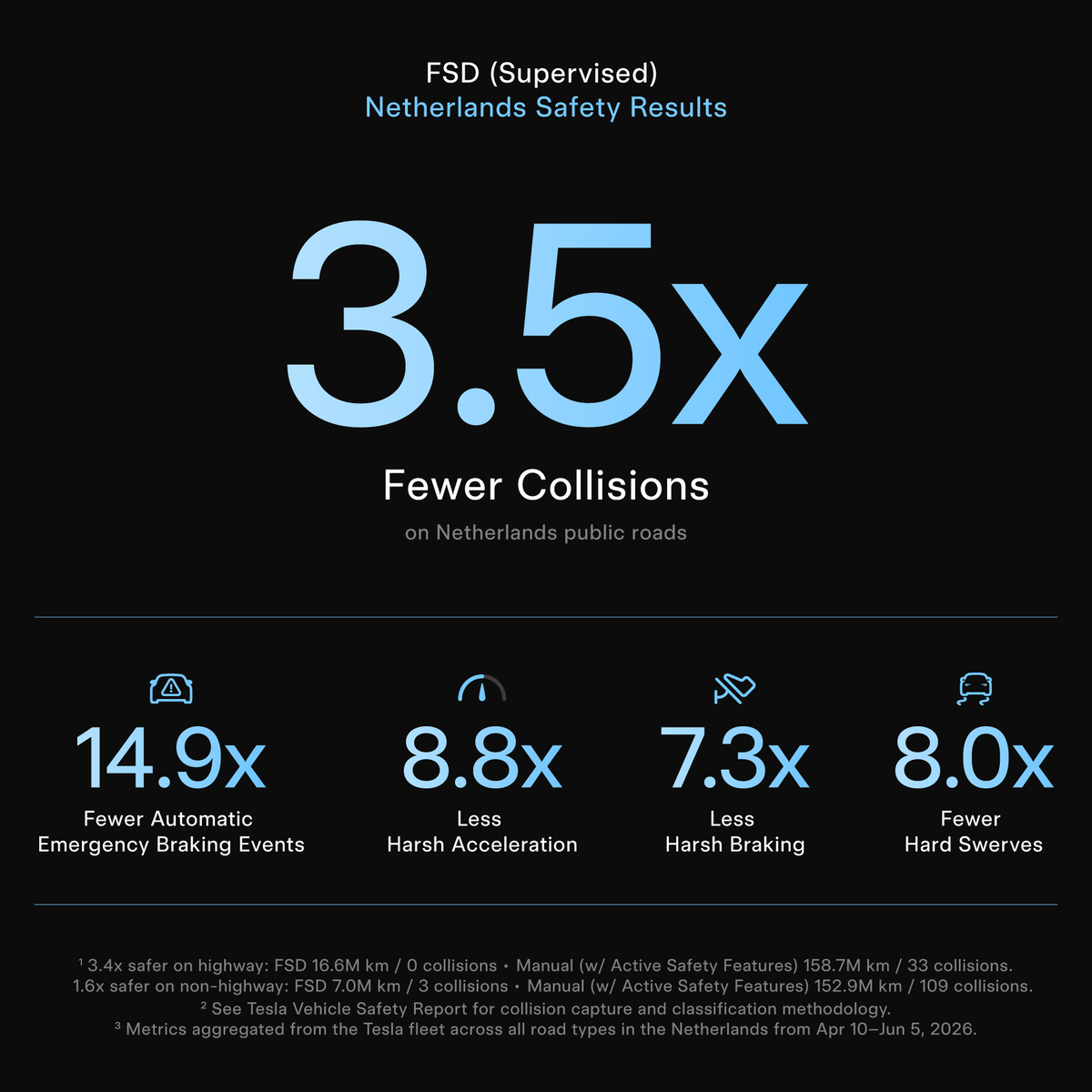
Tesla has published updated FSD (Supervised) safety figures for the Netherlands, now covering 23.6 million km (14.6 million miles) driven in just two months — significantly more than the 16.6M km reported at initial publication. The expanded dataset reinforces the earlier safety picture while adding new metrics: FSD triggered 14.9× fewer automatic emergency braking events, 8.8× less harsh acceleration, and 7.3× less harsh braking compared to human drivers, alongside the previously reported 3.5× collision reduction. These additional behavioural metrics go beyond collision data alone, suggesting FSD's smoother driving profile may also reduce wear and passenger discomfort at scale.
Via @TeslaNewswire, June 9, 2026
Tesla has published its first regional FSD (Supervised) safety dataset from the Netherlands — and the numbers are striking. Over the past two months, FSD-engaged vehicles on Dutch roads recorded 3.5 times fewer collisions than manually driven counterparts, with zero highway collisions across 16.6 million kilometers. It's the first hard safety evidence from Europe, and it arrives at a pivotal moment for the technology's continental expansion.

What the Data Actually Shows
The Netherlands dataset covers roughly two months of real-world operation following the Dutch Vehicle Authority (RDW) granting national type approval on April 10, 2026 — the first such approval in Europe. The fleet has been running FSD (Supervised) v14.2.2.5, bundled with software update 2026.3.6, initially targeting Hardware 4 vehicles.

| Metric | FSD (Supervised) | vs. Manual |
|---|---|---|
| Overall collisions | — | 3.5x fewer |
| Highway collisions (16.6M km) | 0 | 3.4x safer |
| Automatic emergency braking events | — | 14.9x fewer |
| Harsh acceleration events | — | 8.8x less |
| Harsh braking events | — | 7.3x less |
The highway figure deserves particular attention. Zero collisions over 16.6 million kilometers is not a rounding error — it's a statistically meaningful result across a substantial sample. The automatic emergency braking reduction (14.9x) is arguably just as telling: it suggests the system is anticipating and smoothly managing situations that would force a human driver into a reactive, last-resort intervention.
Why This Dataset Is Different
Tesla has published global FSD safety reports before. As of February 2026, the company reported one major collision per 5.3 million miles on FSD (Supervised) globally — roughly 2.4 times better than manually driven Teslas with active safety systems engaged. But those figures aggregate North American and international data across varying road types, regulatory environments, and driver behavior patterns.
The Netherlands data is different in two important ways. First, it's jurisdiction-specific, collected under a formal regulatory framework. The RDW required Tesla to commit to annual performance reporting as a condition of type approval — meaning this isn't voluntary marketing data, it's the beginning of an ongoing compliance record. Second, it reflects European road conditions: denser urban environments, roundabouts, cyclists, and different highway conventions than the US. The fact that the safety margins hold — and in some cases exceed global benchmarks — is meaningful for regulators in other European countries watching closely.
The European Domino Effect
The Netherlands approval has already triggered a cascade. Lithuania approved FSD (Supervised) on May 20, 2026, followed by Estonia on May 29, both leveraging the Dutch certification under EU mutual recognition rules. An EU-wide approval discussion is scheduled for June 30, 2026, though a bloc-wide green light remains further out.
Publishing this two-month safety report now — just before that June 30 discussion — is unlikely to be coincidental. It gives regulators in Brussels and other member states concrete, regulator-verified performance data from a European fleet, not just extrapolated US numbers. For countries still weighing their own approvals, this dataset is the most direct evidence yet that FSD (Supervised) performs at least as well on European roads as Tesla has claimed.
What It Means for European Tesla Owners
If you're in the Netherlands and own a Hardware 4 vehicle, you've been part of this dataset since April. The 10 million kilometer milestone was reached in less than a month after launch — a sign of rapid adoption among eligible owners. For Tesla owners elsewhere in Europe, the regulatory timeline is moving faster than many expected: two additional countries in six weeks, with EU-level talks now formally on the calendar.
The version running in Europe (v14.2.2.5) is described as substantially different from the US release, built to meet RDW and broader EU regulatory requirements. That distinction matters — it means the safety data coming out of the Netherlands reflects a purpose-built European implementation, not a direct port of the North American system.
The real test of these numbers will come when the dataset grows beyond two months and expands to additional markets. But as opening statements go, zero highway collisions over 16.6 million kilometers is a hard figure for skeptics — and regulators — to dismiss.
📋 Tracking Tesla software? See every firmware, FSD and app version in one place in our Tesla Software Update Tracker.
Related Gear
Gear up your Tesla with tested, custom-fit BASENOR accessories — shop Tesla accessories →
Sources & reporting notes
The links below identify the material source records used for this report.
- @SawyerMerritt on X (2026-06-09T03:54:04.000Z) — Direct source
- @teslaeurope on X (2026-06-09T03:48:20.000Z) — Direct source
- @TeslaNewswire on X (2026-06-09T04:23:57.000Z) — Direct source
Source links are preserved as published or accessed. See our editorial standards and corrections policy.
The BASENOR Editorial Desk covers Tesla, SpaceX, and related technology, curating reporting from primary sources — official accounts, regulatory filings, and software release data. Every article passes source-record and fact-checking review before publication. About the newsroom.
This report was curated by the BASENOR Editorial Desk from the sources listed above. Read our editorial standards or email editorial@basenor.com to report an error.