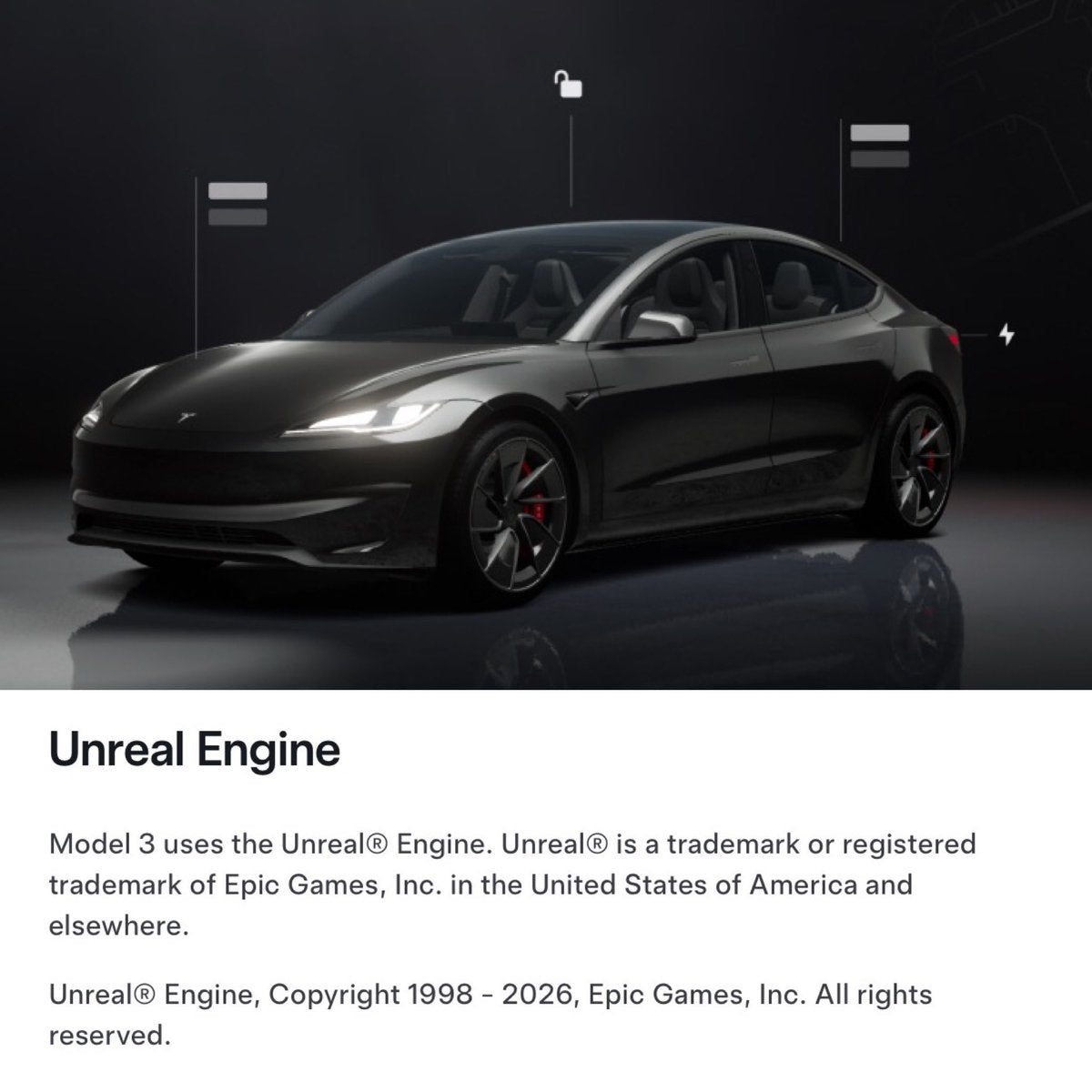
Tesla has quietly made it official: the owner manuals for several of its vehicles now explicitly confirm that Epic Games' Unreal Engine powers the in-car visualization system. It's the clearest documentation yet of a technology shift that enthusiasts and firmware analysts had been tracking for months behind the scenes.

According to the manuals, the Unreal Engine confirmation appears for the 2017+ Model 3, 2020+ Model Y, and 2021+ Model S/X. Notably, it is absent from the Cybertruck and legacy (pre-2021) Model S/X owner manuals — a gap that reflects real hardware differences across Tesla's lineup.
This isn't a surprise to those following Tesla's software evolution closely. Evidence of the switch first surfaced in firmware 2025.20, uncovered by researcher 'greentheonly', with the Unreal Engine binaries initially targeting AMD-based Model S and Model X vehicles. By April 2026, Tesla's Spring Update (2026.14.1) had made the visual upgrade tangible for owners — better reflections, smoother rendering, and more realistic lighting. The most recent 2026.14.6.6 update pushed that further, with brake lights and environmental elements appearing noticeably more prominent on screen.
The Cybertruck's absence from the confirmed list has been a point of discussion. Early concerns centered on whether the vehicle's GPU had enough headroom for Unreal Engine 5's demands. Given Unreal's scalability, that door isn't necessarily closed — but for now, the owner manual is the clearest signal of where the engine is officially deployed. The same applies to older Model S/X hardware, which predates the AMD-based architecture that enabled the transition.
For owners of the supported models, the practical takeaway is already visible in recent software updates. The visualization system on your center display — the animated rendering of your car, surroundings, and nearby objects — is now running on the same engine that powers many of today's most graphically demanding video games. Whether that translates into further visual improvements down the line will depend on how aggressively Tesla continues to develop the integration, but the foundation is clearly in place.
📋 Tracking Tesla software? See every firmware, FSD and app version in one place in our Tesla Software Update Tracker.
Related Gear
Gear up your Model 3 with tested, custom-fit BASENOR accessories — shop Model 3 accessories →
Sources & reporting notes
The links below identify the material source records used for this report.
- @TeslaNewswire on X (2026-05-18T19:08:21.000Z) — Direct source
Source links are preserved as published or accessed. See our editorial standards and corrections policy.
The BASENOR Editorial Desk covers Tesla, SpaceX, and related technology, curating reporting from primary sources — official accounts, regulatory filings, and software release data. Every article passes source-record and fact-checking review before publication. About the newsroom.
This report was curated by the BASENOR Editorial Desk from the sources listed above. Read our editorial standards or email editorial@basenor.com to report an error.