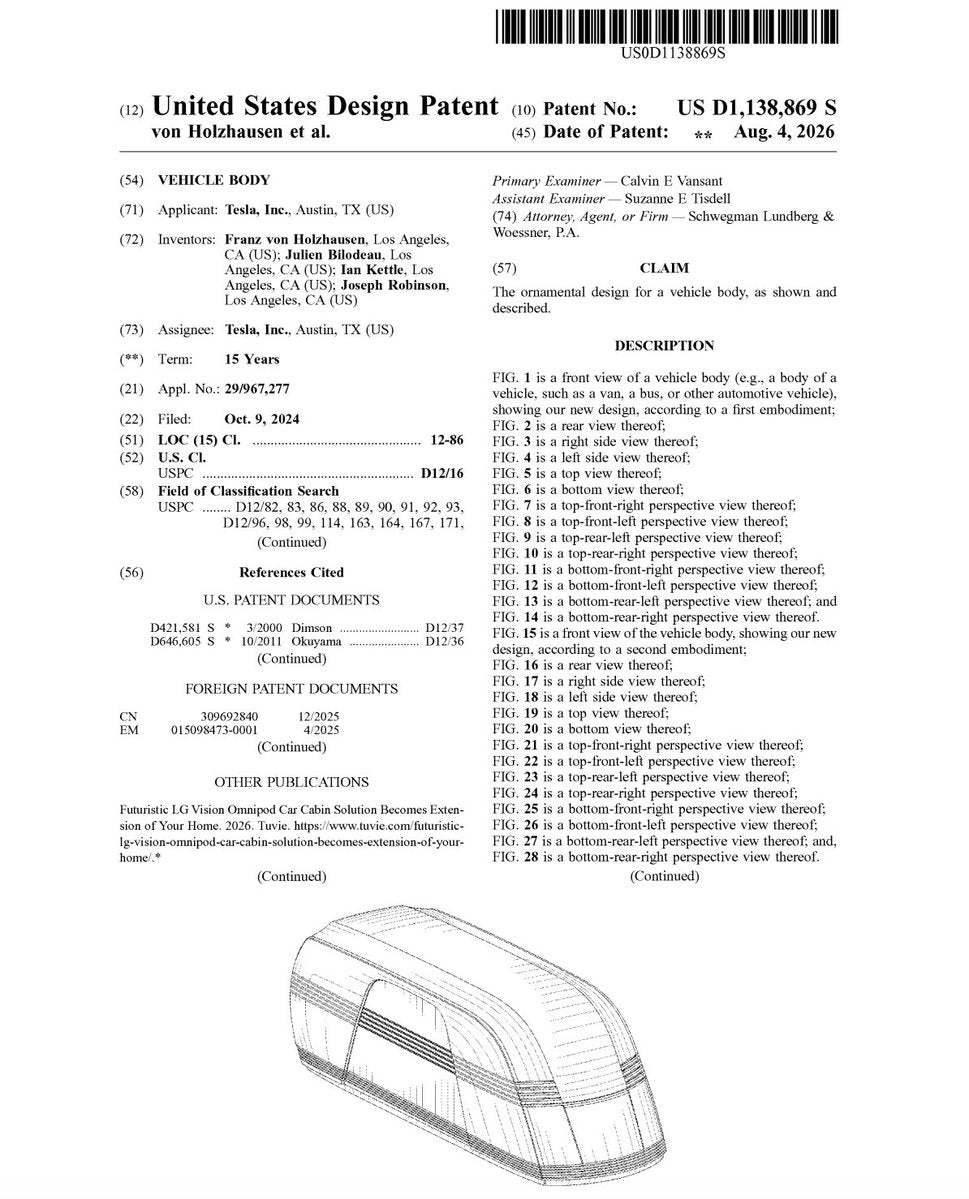
Tesla has officially secured a design patent for its Robus — the autonomous people-mover first revealed to the world at the "We, Robot" event on October 10, 2024. The filing, flagged by The Tesla Newswire on August 5, 2026, marks a formal step in protecting the vehicle's distinctive silhouette as Tesla moves the program closer to a production-ready form.

From Robovan to Robus
When Elon Musk pulled back the curtain on the vehicle at the We, Robot event, it was simply called the "Robovan" — a working name that stuck through months of public discussion. Behind the scenes, Tesla was already building a more formal identity around it. In February 2025, Tesla filed two trademark applications with the USPTO for the mark "Robus": one covering transportation and delivery services (ridesharing, peer-to-peer rentals, commercial leasing), and a second designating it as a model name. By September 2025, chief designer Franz von Holzhausen confirmed the official name publicly.
The design patent now filed locks in the exterior language that made the Robus stand out at its debut. According to background research, the aesthetic draws directly from Art Deco trains of the 1920s and 1930s — slim front and rear light bands, sliding doors, and wheels tucked under the body rather than protruding from the sides. It is a deliberately timeless look, and Tesla is now ensuring no competitor can replicate it without consequence.


What the Robus Is Built to Do
The Robus is not a passenger car in the conventional sense. It is engineered as a fully driverless Level 5 autonomous vehicle aimed at high-density commercial transport — carrying up to 20 passengers or cargo, depending on configuration. There is no steering wheel in the traditional layout; the entire premise is that the vehicle operates without a human driver at any point.
That commercial framing explains why the trademark filings covered ridesharing, peer-to-peer rentals, and leasing services alongside the model name itself. Tesla appears to be positioning the Robus not just as a product to sell, but as infrastructure for a broader autonomous transport network — one that could eventually sit alongside Cybercab in Tesla's robotaxi ecosystem.

Timeline and What Comes Next
Tesla has not announced a production start date for the Robus. Based on available reporting, the vehicle is unlikely to reach customers before 2028, and a more production-focused design iteration is expected in the intervening period. The design patent filing does not accelerate that timeline — but it does signal that Tesla considers the core exterior language settled enough to protect legally, which is typically a meaningful threshold in a product development cycle.
For context, Tesla filed its Cybercab design patents well ahead of that vehicle's commercial launch, and the Robus filing follows a similar pattern: secure the IP, then refine the engineering. The patent drawings circulated by The Tesla Newswire show multiple orthographic views of the vehicle — front, rear, side, and three-quarter angles — consistent with a standard USPTO design patent application intended to cover the ornamental appearance of the product as a whole.

The bigger question hanging over the Robus program is not the design — it is the regulatory path. Level 5 autonomy at commercial scale requires approvals that do not yet exist in most markets. Tesla's ability to deploy the Robus widely will depend as much on what happens in Washington and state capitals as on what happens in Fremont. The patent filing is a business-as-usual IP move; the harder work is still ahead.
🚕 Following the Robotaxi rollout? See every operating city, launch date and announced market in our Tesla Robotaxi Tracker.
Related Gear
Gear up your Tesla with tested, custom-fit BASENOR accessories — shop Tesla accessories →
Sources & reporting notes
The links below identify the material source records used for this report.
- @TeslaNewswire on X (2026-08-05T07:58:51.000Z) — Direct source
Source links are preserved as published or accessed. See our editorial standards and corrections policy.
The BASENOR Editorial Desk covers Tesla, SpaceX, and related technology, curating reporting from primary sources — official accounts, regulatory filings, and software release data. Every article passes source-record and fact-checking review before publication. About the newsroom.
This report was curated by the BASENOR Editorial Desk from the sources listed above. Read our editorial standards or email editorial@basenor.com to report an error.