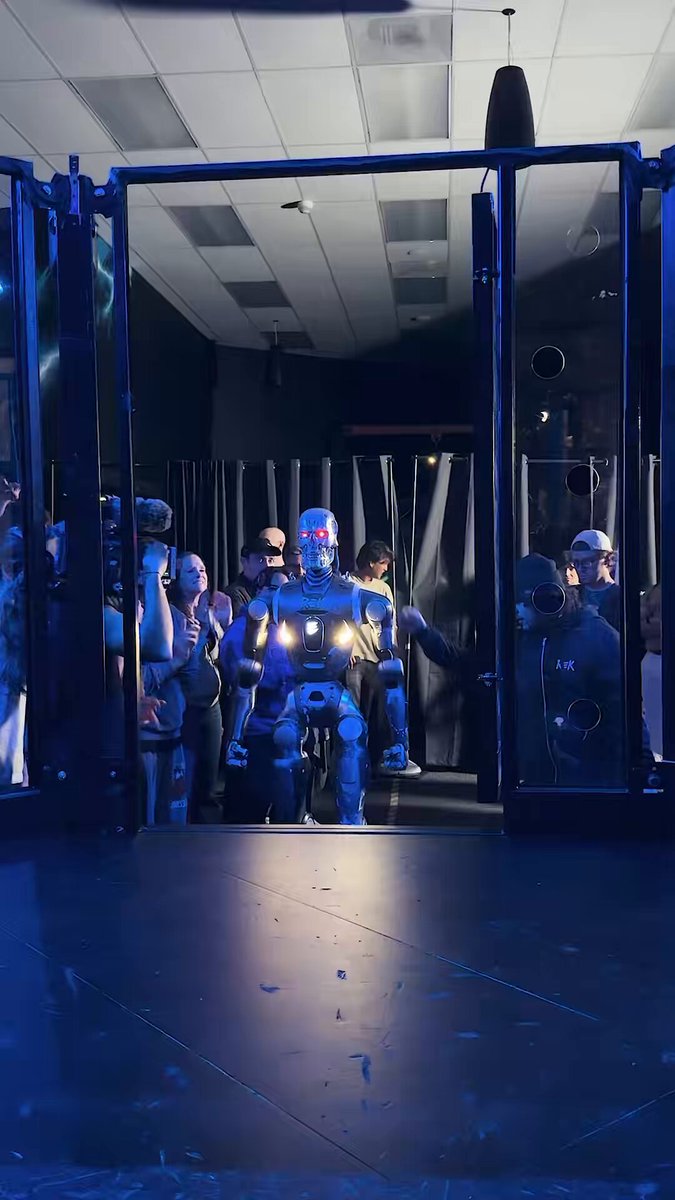
Ashok Elluswamy, Tesla's VP of AI Software and the executive now leading the Optimus program, posted a candid reality check on September 20 that cuts through the hype surrounding humanoid robots: the impressive movements you see in demo videos are, in his words, 'essentially remote controlled.' More striking was his follow-up point — that solving AI safety for physical robots makes the current discourse around large language model safety look, as he put it, like child's play.

What 'Remote Controlled' Actually Means
Elluswamy's phrasing is precise and worth unpacking. When Optimus performs a choreographed sequence — picking up an object, walking a route, demonstrating dexterity — a human operator is directing those actions at a high level, while the robot's onboard systems handle the moment-to-moment physics: balance, joint coordination, and force management. The robot isn't improvising. It's executing instructions while keeping itself upright.
This is a meaningful distinction from fully autonomous operation. The robot isn't perceiving its environment, reasoning about what to do next, and acting on that reasoning in a closed loop — at least not in the demos the public has seen. That gap between 'following remote commands while maintaining balance' and 'acting autonomously in an unstructured environment' is precisely where the hard AI problems live.
According to previous reporting, the Optimus team under Elluswamy has adopted a camera-centric architecture that mirrors the approach used for Tesla's Full Self-Driving software. The system uses an end-to-end foundational neural network processing inputs from cameras and other sensors to make decisions — the same philosophical approach that powers FSD, now being adapted for a body that walks, grasps, and interacts with the physical world.
Why Physical AI Safety Is a Different Problem
The AI safety conversation in 2026 has been dominated by large language models — alignment, hallucination, misuse, and the question of how AI systems represent and pursue goals. Elluswamy's comment reframes that conversation sharply: those challenges, real as they are, exist in a domain where a mistake produces bad text. Physical robots operate in a domain where a mistake produces force.
The technical gap is significant. Optimus uses custom rotary and linear actuators with torque sensing, engineered to detect unexpected resistance — contact with an object or a person — and reduce output force accordingly. But as the background research notes, the critical unknown in that system is the latency between contact and force reduction. In a factory or home environment, that latency window is where injuries happen.
Elluswamy has previously discussed the 'curse of dimensionality' in building foundational robotics models — the challenge of processing enormous inputs (reportedly over 2 billion tokens in 30 seconds) and compressing them into precise, low-latency physical outputs like joint torques. For comparison, Tesla's end-to-end FSD system runs its control loop at 36 Hz, making decisions 36 times per second. A humanoid robot operating in close proximity to people needs comparable or faster response times, with far higher stakes for each decision cycle than a car navigating an open road.
Interpretability is another open problem Elluswamy has flagged in end-to-end systems. When a neural network makes a driving decision, you can audit the outcome after the fact. When a robot applies unexpected force to a person, the post-hoc audit is considerably more consequential. The field doesn't yet have reliable tools to understand why a physical AI system made a specific motor decision in a specific moment.
Where Optimus Actually Stands
Elluswamy took over leadership of the Optimus program in June 2025. In July 2026 he stated publicly that Optimus 'will not disappoint,' signaling internal confidence in the program's trajectory. The current remote-control architecture isn't a failure — it's a development stage. Tesla's FSD followed a similar path: early versions relied heavily on human intervention, with autonomy expanding incrementally as the system accumulated data and the safety envelope was validated.
The difference is that FSD's safety envelope could be tested at scale on public roads with a driver ready to intervene. Validating a humanoid robot's safety envelope in uncontrolled environments — homes, warehouses, public spaces — is a harder problem to instrument and a harder failure mode to recover from.
Elluswamy's post is a rare moment of public candor from inside Tesla's robotics program. The honest framing — 'these moves are essentially remote controlled' — sets a more credible baseline than the polished demo reel narrative. It also signals that the team knows exactly what the hard problem is. Whether the end-to-end neural architecture that solved highway driving can be adapted to solve physical autonomy in human environments is the central question Optimus will spend the next several years answering.
🤖 Tracking Tesla's humanoid robot? See every Optimus production milestone and appearance in our Tesla Optimus Tracker.
Related Gear
Gear up your Tesla with tested, custom-fit BASENOR accessories — shop Tesla accessories →
Sources & reporting notes
The links below identify the material source records used for this report.
- @aelluswamy on X (2026-09-20T21:35:47.000Z) — Direct source
Source links are preserved as published or accessed. See our editorial standards and corrections policy.
The BASENOR Editorial Desk covers Tesla, SpaceX, and related technology, curating reporting from primary sources — official accounts, regulatory filings, and software release data. Every article passes source-record and fact-checking review before publication. About the newsroom.
This report was curated by the BASENOR Editorial Desk from the sources listed above. Read our editorial standards or email editorial@basenor.com to report an error.