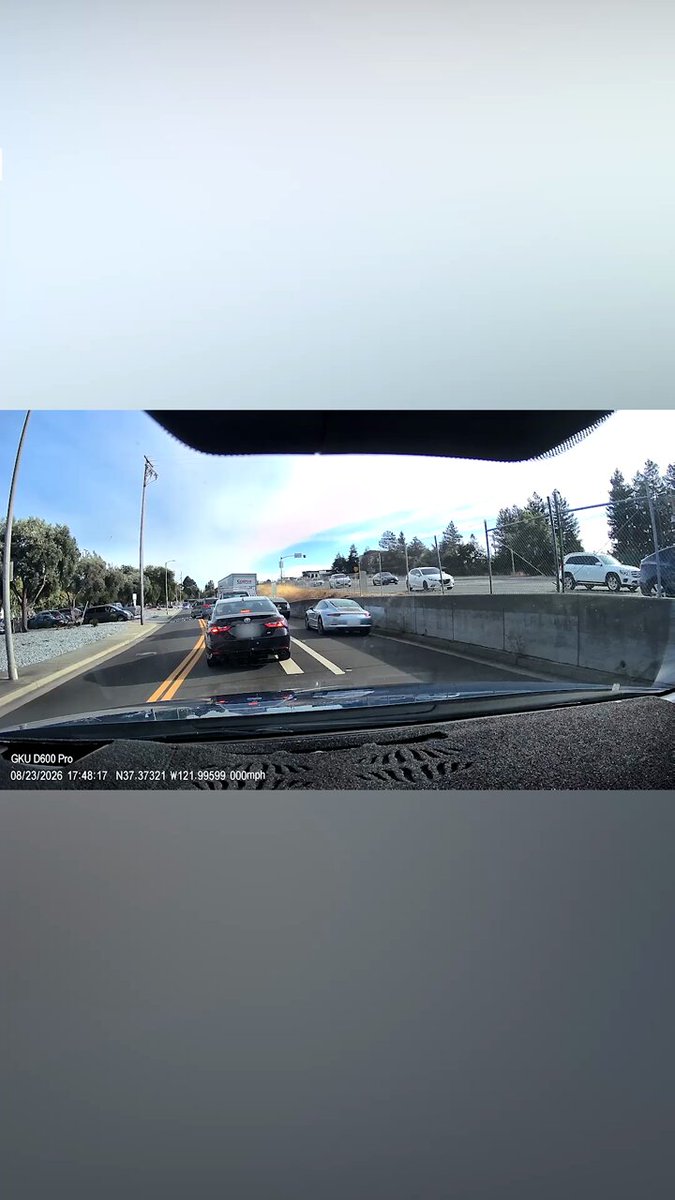
A parking lot scenario most drivers have experienced — a car hidden behind another vehicle at a lot entrance — turns out to be one of the sharpest illustrations of why Tesla's pure vision FSD architecture works differently from sensor-based approaches. Whole Mars Catalog laid it out plainly this week: sensors can only report what they detect. Intelligence anticipates what might be there. Here's why that distinction matters, broken down into five points.

1. Sensors report reality — intelligence predicts it
A radar or LiDAR unit returns a precise point cloud of what's physically in its detection range. That's genuinely useful. But it cannot tell you that a second car is about to emerge from behind the one already in frame. A driver who has navigated thousands of parking lots knows to slow down and cover the brake because that scenario happens constantly. Tesla's end-to-end neural network has been trained on the equivalent of millions of those moments, allowing it to model probable next states — not just current ones. That anticipatory layer is the gap sensors alone cannot close.
2. 13.6 billion miles is the actual training set
The "common sense" Whole Mars Catalog describes isn't a metaphor — it has a number behind it. According to Tesla's own data, FSD (Supervised) had accumulated over 13.6 billion cumulative customer miles as of August 21, 2026, crossing the 13 billion milestone just 18 days earlier on August 3. Every one of those miles fed edge cases, unusual intersections, ambiguous pedestrian behavior, and yes, hidden cars in parking lots back into the neural network. No simulation library or manually labeled dataset scales to that volume of real-world variation.
3. Pure vision eliminates the sensor-fusion translation problem
Systems that combine cameras, radar, and LiDAR face a non-trivial engineering challenge: the outputs of those sensors must be fused into a single coherent world model in real time. Each sensor has its own coordinate system, latency, and failure mode. Disagreements between sensors require arbitration logic, which introduces its own error surface. Tesla's pure vision approach sidesteps this entirely — eight cameras feed a single neural network that builds a unified 3D understanding directly from 2D image data, without an intermediate fusion step that could introduce conflicts or latency.
4. End-to-end AI means the system learns the full task, not sub-tasks
Earlier autonomous driving architectures broke the problem into modular pieces: perception, prediction, planning, control — each handled by a separate model or rule set. End-to-end AI trains a single network across the entire input-to-output chain. The practical consequence is that the system can discover shortcuts and correlations that modular pipelines miss, because no human engineer pre-defined the boundaries between "seeing" and "deciding." The parking lot example is a good illustration: the relevant signal isn't just the detected car — it's the combination of lot geometry, vehicle trajectory, and learned behavioral patterns that together suggest something is hidden.
5. Map-free operation means the system generalizes, not just navigates
Many sensor-heavy autonomous systems depend on pre-built high-definition maps to function reliably. That works well on mapped roads but degrades in construction zones, new developments, or any environment the map doesn't cover. Tesla's pure vision FSD is designed to operate without HD maps, constructing its understanding of the environment in real time from camera feeds alone. That architectural choice forces the system to generalize from learned experience rather than look up a stored answer — which is exactly the kind of generalization that catches the hidden car a map would never have warned you about.
The parking lot scenario is deliberately simple, but it points at something fundamental: autonomous driving at scale requires a system that reasons under uncertainty, not one that only responds to confirmed sensor readings. With over 13.6 billion real-world miles behind it and an architecture built to learn the full driving task end-to-end, Tesla's pure vision approach is making that case with data. The question now is how quickly the gap between what the system handles confidently and what still requires human supervision continues to close. For more on how FSD is evolving, see our FSD coverage.
Related Gear
Gear up your Tesla with tested, custom-fit BASENOR accessories — shop Tesla accessories →
Sources & reporting notes
The links below identify the material source records used for this report.
- @wholemars on X (2026-08-27T19:05:09.000Z) — Direct source
Source links are preserved as published or accessed. See our editorial standards and corrections policy.
The BASENOR Editorial Desk covers Tesla, SpaceX, and related technology, curating reporting from primary sources — official accounts, regulatory filings, and software release data. Every article passes source-record and fact-checking review before publication. About the newsroom.
This report was curated by the BASENOR Editorial Desk from the sources listed above. Read our editorial standards or email editorial@basenor.com to report an error.