The News: Tesla operates a formal Root Access Program that rewards security researchers who discover root exploits with an SSH certificate granting persistent root access to their own vehicle.
Why It Matters: It signals that Tesla treats vehicle cybersecurity as an ongoing, collaborative discipline — not a one-and-done patch cycle — which ultimately makes every Tesla on the road more secure.
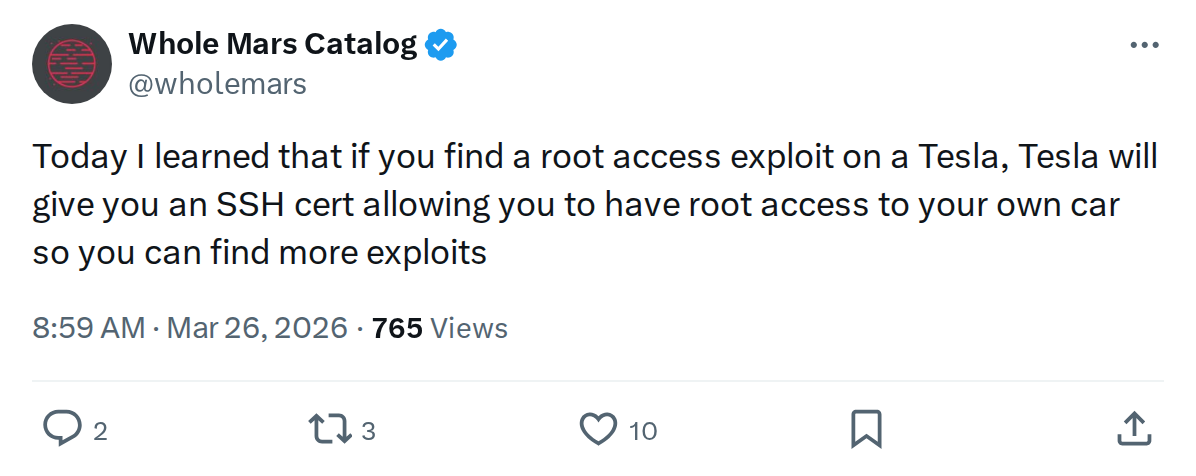
Source: @wholemars on X
Tesla Rewards Security Researchers With Root SSH Access — Here's How the Program Works
Most automakers respond to a security researcher finding a root exploit in their vehicle with a patch, a thank-you email, and a politely worded request to stop poking around. Tesla does something fundamentally different: it hands the researcher a key and says, keep going.
That's the core of Tesla's Root Access Program — a structured policy, managed through Bugcrowd and last updated in October 2025, that converts a one-time vulnerability report into an ongoing research relationship. If you find a novel way to gain root access on a Tesla infotainment system and report it responsibly, Tesla doesn't just patch the hole. It gives you a personalized SSH certificate so you can keep digging.

📊 How the Program Actually Works
According to Tesla's Bugcrowd security page, the mechanics are straightforward but the implications are significant:
| Step | What Happens |
|---|---|
| 1. Discovery | Researcher finds a novel method to gain root access on a Tesla infotainment system |
| 2. Submission | A valid, detailed report is submitted through Tesla's Bugcrowd program |
| 3. Verification | Tesla confirms the report is genuine and qualifies as a novel exploit |
| 4. Activation | Tesla provides instructions to activate a "researcher SSH feature" using the researcher's existing root access |
| 5. Certificate | A custom SSH certificate is issued, tied to the researcher's specific hardware ID and public key |
| 6. Ongoing Access | Researcher retains root access on their infotainment system — even after the original vulnerability is patched — restricted to the local diagnostic Ethernet link |
That last detail is worth pausing on. The SSH certificate persists through patches. Tesla is explicitly allowing approved researchers to maintain a foothold in the system so they can continue finding the next vulnerability before a malicious actor does.
🔒 What the Access Actually Covers — and What It Doesn't
The program is deliberately scoped. The SSH certificate is restricted exclusively to the local diagnostic Ethernet link — meaning remote access over the internet or cellular is not part of the deal. A researcher with this certificate can examine the infotainment system deeply when physically connected to the vehicle, but they cannot access another owner's car, Tesla's backend infrastructure, or vehicle safety systems remotely.
This is a meaningful boundary. It enables deep security research on the software stack while keeping the access model physically bounded and auditable.
🔭 The BASENOR Take
| Timeline | Program active; Bugcrowd page last updated October 30, 2025 |
| Impact Level | High — systemic benefit to all Tesla owners over time |
| Confidence | High — confirmed via Tesla's official Bugcrowd security page |
| Vehicles Affected | All Tesla models with infotainment systems |
The automotive industry has a long history of treating security researchers as adversaries — sending cease-and-desist letters, threatening warranty voids, and patching vulnerabilities quietly without acknowledgment. Tesla's approach inverts that model entirely.
By issuing persistent SSH certificates to qualified researchers, Tesla is essentially building a distributed, incentivized red team. Every researcher who earns access becomes a long-term asset in Tesla's security posture. The alternative — patching each exploit in isolation and hoping no one finds the next one — is a losing strategy against sophisticated attackers.
The responsible disclosure framework matters here too. Tesla commits to not pursuing legal action and not voiding warranties for researchers who follow the program guidelines. That's not a small thing. The legal ambiguity around vehicle security research has historically chilled legitimate work in this space. Tesla removing that barrier lowers the cost of responsible disclosure and raises the quality of reports Tesla receives.
📰 Deep Dive
Vehicle cybersecurity is a fundamentally different problem than traditional software security. A compromised phone is a privacy and financial risk. A compromised vehicle — one with drive-by-wire steering, remote unlock, and always-on cellular connectivity — is a physical safety risk. The stakes of getting security wrong are categorically higher, which is why Tesla's willingness to invest in a structured researcher program is notable.
The program's design also reflects a sophisticated understanding of how security research actually works. Finding a root exploit is rarely the end of the story — it's usually the beginning. Once a researcher has root access, they can map the system's attack surface, identify trust boundaries, and find secondary vulnerabilities that would be invisible from the outside. By allowing researchers to retain access post-patch, Tesla is funding exactly that kind of deep, systematic work.
What's also worth noting is the hardware-binding of the SSH certificate. Tying the certificate to a specific hardware ID means Tesla maintains a clear audit trail of who has authorized access to which vehicle. This isn't a blanket jailbreak — it's a controlled, revocable credential that Tesla can track and terminate if a researcher violates the program's terms. The architecture of the program reflects the same engineering discipline Tesla applies to its vehicles.
For the average Tesla owner, none of this requires any action. But it does mean that the software running your vehicle is being scrutinized by motivated, technically sophisticated researchers who have strong incentives to find problems before bad actors do — and a direct channel to report what they find. That's a meaningful layer of security that most automakers simply don't have.
Related Gear
Gear up your Tesla with tested, custom-fit BASENOR accessories — shop Tesla accessories →
Sources & reporting notes
The links below identify the material source records used for this report.
- @wholemars on X (2026-03-26T00:59:47.000Z) — Direct source
Source links are preserved as published or accessed. See our editorial standards and corrections policy.
The BASENOR Editorial Desk covers Tesla, SpaceX, and related technology, curating reporting from primary sources — official accounts, regulatory filings, and software release data. Every article passes source-record and fact-checking review before publication. About the newsroom.
This report was curated by the BASENOR Editorial Desk from the sources listed above. Read our editorial standards or email editorial@basenor.com to report an error.