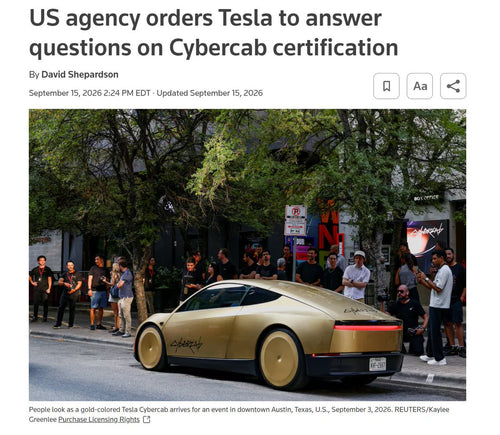
Nearly a year into Tesla's Robotaxi service in Austin, the federal safety record is in — and it's more nuanced than either critics or boosters typically acknowledge. NHTSA crash data covering July 2025 through March 2026 shows 17 total reported incidents, zero major crashes, and only 6 minor contact events where the Tesla Autonomous Driving System (ADS) was deemed at fault or partially at fault.

Breaking Down the 17 Incidents
All 17 reported events involved a 2026 Model Y operating with the ADS engaged and a human safety monitor present. According to the NHTSA filings, the injury breakdown is as follows:
| Outcome | Incidents |
|---|---|
| Property damage only | 13 |
| No injuries reported | 2 |
| Minor injury, no hospitalization | 1 |
| Minor injury requiring hospitalization | 1 |
| Total | 17 |
Several incidents in the dataset were rear-endings and sideswipes caused by inattentive human drivers — not the Robotaxi itself. That context matters when reading the headline number of 17 events.
The Teleoperator Cases Worth Noting
Two of the more significant incidents involved remote teleoperators taking manual control of the vehicle — a detail that adds important texture to the safety picture.
In July 2025, a teleoperator drove a Robotaxi up a curb and into a metal fence at 8 mph after the ADS failed to proceed through a situation it couldn't resolve autonomously. That incident produced the one minor injury requiring hospitalization in the dataset. In January 2026, a second teleoperator drove a Robotaxi into a construction barricade at 9 mph under similar circumstances, resulting in property damage only.
Both cases highlight a reality that often goes unmentioned: the handoff between autonomous and human control is itself a risk surface. The ADS stopping and deferring to a teleoperator is the system working as designed — but the human operator still has to execute correctly once in control.
What Austin's Police Department Says
Austin Police Lieutenant William White has publicly confirmed there have been no major crashes and no traffic citations issued to Tesla Robotaxis operating in the city. That on-the-ground assessment from local law enforcement aligns with the federal data and gives the NHTSA numbers additional credibility.
Context: Where the Program Stands Now
Tesla launched its Austin Robotaxi service in limited capacity on June 22, 2025. By January 2026, the company began integrating unsupervised vehicles — without a safety monitor — into the Austin fleet on a limited basis. Tesla has since expanded unsupervised Robotaxi operations to Dallas and Houston, according to previous announcements.
One procedural note worth flagging: Tesla had initially redacted the crash narratives for all 17 incidents, citing them as confidential business information. The company subsequently unredacted those filings, making the incident details publicly accessible through NHTSA's reporting system. That transparency step, whether voluntary or prompted, is what allows the level of detail now available in the public record.
For a service that completed its first full operational year with one hospitalization across 17 reported events — many of which were caused by other drivers — the data offers a measured but genuinely encouraging early baseline. The harder test will come as unsupervised operations scale and the safety monitor safety net disappears entirely.
🚕 Following the Robotaxi rollout? See every operating city, launch date and announced market in our Tesla Robotaxi Tracker.
Related Gear
Gear up your Tesla with tested, custom-fit BASENOR accessories — shop Tesla accessories →
Sources & reporting notes
The links below identify the material source records used for this report.
- @TeslaNewswire on X (2026-05-15T18:54:42.000Z) — Direct source
Source links are preserved as published or accessed. See our editorial standards and corrections policy.
The BASENOR Editorial Desk covers Tesla, SpaceX, and related technology, curating reporting from primary sources — official accounts, regulatory filings, and software release data. Every article passes source-record and fact-checking review before publication. About the newsroom.
This report was curated by the BASENOR Editorial Desk from the sources listed above. Read our editorial standards or email editorial@basenor.com to report an error.