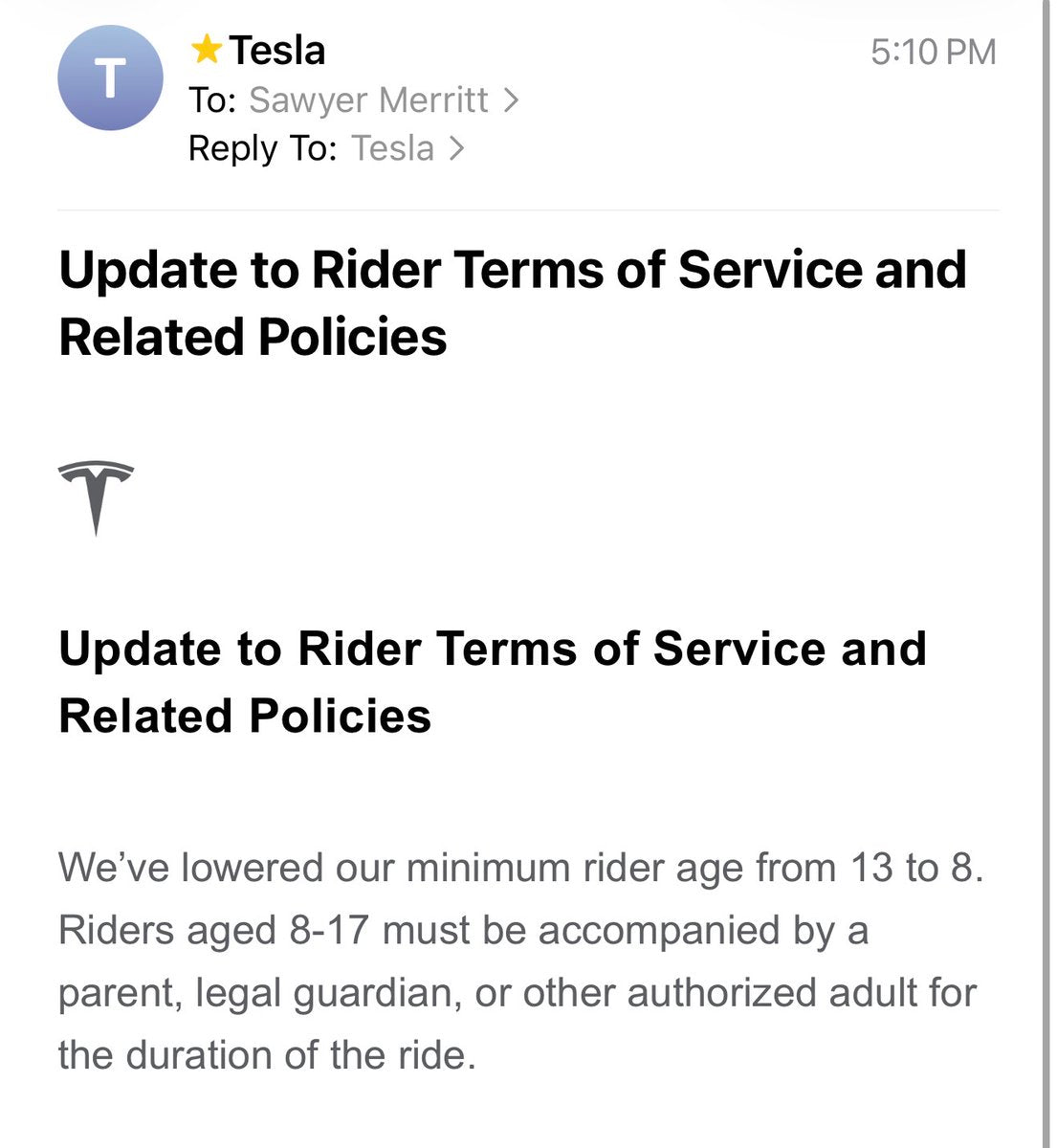
The News: Tesla has lowered the minimum rider age for its Robotaxi service from 13 years old to 8 years old, effective March 27, 2026.
Why It Matters: Families with younger children can now use Tesla's autonomous rideshare service, significantly expanding the potential rider base — though adult supervision remains mandatory for anyone under 18.
Source: @SawyerMerritt on X
Tesla Robotaxi Lowers Minimum Rider Age to 8 Years Old — What Families Need to Know
Tesla has quietly updated its Robotaxi Rider Terms of Service, dropping the minimum passenger age from 13 to 8 years old. The change, reported on March 27, 2026, applies to both the dedicated Robotaxi service and the FSD (Supervised) Rideshare platform — and it signals Tesla's intent to position autonomous rideshare as a genuine family transportation option.

📊 What Changed
| Policy | Before | After |
|---|---|---|
| Minimum Rider Age | 13 years old | 8 years old |
| Supervision for minors | Required for ages 13–17 | Required for ages 8–17 |
| Who can supervise | Parent or legal guardian | Parent, legal guardian, or authorized adult |
| Guests under 8 | Not permitted | Still not permitted |
| Applies to | Robotaxi service | Robotaxi + FSD (Supervised) Rideshare |

The Fine Print: What the Updated Terms Actually Say
The updated Rider Terms of Service state that "Riders aged 8–17 must be accompanied by a parent, legal guardian, or other authorized adult for the duration of the ride." That last phrase — for the duration of the ride — is important. This isn't a drop-off situation. An adult must be present in the vehicle for the entire trip, not just at pickup or destination.
Children under 8 remain prohibited entirely. And by continuing to use the Tesla app, existing customers automatically agree to the updated terms — no separate opt-in required.

🔭 The BASENOR Take
Timeline: March 27, 2026 — Terms updated and reported same day
Impact Level: Medium — Expands rider eligibility but doesn't change the supervised-only requirement for minors
Confidence: High — Confirmed via Tesla's official Rider Terms of Service
This isn't just a minor housekeeping update to the terms. Lowering the minimum age from 13 to 8 is a deliberate signal that Tesla sees Robotaxi as a family-ready service — not just a commuter tool for adults.
Think about the use case Tesla is opening up: a parent can now take a child to a weekend activity, a sports practice, or a school event via Robotaxi. The "authorized adult" language also gives Tesla flexibility — it doesn't have to be a parent, just a responsible adult who has agreed to the terms. That opens the door for grandparents, coaches, or family friends to accompany younger riders.
The fact that this applies to both the standalone Robotaxi service and the FSD (Supervised) Rideshare platform suggests Tesla is standardizing its minor-rider policy across all autonomous rideshare offerings — a sign of operational maturity as the service scales.
📰 Deep Dive
The age floor of 8 is not arbitrary. It roughly aligns with the age at which most U.S. states consider children capable of riding in standard vehicles without a booster seat, and it's a common threshold in youth activity and transportation policies. Tesla's choice of this number suggests legal and liability teams were closely involved in calibrating where to draw the line.
What's notably absent from the updated terms is any provision for unaccompanied minor travel — something that would be a genuinely transformative feature (imagine a child riding solo to school). That remains off the table for now, and given the current regulatory climate around autonomous vehicles and child safety, it's unlikely to change in the near term. Tesla is threading the needle: expanding access while keeping adult accountability intact.
For the broader Robotaxi rollout, this update matters because it directly addresses a friction point for family adoption. A service that excluded anyone under 13 was functionally a non-starter for parents with elementary-school-aged children. By dropping to 8, Tesla captures a much wider slice of family transportation needs — and potentially increases ride frequency among its existing user base. Whether regulators in all operating markets will accept these terms as written is a separate question worth watching as the service expands geographically.
🚕 Following the Robotaxi rollout? See every operating city, launch date and announced market in our Tesla Robotaxi Tracker.
Related Gear
Gear up your Tesla with tested, custom-fit BASENOR accessories — shop Tesla accessories →
Sources & reporting notes
The links below identify the material source records used for this report.
- @SawyerMerritt on X (2026-03-27T21:18:17.000Z) — Direct source
- @SawyerMerritt on X (2026-03-27T21:06:29.000Z) — Direct source
- @wholemars on X (2026-03-27T21:51:31.000Z) — Direct source
Source links are preserved as published or accessed. See our editorial standards and corrections policy.
The BASENOR Editorial Desk covers Tesla, SpaceX, and related technology, curating reporting from primary sources — official accounts, regulatory filings, and software release data. Every article passes source-record and fact-checking review before publication. About the newsroom.
This report was curated by the BASENOR Editorial Desk from the sources listed above. Read our editorial standards or email editorial@basenor.com to report an error.