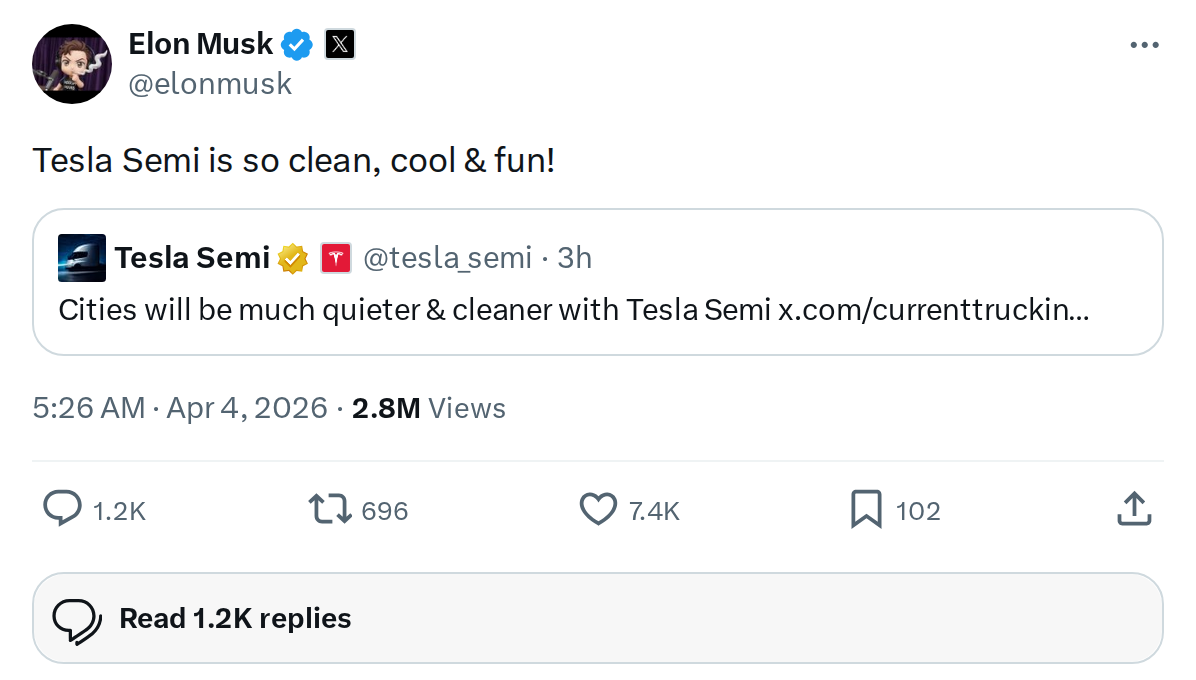
The News: Elon Musk publicly praised the Tesla Semi as "clean, cool & fun," reinforcing the truck's momentum as mass production ramps at a dedicated Nevada factory in April 2026.
Why It Matters: The CEO's enthusiasm signals confidence in the Semi program at a critical moment — 2026 deliveries are projected between 5,000 and 15,000 units, with a long-term capacity target of 50,000 trucks per year.
Source: @elonmusk on X

Three words. 2.3 million views. When the CEO of Tesla calls his Class 8 electric truck "clean, cool & fun," it's worth paying attention — especially when those words land in the middle of the Semi's most consequential production ramp to date.
The Tesla Semi entered mass production in April 2026 at a purpose-built factory adjacent to Gigafactory Nevada. That timing makes Musk's enthusiasm more than a casual compliment. It's a signal that the program is on track and that the product itself is living up to the hype that's been building since the Semi's original reveal years ago.
📊 Key Figures
| Metric | Value | Context |
|---|---|---|
| 2026 Delivery Target | 5,000–15,000 units | First mass-production year |
| Annual Capacity Target | 50,000 trucks/year | Nevada Megafactory |
| Long Range: Range | 500 miles | At 82,000 lbs GCW |
| Standard Range: Range | 325 miles | At 82,000 lbs GCW |
| Drive Power | 800 kW (1,000+ hp) | Three independent rear motors |
| Peak Charging Speed | 1.2 MW | Via Tesla Megacharger (MCS 3.2) |
| Charge Recovery | 60% in 30 min | Fast charging capability |
| Energy Consumption | 1.7 kWh/mile | Both trims |
| Real-World Miles Logged | 13.5M+ | Pilot fleet, 95% uptime |
| Operating Cost vs. Diesel | ~20–50% cheaper/mile | 20% nationwide, 50% in California |
| Starting Price (Standard Range) | $250,000 | Before taxes, incentives, destination |
| Long Range Price | $290,000 | Before taxes, incentives, destination |
| Battery Lifespan Target | 1 million miles | 4680 cell pack |
What Makes the Semi "Fun" — By the Numbers
Musk's choice of the word "fun" is not accidental. The Tesla Semi packs over 1,000 horsepower from three independent rear motors producing up to 800 kW of drive power. That's a Class 8 truck with supercar-grade instant torque — and professional truckers who've driven it in pilot programs consistently describe the experience as unlike anything else on the road. The centered driving position, elimination of traditional blind spots, and instant throttle response are cited repeatedly as highlights.
The "cool" part is harder to argue against. The Semi's drag coefficient of 0.4 — a 7% aerodynamic improvement over its predecessor — gives it a profile that looks nothing like a conventional big rig. The 2026 model also sheds approximately 1,000 lbs compared to earlier versions, improving both payload capacity and efficiency without sacrificing the structural integrity needed for 82,000-lb GCW operation.
And "clean"? The data backs that up too. Running costs are approximately 50% cheaper than diesel in California and 20% cheaper per mile nationally. California fleets also have access to roughly $165 million in HVIP vouchers specifically earmarked for Tesla Semi purchases, which can dramatically reduce the effective purchase price for qualifying operators.
The Charging Infrastructure Behind It
Range anxiety at scale requires a serious answer, and Tesla's Megacharger network provides one. The Long Range Semi supports peak charging at 1.2 megawatts via MCS 3.2 — recovering 60% of range in just 30 minutes. For long-haul routes, that's a meaningful stop, not a day-ending delay. The Standard Range variant at 325 miles handles regional and hub-and-spoke operations comfortably without needing the full Megacharger infrastructure.
The Semi's 4680 battery pack is engineered for a 1 million-mile lifespan — a critical figure for fleet operators calculating total cost of ownership over a truck's working life. Combined with 95% uptime across 13.5 million pilot fleet miles, the reliability case is no longer theoretical.
🔭 The BASENOR Take
Timeline: Mass production began April 2026. Deliveries projected 5,000–15,000 units in 2026, scaling toward 50,000/year capacity.
Impact Level: High — the Semi represents Tesla's entry into the commercial freight market, a segment that moves the needle on both revenue and emissions at scale.
Confidence: High — production confirmation, pilot fleet data, and pricing are all verified. Delivery range reflects genuine ramp uncertainty, not speculation.
A three-word tweet from Elon Musk rarely tells the whole story — but in this case, it lands at exactly the right moment. The Tesla Semi is no longer a concept, a prototype, or a limited pilot. It's in mass production. The 13.5 million real-world miles already logged by the pilot fleet have de-risked the program considerably, and the economics for fleet operators — particularly in California — are genuinely compelling even before incentives.
The bigger question for the industry isn't whether the Semi is good. It's whether Tesla can build enough of them fast enough to satisfy demand and whether the Megacharger network can scale in parallel. A 50,000-unit annual capacity target is ambitious. Getting from 5,000–15,000 units in year one to that ceiling will require flawless execution at the Nevada factory and continued infrastructure expansion.
For fleet operators watching from the sidelines, Musk's enthusiasm is a signal worth noting — not because of the sentiment, but because of the timing. This is the moment the Tesla Semi transitions from promise to product. The fleets that move early will have the advantage of locked-in pricing, priority delivery slots, and the operational data to optimize routes before competitors catch up.
The freight industry is slow to change by nature. But when a truck with 1,000+ horsepower, 500 miles of range, and 50% lower operating costs starts rolling off a production line at scale, "slow to change" becomes a liability.
Related Gear
Gear up your Tesla with tested, custom-fit BASENOR accessories — shop Tesla accessories →
Sources & reporting notes
The links below identify the material source records used for this report.
- @elonmusk on X (2026-04-03T21:26:07.000Z) — Direct source
Source links are preserved as published or accessed. See our editorial standards and corrections policy.
The BASENOR Editorial Desk covers Tesla, SpaceX, and related technology, curating reporting from primary sources — official accounts, regulatory filings, and software release data. Every article passes source-record and fact-checking review before publication. About the newsroom.
This report was curated by the BASENOR Editorial Desk from the sources listed above. Read our editorial standards or email editorial@basenor.com to report an error.