📌 UPDATE — September 14, 2026
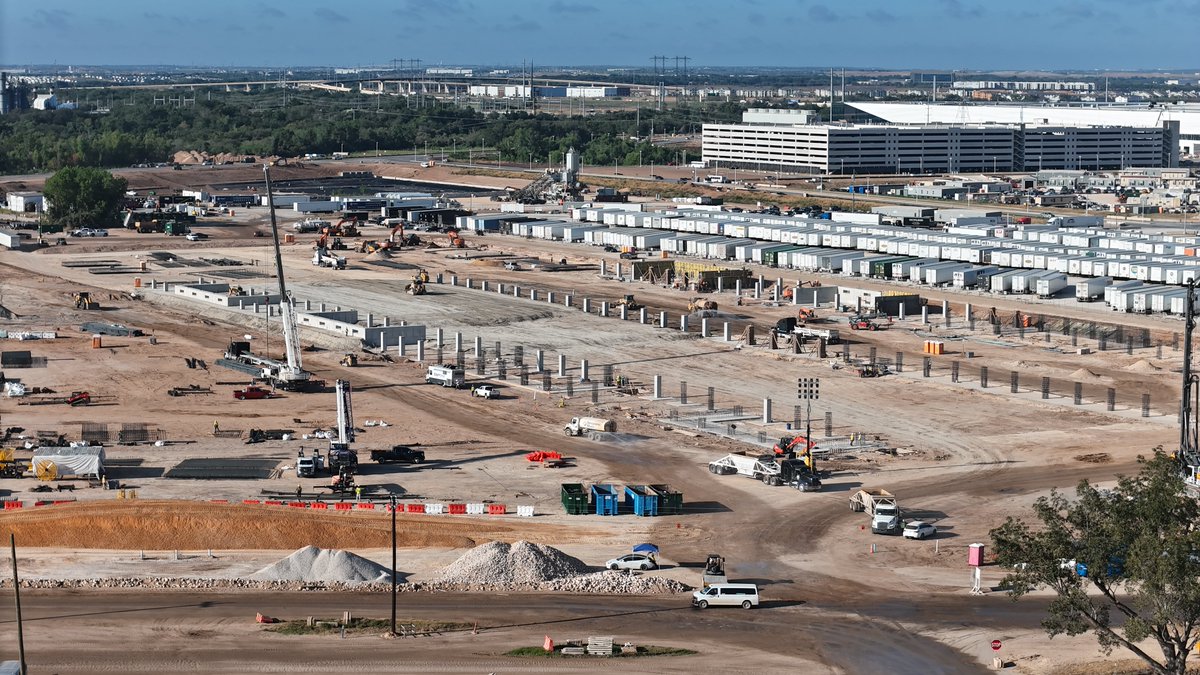
Foundation work on the joint Tesla/SpaceX Advanced Technology Chip Fab at Giga Texas is accelerating rapidly. Aerial footage from drone tracker @JoeTegtmeyer captured on September 14 shows large sections of the foundation now receiving yellow moisture barriers followed by rebar placement — the final prep steps before major concrete pours begin on the main slab and the heavily reinforced footings between structural columns. The scale and density of the rebar visible in the footage signals this is a precision-critical cleanroom-grade foundation, consistent with advanced semiconductor fabrication requirements. Progress since the last site update has been notably fast, suggesting the construction timeline is tracking ahead of early estimates.
📹 @JoeTegtmeyer · Sep 14, 2026
"The joint @SpaceX and @Tesla Advanced Technology Chip Fab foundation is making fast progress here at Giga Texas with a large section getting yellow moisture barriers and then rebar ahead of concrete pours on the main slab and in between the heavily reinforced footings…"
View on X →

📌 UPDATE — September 10, 2026
Foundation construction has officially kicked off at the Tesla/SpaceX Terafab site at Giga Texas. Aerial observer Joe Tegtmeyer spotted active footing excavation work today along a long rectangular graded area — the first visible signs that vertical construction of the main structure may be imminent. While it's still early to confirm exactly which portion of the building this represents, the pace of progression from site prep to foundation work has been notably rapid. This marks a meaningful step beyond the grading and clearing phases previously reported.


📸 Aerial photos via @JoeTegtmeyer — September 10, 2026
A joint Tesla and SpaceX Advanced Technology Chip Fabrication facility is taking shape at Giga Texas — and the construction details emerging this week reveal just how serious both companies are about building their own silicon supply chain. Aerial footage captured by drone journalist Joe Tegtmeyer on September 8 shows a specialized vibration-resistant foundation actively under construction, a structural choice that signals precision semiconductor manufacturing is the end goal.

1. This Is a Research Fab First — the Terafab Comes Later
What's rising at Giga Texas right now is described as a research fabrication facility — a smaller, high-precision proving ground rather than a mass-production plant. According to background reporting on the project, this structure is explicitly a precursor to a much larger initiative called the Terafab. Think of it as the pilot line: engineers validate processes, equipment, and yields here before committing to full-scale production infrastructure. That sequencing is standard in semiconductor manufacturing and suggests Tesla and SpaceX are playing a long game rather than rushing to volume output.
2. The Foundation Is Unlike Anything Else on the Giga Texas Site
Tegtmeyer specifically called out that this structure 'will require a level of vibration dampening unlike any other on the entire site.' That's a meaningful engineering statement at a campus that already houses high-speed stamping presses, casting machines, and assembly lines. Vibration isolation at this level — typically achieved through inertia blocks, air mounts, or reinforced concrete plinths decoupled from the surrounding slab — is a prerequisite for the lithography and metrology equipment used in chip production. The foundation itself is the tell: this isn't a warehouse or a data center, it's a cleanroom-class manufacturing environment.
3. Both Tesla and SpaceX Have Clear Reasons to Want Their Own Silicon
Tesla's dependency on third-party chip supply became painfully visible during the 2021–2022 semiconductor shortage, which disrupted production schedules across the industry. Since then, Tesla has developed its own AI training chip (the D1, used in Dojo) and its own inference chip for FSD. SpaceX, meanwhile, relies on radiation-hardened processors for Starlink satellites and Starship avionics. A shared in-house fab would give both companies tighter control over supply, design iteration cycles, and cost — advantages that become more valuable as FSD compute demands and Starlink constellation density both continue to scale.
4. Co-locating at Giga Texas Is a Strategic Choice, Not Just a Convenience
Giga Texas already serves as Tesla's primary North American vehicle production hub and has been expanding steadily since it opened in 2022. Placing a chip fab on the same campus compresses the feedback loop between vehicle hardware teams and silicon designers — an engineer can walk from the fab to the vehicle integration lab. It also concentrates security and infrastructure investment. For SpaceX, whose Starbase launch facility is roughly 350 miles south in Boca Chica, the Austin campus provides a more accessible base for joint engineering work without requiring a separate greenfield site.
5. The Timeline Is Still Open — but the Foundation Pour Means It's Real
No official production or operational date has been announced for the chip fab. What the current construction activity confirms is that the project has moved past planning and permitting into active civil works — the foundation pour is one of the most capital-intensive early commitments a construction project makes. Semiconductor fabs typically take two to four years from groundbreaking to first wafer output, even for research-scale facilities. If foundation work is underway in September 2026, a realistic window for initial operations would be somewhere in the 2028–2029 range, though that estimate depends heavily on equipment lead times and regulatory approvals that haven't been made public.
The chip fab project is one of the more consequential things happening at Giga Texas right now, even if it generates less social media noise than vehicle production milestones. Control over silicon is increasingly the leverage point in both autonomous driving and aerospace — and the foundation going into the ground this week is the clearest sign yet that Tesla and SpaceX intend to own that leverage themselves. For more on SpaceX coverage, check our dedicated tag page.
Related Gear
Gear up your Tesla with tested, custom-fit BASENOR accessories — shop Tesla accessories →
Sources & reporting notes
The links below identify the material source records used for this report.
- @JoeTegtmeyer on X (2026-09-08T16:12:56.000Z) — Direct source
Source links are preserved as published or accessed. See our editorial standards and corrections policy.
The BASENOR Editorial Desk covers Tesla, SpaceX, and related technology, curating reporting from primary sources — official accounts, regulatory filings, and software release data. Every article passes source-record and fact-checking review before publication. About the newsroom.
This report was curated by the BASENOR Editorial Desk from the sources listed above. Read our editorial standards or email editorial@basenor.com to report an error.