Tesla has confirmed that the in-car voice assistant shipping with its 2026 Summer Update is now running on xAI's newly released Grok Voice Think Fast 2.0 — a meaningful jump over the version that launched with the update in July. Whole Mars Catalog surfaced the confirmation late Monday, followed by a second post noting the model is actively rolling out to Tesla vehicles.

The upgrade matters because Grok in the car isn't a novelty chatbot — with the Summer Update, it now controls core vehicle functions through natural speech, and the underlying model determines how fast, how accurate, and how conversational that experience feels.
What Grok Voice Think Fast 2.0 Actually Changes
Grok Voice Think Fast 2.0 was released by xAI on July 29, 2026, according to xAI's own release notes. It replaces the 1.0 model that shipped with Tesla's Summer Update, which began rolling out to vehicles on July 21. The core architectural change is that the model reasons in parallel with speech — it can start speaking a response while it's still processing the query and calling tools, rather than waiting for a full reasoning pass to finish.
On paper, the deltas are significant. According to xAI's published benchmarks:
- Time to first audio dropped from 1.25 seconds in v1.0 to 0.70 seconds in v2.0 — under the one-second threshold that generally separates "conversational" from "waiting on a computer."
- Reasoning tokens reduced by roughly 60%, which translates to faster tool calls in production — the difference between asking Grok to adjust climate and having it happen versus watching a spinner.
- Transcription accuracy improved 1.4x over the prior Grok voice model, and up to 10x better than competing state-of-the-art transcription models in noisy environments — relevant when you're issuing commands with road noise, HVAC, or music in the mix.
- 25+ language support, up from a narrower footprint in 1.0.
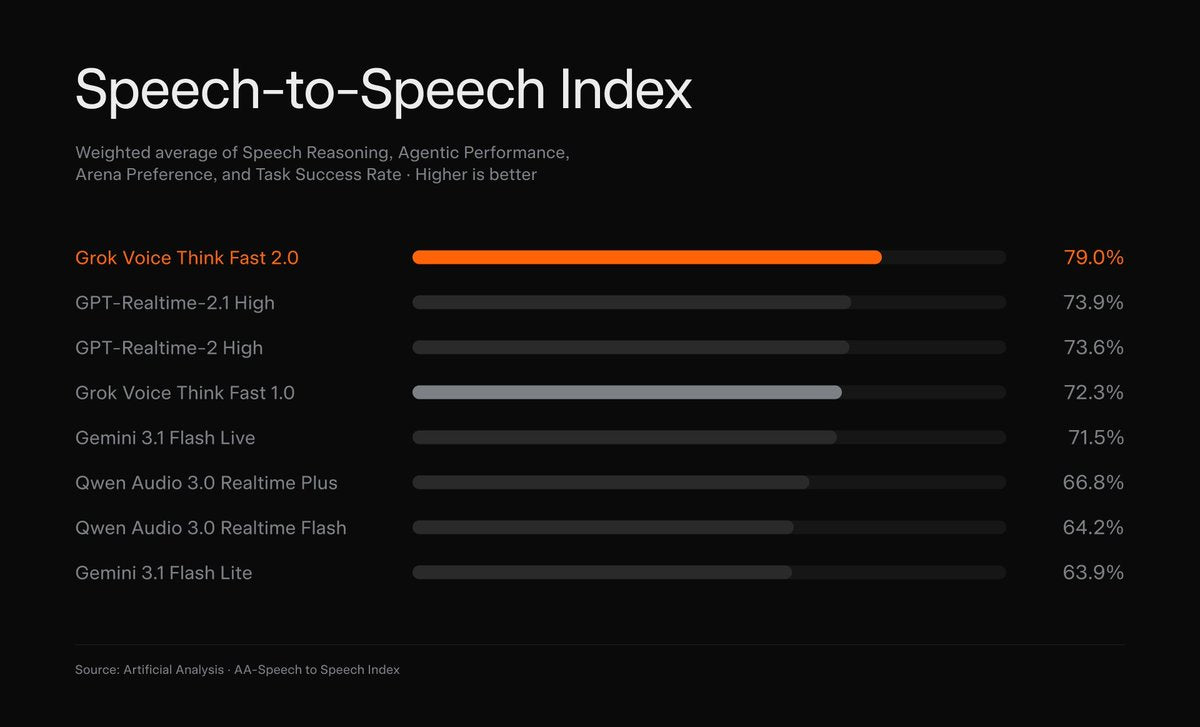
- Benchmark scores: 82.9% on the Artificial Analysis Speech-to-Speech Quality Index (up from 75.7%), and 56.5% on the τ-voice Bench for agentic performance.
What Grok Can Do Inside the Car
The Summer Update's integration pushed Grok from "answer questions" to "actually operate the vehicle." Per Tesla's release notes and coverage of the July rollout, Grok can now handle natural-language commands to make phone calls, search and play music, adjust climate, open the glovebox, and answer questions about the vehicle itself — things like how a feature works or what a warning icon means.
With the 2.0 model behind it, the practical experience should shift in two ways. First, latency: sub-second response time is the difference between a voice assistant you actually use and one you gave up on after a week. Second, accuracy in noisy conditions — the environment every Tesla owner actually drives in.
Rollout Mechanics
According to xAI, the grok-voice-latest API endpoint automatically updated to Voice Think Fast 2.0 on August 5, 2026. That's the endpoint the Tesla integration ties into, which is why the model swap can happen server-side without requiring a new vehicle firmware version. Owners already running the Summer Update should see the upgraded model arrive without a fresh OTA — it's a backend change rather than a client-side software push.
xAI has noted that the standalone Grok app for consumer chat may still be running the older model in some contexts, with a broader upgrade expected later. The Tesla vehicle integration appears to be prioritized alongside the API endpoint update.
How We Got Here
Tesla's voice assistant has historically been a weak point — a rules-based system that could handle a narrow set of commands but frequently misheard or refused anything conversational. The Grok integration announced with the Summer Update was the first meaningful rework, and it landed with Voice Think Fast 1.0. The 2.0 swap, less than five weeks later, suggests xAI is iterating on the voice stack aggressively and that Tesla is willing to move in lockstep rather than pin the vehicle experience to a specific model version.
The pricing signal is worth noting too: the API cost for Voice Think Fast 2.0 is $0.08 per minute of audio, up from $0.05 for 1.0, per xAI's developer pricing. That's a real cost increase Tesla is absorbing on behalf of drivers — an indication of how central voice is becoming to the in-car UX.
What to Watch Next
Three things worth tracking in the coming weeks:
- Expanded vehicle control: The current command set is deliberately narrow. Whether Grok gains the ability to touch driving-related settings, navigation destinations, or Autopilot preferences will be the real test of Tesla's confidence in the model.
- Non-English performance: With 25+ languages now supported, non-US markets — particularly China and Europe — should see the biggest step change from 1.0 to 2.0.
- The next model swap: If the pace holds, expect Voice Think Fast 3.0 discussions before year-end. The API endpoint auto-update mechanic means Tesla owners are now effectively on a rolling AI upgrade cycle, separate from the firmware release schedule.
The bigger picture: Tesla has quietly become one of the largest deployment surfaces for xAI's voice models, and every firmware push now carries an implicit dependency on how fast xAI ships. That's a real coupling — good when both companies are executing, uncomfortable if either stumbles.
Related Gear
Gear up your Tesla with tested, custom-fit BASENOR accessories — shop Tesla accessories →
Sources & reporting notes
The links below identify the material source records used for this report.
- @wholemars on X (2026-08-26T03:55:11.000Z) — Direct source
- @wholemars on X (2026-08-26T04:03:36.000Z) — Direct source
Source links are preserved as published or accessed. See our editorial standards and corrections policy.
The BASENOR Editorial Desk covers Tesla, SpaceX, and related technology, curating reporting from primary sources — official accounts, regulatory filings, and software release data. Every article passes source-record and fact-checking review before publication. About the newsroom.
This report was curated by the BASENOR Editorial Desk from the sources listed above. Read our editorial standards or email editorial@basenor.com to report an error.