

📌 UPDATE — August 14, 2026
Tesla has released two new official FSD (Supervised) videos showcasing V14.3.7 in action: one capturing a drive through a total solar eclipse in Spain, and another highlighting challenging European edge cases — including avoiding a head-on collision — that the system handled flawlessly, reportedly better than a human driver would. Meanwhile, prominent Tesla watcher @wholemars called 14.3.7 "quite a beautiful build," praising its expert navigation of dense LA traffic. The new footage adds real-world evidence that Wave 2 recipients are getting a meaningfully polished release, with strong performance across both North American and European road conditions.
🇪🇺 FSD European Edge Cases

▶ Watch on X — @TeslaNewswire
☀️ FSD During Solar Eclipse in Spain

▶ Watch on X — @TeslaNewswire
📌 UPDATE — August 14, 2026
Early user feedback on FSD V14.3.7 is turning positive. Prominent Tesla watcher @wholemars reported smooth drives with the update last night, specifically calling out that a "stuttering" behavior noticeable in earlier drives with this version now appears to be resolved. This is an encouraging sign for Wave 2 recipients who may have held off enabling FSD after reports of rough behavior in Wave 1.
"Had some very nice drives with Tesla Self-Driving 14.3.7 last night. The 'stuttering' behavior I noticed in some of my first drives seems to be resolved." — @wholemars, Aug 14, 2026
📌 UPDATE — August 12, 2026
Real-world footage is emerging that puts FSD V14.3.7's predictive capabilities on full display. Popular Tesla creator @DirtyTesLa shared two back-to-back clips today showing the system in action: first, FSD reacting to and avoiding a potential accident triggered by another driver's sudden lane change — a moment he called "invaluable." Minutes later, a second clip showed FSD apparently anticipating a driver cutting across multiple lanes to catch a highway exchange before it happened, reacting proactively rather than reactively.
The clips are generating buzz as concrete evidence of the improved situational awareness Tesla has been building toward in the V14 branch. If you're on Wave 2 of the 2026.21.5 rollout, these are the kinds of interventions you may already be experiencing.
@DirtyTesLa · Aug 12, 2026
"FSD 14.3.7 avoided this accident today. Even experiencing this a single time makes FSD invaluable."

@DirtyTesLa · Aug 12, 2026
"FSD used its seemingly psychic abilities to predict this joker was going to swerve across multiple lanes to ensure they took the correct exchange."

📌 UPDATE — August 12, 2026
Early real-world feedback on FSD V14.3.7 is coming in mixed. On the positive side, California Post reporter Jon Fleischman says FSD was the single biggest reason he traded in a six-figure Lincoln Navigator Black Label for a Model Y — calling it unmatched by any competitor. Meanwhile, @wholemars posted a more nuanced take after hands-on time with 14.3.7: the version shows strong traffic-cutting intelligence and noticeably improved parking, but exhibits a "skittish" feel and a "stutter" compared to 14.3.6. His verdict — it's not quite ready for wide release yet. This aligns with Tesla's current Wave 2 staged rollout approach rather than an immediate broad push.

Sources: @SawyerMerritt · @wholemars
📌 UPDATE — August 9, 2026 🔍
Tesla has bumped the build version to 2026.21.6, delivering FSD V14.3.7 to a new batch of early access users — first spotted on a Cybertruck AWD in Florida via Teslascope. Official release notes remain unchanged from 2026.21.5, but Teslascope data reveals two undocumented features bundled in this build: Camera Preview and Actually Smart Summon. Sawyer Merritt confirmed the rollout is live for early access users now.
@SawyerMerritt · Aug 9, 2026
"New version of FSD V14.3.7 rolling out to early access users now. Same release notes."

⚠️ Camera Preview and Actually Smart Summon are not mentioned in Tesla's official release notes — these are undocumented changes detected by third-party tracker Teslascope.
📌 UPDATE — August 8, 2026
Wave 3 of the 2026.21.5 / FSD V14.3.7 rollout is now live. Teslascope detected approximately 1,210 additional vehicles receiving the update within a five-minute window around 1:18 AM UTC. This wave is notable for confirming several newly surfaced features not previously documented in earlier waves: Start Self-Driving from Park, Speed Profiles, UI Improvements, and a new FSD (Supervised) v14 Lite variant. 🔍 The "v14 Lite" designation in particular is undocumented — it's unclear whether this is a reduced-capability tier for non-AI4 hardware or a bandwidth-optimized delivery variant; Tesla has not officially commented.

Sources: @NowRollingOut, @Teslascope — August 8, 2026
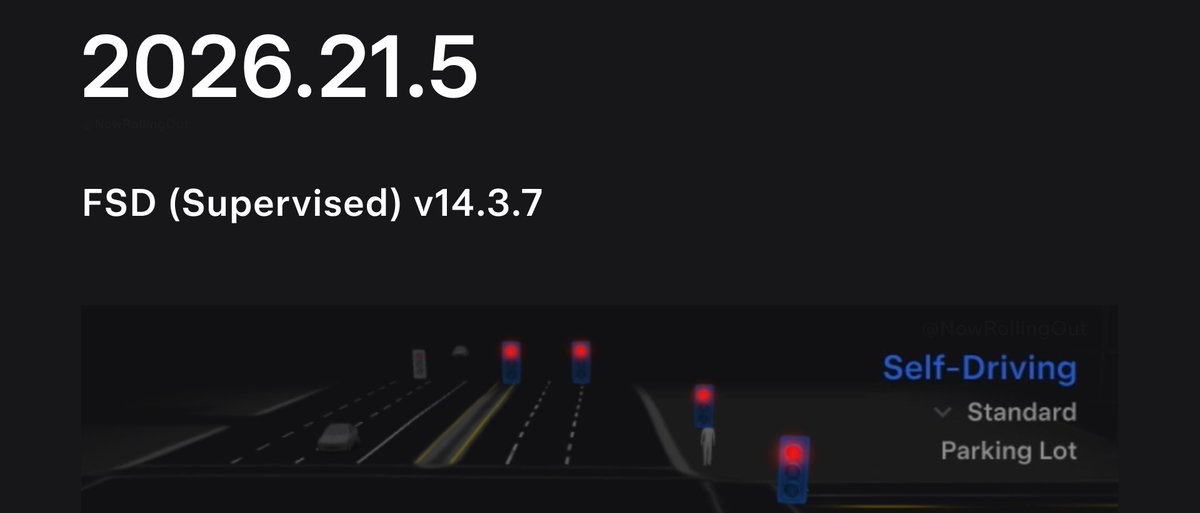
Tesla has pushed a second wave of software update 2026.21.5, carrying Full Self-Driving V14.3.7 to roughly 1,100 additional AI4-equipped vehicles. If you haven't received it yet and you're on Hardware 4, your notification could arrive within hours — here's what the update brings and how to make sure you're first in line.

What's Inside 2026.21.5
The official release notes for 2026.21.5 appear nearly identical to the previous FSD V14.3.6 on the surface, but the under-the-hood changes are meaningful. According to background research from multiple tracking sources, V14.3.7 delivers several concrete improvements over its predecessor:
| Change | Type | Models |
|---|---|---|
| Upgraded RL training stage for FSD neural network | Official | AI4 vehicles |
| Upgraded neural network vision encoder — better low-visibility, 3D geometry, traffic sign recognition | Official | AI4 vehicles |
| MLIR2 AI compiler rewrite — 20% faster reaction time | Official | AI4 vehicles |
| Fixes for brake-stuttering and parking regressions from V14.3.6 | Official | AI4 vehicles |
| Smoother braking and proactive lane selection | Official | AI4 vehicles |
| Reaction to construction worker hand signals | Official | AI4 vehicles |
| Camera Preview feature | Official | AI4 vehicles |
| Significantly updated Actually Smart Summon | Official | AI4 vehicles |
The brake-stuttering fix is arguably the most owner-relevant change. V14.3.6 introduced hesitant, choppy braking behavior that frustrated a number of early adopters — V14.3.7 specifically targets that regression.
Who Gets It — and Who Doesn't
This update is exclusive to AI4 (Hardware 4) vehicles. If you're still on Hardware 3, you will not receive V14.3 in its current form. According to background research, a separate "FSD v14 Lite" build for HW3 is in testing and expected later in 2026, but no release date has been confirmed.
The first wave of 2026.21.5 began rolling out around August 1–3, initially reaching early access members and a small slice of the HW4 fleet. This second wave — flagged by @teslascope and @NowRollingOut within minutes of each other on August 6 — expands that reach by approximately 1,100 vehicles. Broader rollout to the wider North American HW4 fleet is expected to follow as Tesla monitors feedback.
How to Check and Grab the Update Now
Tesla's OTA system delivers updates on its own schedule, but there are a few things you can do to move to the front of the queue:
- Connect to Wi-Fi at home. Updates almost always download over Wi-Fi, not LTE. Plug in and connect before bed — Tesla typically installs overnight when the car is idle and charging.
- Check for updates manually. On your touchscreen, go to Controls → Software. If an update is staged, you'll see a yellow clock icon. Tap Install Now if you don't want to wait for the scheduled window.
- Enable Advanced Updates (if available). In the same Software menu, look for the update preference toggle. Setting it to Advanced opts you into earlier access for future releases.
- Verify your hardware generation. Go to Controls → Software → Additional Vehicle Information. Confirm your Autopilot computer reads "Full Self-Driving Computer (AI4)" or "Hardware 4." If it shows HW3, this wave isn't for you yet.
- Check your version after install. Once updated, your software version should read 2026.21.5 and your FSD version should show V14.3.7 under Controls → Autopilot → Full Self-Driving.
What to Watch After You Update
The two things worth paying close attention to once V14.3.7 is installed: braking smoothness on approach to stops (the regression fix is the headline change here), and Summon behavior if you use it regularly. Tesla made substantial changes to Actually Smart Summon in this build, so your muscle memory from V14.3.6 may need recalibrating.
For owners who use FSD daily, the 20% faster reaction time from the MLIR2 compiler rewrite is the kind of change that's hard to quantify in a parking lot but becomes obvious in complex highway merge situations. Give it a few hundred miles before drawing conclusions.
With the second wave now live and fleet data confirming active deployment, a broader third wave is likely within days. Keep your car on Wi-Fi tonight.
📋 Tracking Tesla software? See every firmware, FSD and app version in one place in our Tesla Software Update Tracker.
Related Gear
Gear up your Tesla with tested, custom-fit BASENOR accessories — shop Tesla accessories →
Sources & reporting notes
The links below identify the material source records used for this report.
- @teslascope on X (2026-08-06T23:40:55.000Z) — Direct source
- @NowRollingOut on X (2026-08-06T23:42:09.000Z) — Direct source
Source links are preserved as published or accessed. See our editorial standards and corrections policy.
The BASENOR Editorial Desk covers Tesla, SpaceX, and related technology, curating reporting from primary sources — official accounts, regulatory filings, and software release data. Every article passes source-record and fact-checking review before publication. About the newsroom.
This report was curated by the BASENOR Editorial Desk from the sources listed above. Read our editorial standards or email editorial@basenor.com to report an error.






