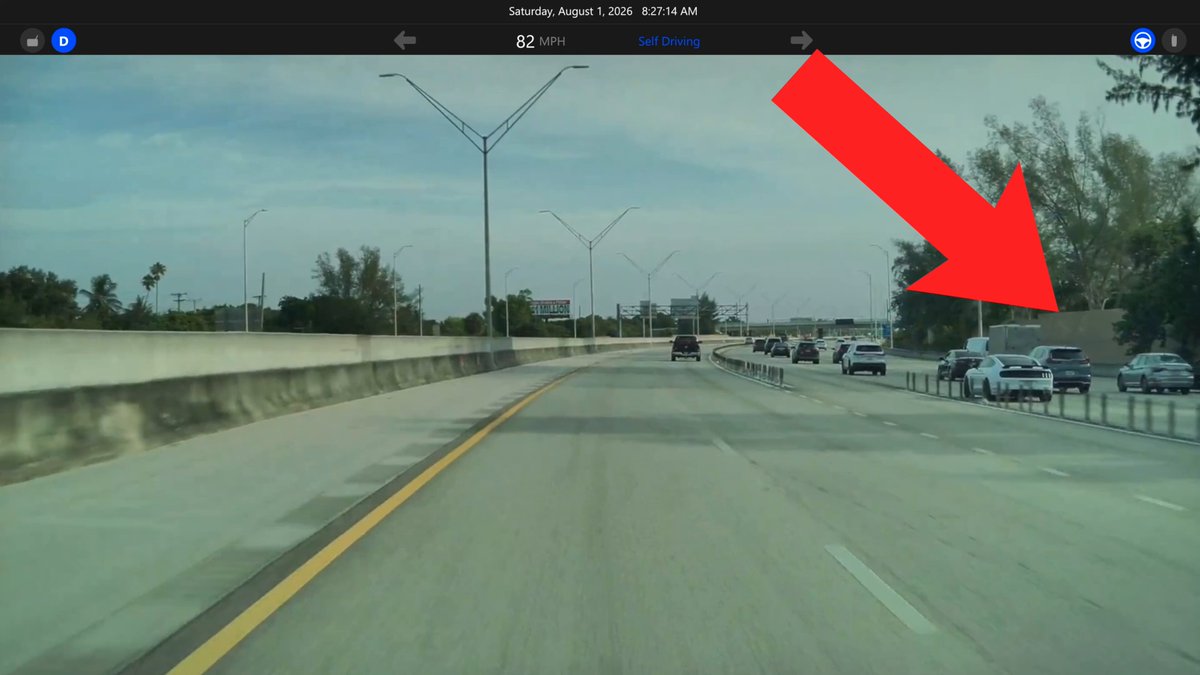
A video shared by Tesla commentator Sawyer Merritt on August 16 shows a Tesla running FSD (Supervised) V14 executing an autonomous collision avoidance maneuver on the highway — and the multi-angle footage, complete with live self-driving data overlays, gives one of the clearest looks yet at how the system responds under real pressure.

What the Footage Shows
The clip, submitted by a follower and posted by Merritt, captures the incident from multiple camera angles while the car's self-driving data stream runs in the upper portion of the frame. That data readout — showing speed, steering input, object detection, and predicted path — is the detail that elevates this beyond a typical dashcam near-miss video. Viewers can watch what the car was "thinking" in the moments before and during the avoidance, not just what it did.
The vehicle was operating on FSD (Supervised), meaning a human driver was present and legally responsible, but the system handled the avoidance autonomously. No disengagement or override is visible in the clip.
Where V14 Stands Right Now
The timing of this clip is worth noting. According to autopilotreview.com, Tesla is currently rolling out FSD v14.3.7 to Hardware 4 (HW4) vehicles, while Hardware 3 (HW3) owners began receiving FSD v14.1 Lite — firmware version 2026.21.6 — in a limited early access wave around August 8–9, with a wider release pending further data collection.
Both sub-versions of V14 include an official change Tesla describes as "Improved Collision Avoidance," which enhances reward predictions to better prevent potential collisions. That language is deliberately technical — reward predictions are a core component of Tesla's neural network training loop, where the system learns to assign value to outcomes and steer toward safer ones. The clip appears to be a direct, real-world expression of that improvement.
Tesla itself signaled confidence in V14's safety performance on August 14, releasing two official FSD (Supervised) demonstration videos showcasing v14.3.7 in action — suggesting the company is actively building a public record of the system's capabilities ahead of broader autonomy milestones.
Why User-Submitted Clips Still Matter
Official Tesla demos are produced under controlled or curated conditions. What makes this footage different is its provenance: an ordinary owner, on an ordinary highway, with no advance notice that the system would need to act. The self-driving data overlay also makes it more analytically useful than a raw dashcam clip — it lets engineers, regulators, and enthusiasts trace the system's decision chain rather than just observe the outcome.
For the broader FSD narrative, real-world avoidance events like this carry weight precisely because they are unscripted. The system either works or it doesn't, and in this instance it did — with enough margin that the footage is worth sharing.
As V14 continues its rollout across the fleet, the accumulation of clips like this one will increasingly shape public and regulatory perception of where Tesla's autonomous stack actually stands. One video doesn't define a safety record, but it adds to a growing body of evidence that V14's collision avoidance improvements are showing up where it counts — on the road, at speed, without a human hand on the wheel.
📋 Tracking Tesla software? See every firmware, FSD and app version in one place in our Tesla Software Update Tracker.
Related Gear
Gear up your Tesla with tested, custom-fit BASENOR accessories — shop Tesla accessories →
Sources & reporting notes
The links below identify the material source records used for this report.
- @SawyerMerritt on X (2026-08-16T23:46:55.000Z) — Direct source
Source links are preserved as published or accessed. See our editorial standards and corrections policy.
The BASENOR Editorial Desk covers Tesla, SpaceX, and related technology, curating reporting from primary sources — official accounts, regulatory filings, and software release data. Every article passes source-record and fact-checking review before publication. About the newsroom.
This report was curated by the BASENOR Editorial Desk from the sources listed above. Read our editorial standards or email editorial@basenor.com to report an error.