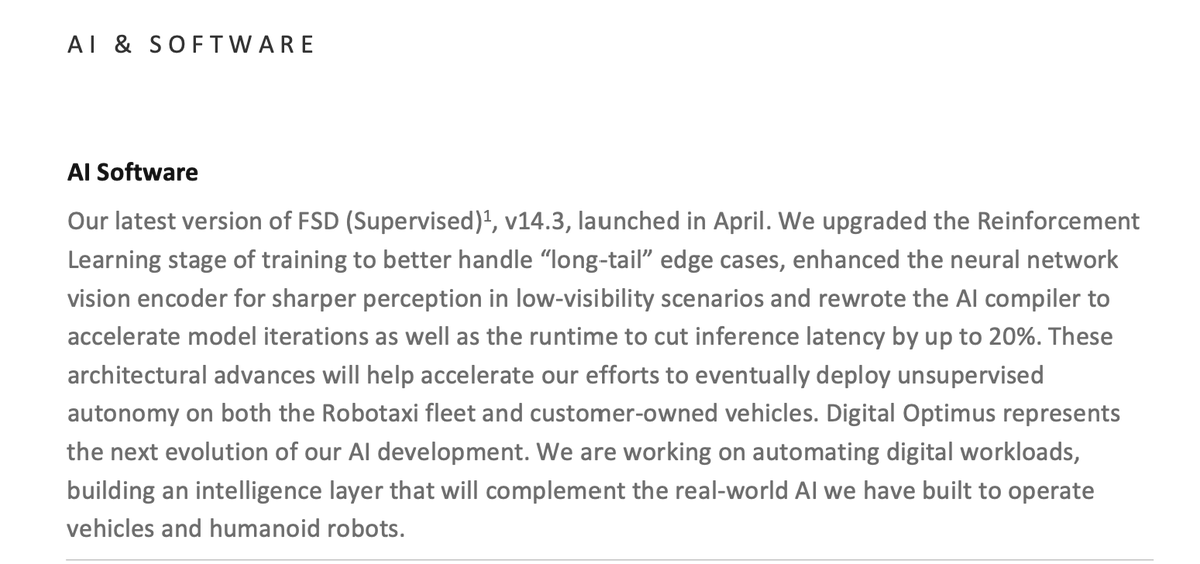
The News: Tesla has officially named its new AI initiative "Digital Optimus" — an intelligence layer designed to automate digital workloads, complementing the real-world AI already powering its vehicles and Optimus robots.
Why It Matters: This isn't just a software feature — it's Tesla's bid to turn every AI4-equipped vehicle and Supercharger station into a distributed computing node capable of running office-level AI tasks.
Source: @SawyerMerritt on X
Tesla's "Digital Optimus" Is the AI Play Nobody Saw Coming — Here's the Full Picture
Tesla has quietly been building something that goes well beyond cars and robots. The company has now put a name to it: Digital Optimus. In Tesla's own words, it represents "the next evolution of our AI development" — an intelligence layer built to automate digital workloads the same way FSD automates driving and Optimus automates physical labor.
The announcement, surfaced by Tesla tracker Sawyer Merritt, is brief but significant. Tesla is explicitly connecting its real-world AI (vehicles, humanoid robots) to a new digital-world counterpart. Think of it as a third pillar in Tesla's AI stack — one that operates in the software domain rather than on roads or factory floors.

📊 Key Figures
| Metric | Detail | Context |
|---|---|---|
| Official Announcement | March 11, 2026 | Announced by Elon Musk; joint Tesla + xAI project |
| Tesla Investment in xAI | $2 billion | Funds the infrastructure backing Digital Optimus |
| Primary Hardware | Tesla AI4 (~$650) | Planned to run on all AI4-equipped Tesla vehicles |
| Supercharger Power Available | ~7 gigawatts | Network capacity earmarked for distributed compute |
| Expected User Rollout | ~September 2026 | Approx. 6 months from March 2026 announcement |
What Exactly Is Digital Optimus?
According to verified reporting, Digital Optimus — also internally referenced as "Macrohard" — is a joint project between Tesla and xAI. Its core function is to observe and replicate how humans interact with computers: processing real-time screen video, keyboard inputs, and mouse actions to automate complex office workflows. Tesla's stated ambition is for it to "emulate the function of entire companies," handling tasks like accounting, HR, and repetitive digital operations.
The architecture is a dual-process system. xAI's Grok serves as the high-level reasoning engine — the "thinking" layer — while a Tesla-built AI agent handles real-time, instinctive execution by processing the last five seconds of screen activity. It's the same System 1 / System 2 cognitive framework Tesla has applied to FSD, now mapped onto digital work.

Your Parked Tesla as a Computing Node
Here's where it gets directly relevant to owners. Digital Optimus is planned to run on all AI4-equipped Tesla vehicles — meaning your parked car could become an active participant in Tesla's distributed AI network. When you're not driving, the vehicle's onboard compute would handle Digital Optimus tasks.
Beyond individual vehicles, Tesla plans to deploy millions of dedicated Digital Optimus units at Supercharger stations, tapping into the network's approximately seven gigawatts of available power for large-scale distributed computing. The Supercharger network, already the world's largest EV charging infrastructure, would double as a compute backbone.
🔭 The BASENOR Take
Timeline: Announced March 11, 2026 — user-facing rollout targeted for ~September 2026
Impact Level: 🔴 High — reshapes what a Tesla vehicle fundamentally is
Confidence: Medium-High — sourced from Tesla's own language; specific rollout details from verified reporting
Tesla has spent years building three things in parallel: a global fleet of AI-trained vehicles, a humanoid robot, and a massive charging infrastructure. Digital Optimus is the moment those three assets converge into something new — a distributed AI compute network with Tesla vehicles and Superchargers as the nodes.
The $2 billion Tesla investment in xAI isn't just a financial bet on Grok. It's the funding mechanism for this exact architecture: Grok as the reasoning layer, Tesla hardware as the execution layer. The fact that Digital Optimus runs primarily on the AI4 chip — priced at approximately $650 — suggests Tesla is deliberately keeping the entry point accessible rather than requiring expensive Nvidia hardware for every task.
For owners, the immediate question is opt-in vs. opt-out. Tesla hasn't detailed whether idle vehicle compute participation will be voluntary, compensated, or automatic. That's the detail to watch as September approaches. If Tesla follows its FSD and Full Self-Driving beta playbook, expect a staged rollout to a small group of early adopters before broader availability.
The bigger picture: Tesla is no longer just an automaker or even a robotics company. Digital Optimus is a direct move into enterprise AI automation — a market currently dominated by software incumbents. Whether it delivers on the ambition of emulating "entire companies" is a long-term question. But the infrastructure to attempt it — the fleet, the chargers, the chips, the Grok integration — is already in place. That's not nothing.
🤖 Tracking Tesla's humanoid robot? See every Optimus production milestone and appearance in our Tesla Optimus Tracker.
Related Gear
Gear up your Tesla with tested, custom-fit BASENOR accessories — shop Tesla accessories →
Sources & reporting notes
The links below identify the material source records used for this report.
- @SawyerMerritt on X (2026-04-22T20:18:22.000Z) — Direct source
- @SawyerMerritt on X (2026-04-22T20:10:39.000Z) — Direct source
Source links are preserved as published or accessed. See our editorial standards and corrections policy.
The BASENOR Editorial Desk covers Tesla, SpaceX, and related technology, curating reporting from primary sources — official accounts, regulatory filings, and software release data. Every article passes source-record and fact-checking review before publication. About the newsroom.
This report was curated by the BASENOR Editorial Desk from the sources listed above. Read our editorial standards or email editorial@basenor.com to report an error.