30-Second Brief
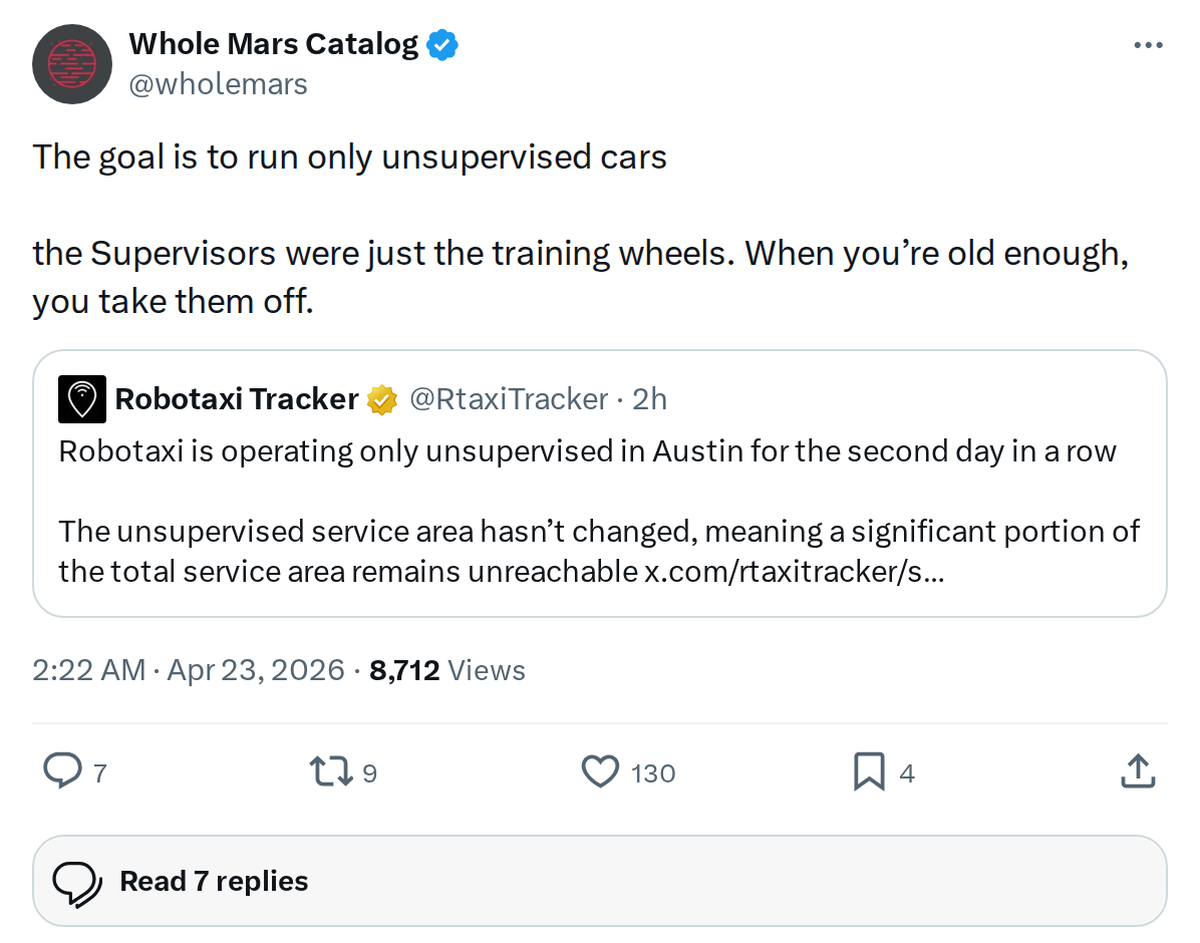
The News: Prominent Tesla commentator Whole Mars Catalog states that Tesla's ultimate goal is a fleet of fully unsupervised autonomous vehicles — and that today's human-supervised FSD is simply a transitional training phase.
Why It Matters: This framing redefines how owners should think about current FSD limitations — not as a ceiling, but as a deliberate, temporary step toward a world where no human needs to be behind the wheel at all.
Source: @wholemars on X
Tesla's Endgame: Fully Unsupervised FSD and No Human Backup
By BASENOR Editorial — April 22, 2026
The phrase 'supervised autonomy' has become so familiar in Tesla circles that it's easy to forget it was never meant to be permanent. A post from Whole Mars Catalog — one of the most closely followed independent Tesla commentators — cuts straight to the point: the Supervisors are training wheels, and Tesla intends to take them off.
That single observation reframes everything about where Tesla's Full Self-Driving program is headed. The human in the driver's seat isn't the product. The human in the driver's seat is the data source — and once the model no longer needs that data, the human becomes optional.

📊 Key Figures
The source tweet does not contain specific numerical data. The significance here is strategic, not statistical.
What 'Unsupervised' Actually Means
There's an important distinction worth spelling out clearly for owners who've been following FSD's evolution:
- Supervised FSD (current state): A licensed driver must be present, attentive, and legally responsible. The car drives; the human monitors and intervenes if needed.
- Unsupervised FSD (the goal): No human required in the vehicle at all. The car is legally and operationally autonomous. This is the Robotaxi model — and Tesla's stated long-term objective.
The 'Supervisor' role that Tesla introduced — human operators who oversee FSD trips and can intervene remotely or in-person — fits squarely in the middle of this spectrum. It's a bridge. It generates real-world edge-case data at scale, without requiring every trip to be fully autonomous from day one. Once the AI has consumed enough of those edge cases, the bridge gets dismantled.
Think of it like this: Tesla isn't building a supervised driving company. It's building an autonomous fleet, and supervision is the methodology it's using to get there safely and legally.
Why This Framing Matters for Current FSD Owners
If you're using FSD today — whether on a Model 3, Model Y, or Cybertruck — you're not just a customer. You're an active participant in the training pipeline that makes unsupervised operation possible. Every intervention you make, every disengagement, every edge case your car encounters and handles correctly is feeding the neural net that eventually replaces the need for you to be there at all.
That's not a criticism. It's actually a compelling reason to stay engaged with the software, keep your dashcam footage clean, and report issues through the in-car feedback system. The data you generate today shapes the autonomy that arrives tomorrow. For more on how FSD is evolving, see our FSD coverage.
The Robotaxi Connection
Tesla's Robotaxi program — built around the purpose-designed Cybercab — only makes economic sense if it runs without human drivers. A supervised Robotaxi is just an expensive taxi. An unsupervised one is a scalable, high-margin revenue stream that operates 24/7 without labor costs.
The Supervisor phase, then, isn't just about safety validation. It's about building the regulatory track record and the AI confidence threshold required to get regulators comfortable with removing the human entirely. Every clean autonomous mile logged by a supervised vehicle is an argument Tesla can take to the NHTSA, the CPUC, and state DMVs around the country.
🔭 The BASENOR Take
Timeline: Unsupervised commercial operation at scale — likely 2027 or beyond, contingent on regulatory approval in key markets.
Impact Level: 🔴 High — This isn't a feature update. It's a fundamental shift in what Tesla is building toward and how every current FSD interaction should be understood.
Confidence: Medium-High. The strategic logic is airtight and consistent with Tesla's stated Robotaxi ambitions. The timeline is the only real variable.
What to Watch: Regulatory milestones in California and Texas. Any Tesla announcement about expanding driverless Robotaxi zones. FSD version releases that reduce required interventions per mile — that metric is the clearest leading indicator of how close Tesla is to pulling the training wheels off.
📰 Deep Dive
The 'training wheels' metaphor from Whole Mars Catalog is more precise than it might appear on first read. Training wheels don't make a bike safer forever — they make learning safer temporarily. Once the rider has internalized balance, the wheels don't just become unnecessary. They become a liability, adding drag and creating a false sense of the bike's actual geometry. The goal was always to remove them.
Tesla's supervised fleet operates on the same logic. The Supervisors — whether remote operators or attentive drivers — are generating the labeled edge-case data that the FSD neural network needs to generalize to truly novel situations. As that dataset grows and the model's confidence on rare scenarios improves, the marginal value of each additional supervised mile decreases. At some point, the cost of maintaining the supervised infrastructure outweighs the data it produces, and the transition to full autonomy becomes not just desirable but economically rational.
The question that remains genuinely open is sequencing: does Tesla pull supervision from its own Robotaxi fleet first, then extend unsupervised capability to customer-owned vehicles? Or does it move both simultaneously? The regulatory path for a commercial driverless fleet is different from — and arguably clearer than — the path for privately owned vehicles operating without oversight. Expect Tesla to achieve commercial unsupervised Robotaxi operation in at least one jurisdiction before broadly enabling the same on customer hardware.
For owners, the practical takeaway is patience paired with participation. The FSD you're using today isn't the finished product. It's the mechanism by which the finished product gets built. And if Whole Mars Catalog's read of Tesla's internal direction is accurate — which, given the source's track record, is a reasonable assumption — the endgame is a version of FSD that doesn't need you watching it at all.
🚕 Following the Robotaxi rollout? See every operating city, launch date and announced market in our Tesla Robotaxi Tracker.
Related Gear
Gear up your Tesla with tested, custom-fit BASENOR accessories — shop Tesla accessories →
Sources & reporting notes
The links below identify the material source records used for this report.
- @wholemars on X (2026-04-22T18:22:21.000Z) — Direct source
Source links are preserved as published or accessed. See our editorial standards and corrections policy.
The BASENOR Editorial Desk covers Tesla, SpaceX, and related technology, curating reporting from primary sources — official accounts, regulatory filings, and software release data. Every article passes source-record and fact-checking review before publication. About the newsroom.
This report was curated by the BASENOR Editorial Desk from the sources listed above. Read our editorial standards or email editorial@basenor.com to report an error.