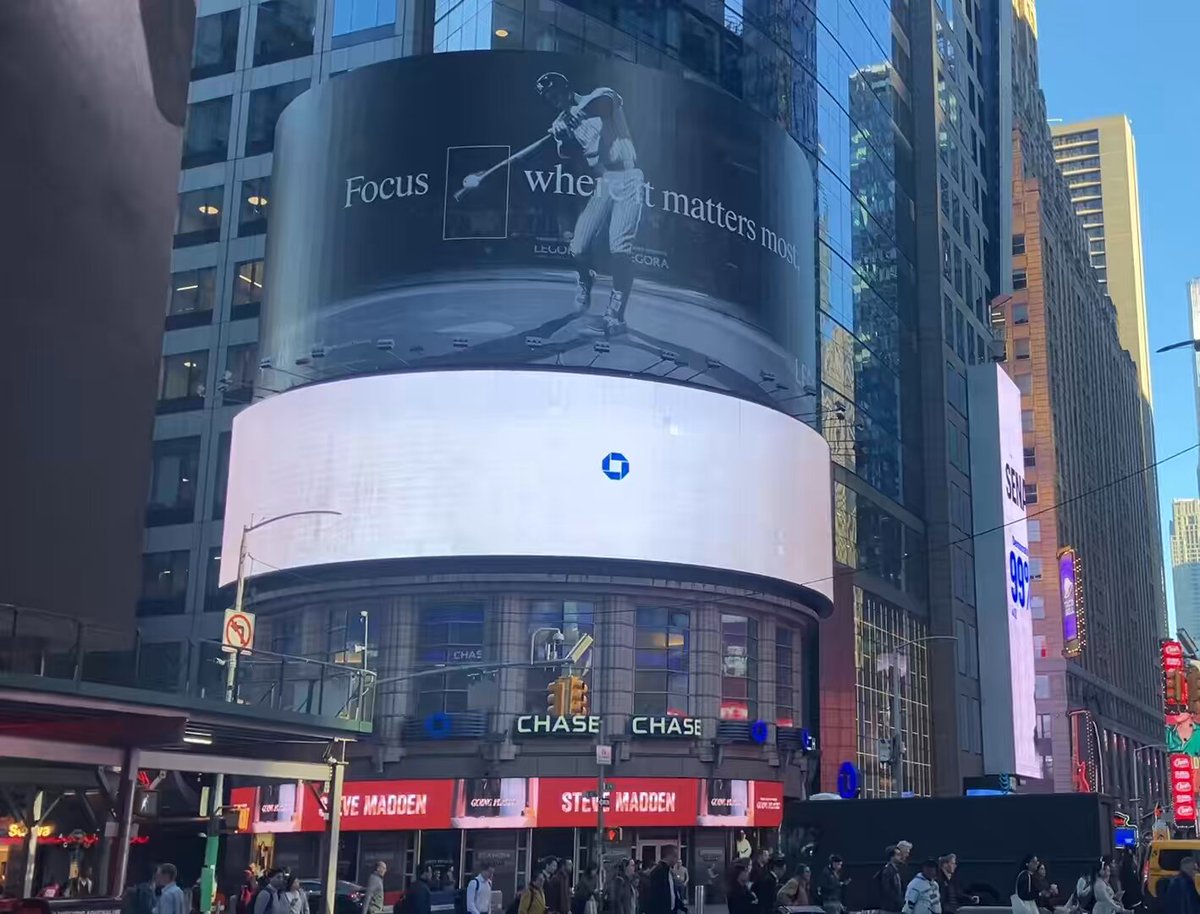
Tesla has taken Full Self-Driving to one of the most-watched advertising surfaces in the world. A new billboard in Times Square — the first Tesla has ever run specifically for FSD — went live this month and is set to run through the end of November. The ad leads with two numbers: 7x safer than a human when engaged and 15+ billion miles driven globally. Here's what those claims mean and why this campaign is worth paying attention to.

Has Tesla ever advertised FSD like this before?
Not in Times Square, no. Tesla has historically relied on word-of-mouth, owner referrals, and Elon Musk's own social media presence to market its products. While the company has placed other ads in Times Square — a Cybertruck towing a Model Y appeared there in April 2024 — a dedicated FSD campaign at this scale is a genuine first. The shift signals that Tesla now views FSD as a product mature enough to market to a mass, non-enthusiast audience.
What does '7x safer than a human' actually mean?
The claim comes from Tesla's own Full Self-Driving (Supervised) Vehicle Safety Report, which compares collision rates when FSD is engaged against national driver averages. Specifically, Tesla reports approximately 7x fewer minor collisions when FSD (Supervised) is active versus a human-driven baseline. The important qualifier is when engaged — meaning the system is actively controlling the vehicle with an attentive driver ready to intervene. It is not a claim about unattended autonomous driving. According to Tesla's safety data, this comparison draws on real-world miles accumulated by customer vehicles from 2020 onward.
How real is the '15+ billion miles' figure?
Very real, and recently crossed. According to Tesla's own tracking data, FSD (Supervised) surpassed 15 billion cumulative miles driven as of late September 2026 — with one reported figure of 15,041,537,027 miles as of September 30, 2026. Tesla notes this total covers supervised miles in customer vehicles and excludes China. The milestone matters because more miles mean more edge-case training data, which directly feeds the neural network improvements that show up in each new FSD version.
Why run this campaign now?
Timing is deliberate. Tesla is in the middle of scaling its Robotaxi ambitions, with Cybercab production and commercial ride-hailing expansion on the near-term roadmap. Building public trust in FSD's safety record before that launch — especially with a non-technical audience who may encounter Cybercabs on city streets — is a logical pre-campaign. Times Square is also a global media amplifier: a billboard there generates earned media well beyond the physical foot traffic that sees it.
Does this change anything for current FSD subscribers?
Not directly — this is a marketing move, not a product update. But it does reflect Tesla's growing confidence in FSD's real-world performance data. If you're already using FSD (Supervised), the billboard is essentially a public-facing version of what Tesla's internal safety reports have been saying for several quarters. For owners who have been on the fence about enabling FSD, the campaign may be worth pairing with a look at Tesla's latest safety report data before deciding.
The billboard runs through the end of November. Whether Tesla extends the campaign or rolls it out to other high-traffic markets will be a telling indicator of how seriously the company is leaning into traditional advertising as it moves FSD — and eventually Robotaxi — into the mainstream.
🚕 Following the Robotaxi rollout? See every operating city, launch date and announced market in our Tesla Robotaxi Tracker.
Related Gear
Gear up your Tesla with tested, custom-fit BASENOR accessories — shop Tesla accessories →
Sources & reporting notes
The links below identify the material source records used for this report.
- @SawyerMerritt on X (2026-11-14T16:36:10.000Z) — Direct source
Source links are preserved as published or accessed. See our editorial standards and corrections policy.
The BASENOR Editorial Desk covers Tesla, SpaceX, and related technology, curating reporting from primary sources — official accounts, regulatory filings, and software release data. Every article passes source-record and fact-checking review before publication. About the newsroom.
This report was curated by the BASENOR Editorial Desk from the sources listed above. Read our editorial standards or email editorial@basenor.com to report an error.