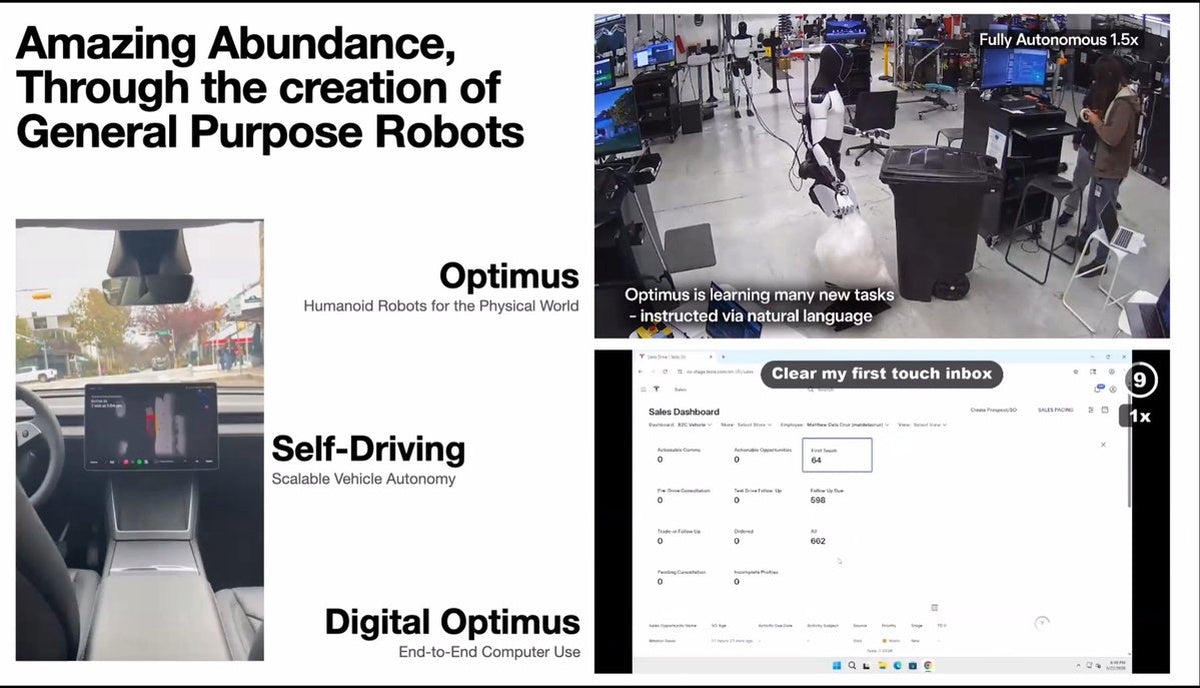
Tesla has restated its core company mission in the clearest terms yet: build a world of "amazing abundance" through general-purpose robots. That framing, circulating again this week, puts three specific programs at the center of everything Tesla does — its Self-Driving platform, the Optimus humanoid robot, and a newer entry called Digital Optimus, designed for computer-based tasks.

This isn't a sudden pivot. According to verified reporting, Tesla formally updated its official mission statement on January 21, 2026 — replacing the company's long-standing sustainable energy focus with the abundance framing. The groundwork was laid even earlier: Tesla's Master Plan Part 4, released in September 2025, explicitly mapped out a future where AI is deeply embedded in the physical world through autonomous driving, humanoid robotics, and energy systems.
What's notable about the three-pillar breakdown is how it separates Tesla's AI ambitions by domain. Self-Driving handles the physical world of transportation. Optimus handles physical labor. Digital Optimus — the least-discussed of the three — targets software and computer interaction, essentially positioning Tesla to compete in the agentic AI space alongside pure software companies. For Tesla owners, the near-term implication is straightforward: every software update, every FSD improvement, every Optimus production milestone feeds directly into this stated mission. These aren't side projects. They are the mission.
🤖 Tracking Tesla's humanoid robot? See every Optimus production milestone and appearance in our Tesla Optimus Tracker.
Related Gear
Gear up your Tesla with tested, custom-fit BASENOR accessories — shop Tesla accessories →
Sources & reporting notes
The links below identify the material source records used for this report.
- @wholemars on X (2026-06-03T22:06:37.000Z) — Direct source
Source links are preserved as published or accessed. See our editorial standards and corrections policy.
The BASENOR Editorial Desk covers Tesla, SpaceX, and related technology, curating reporting from primary sources — official accounts, regulatory filings, and software release data. Every article passes source-record and fact-checking review before publication. About the newsroom.
This report was curated by the BASENOR Editorial Desk from the sources listed above. Read our editorial standards or email editorial@basenor.com to report an error.