📌 UPDATE — July 24, 2026
Investor sentiment around Tesla's growth trajectory is drawing renewed attention following Q2 results. Prominent Tesla commentator @wholemars acknowledged the frustration of long-term investors, noting that 2023 remains the last year of record deliveries — a stark contrast to the 50–100% year-over-year growth rates that once defined the company. Despite that, he pointed to Tesla's $103.7 billion in trailing four-quarter revenue as a sign of underlying scale, projecting the company could surpass $1 trillion in annual revenue within a decade — driven largely by energy, autonomy, and robotics businesses yet to fully mature.


Source: @wholemars on X, July 24, 2026
📌 UPDATE — July 22, 2026
Four key details emerged from Tesla's Q2 earnings call today. Tesla CFO confirmed the company exited Q2 with its largest order backlog since 2023, a strong demand signal heading into H2. On the autonomous side, Tesla is now generating $791 million in Annual Recurring Revenue from self-driving subscriptions — on top of the majority of customers who paid for FSD upfront, making it a meaningful and growing revenue line. Elon Musk added that Tesla expects to announce a location for its Terafab factory soon, the next major Optimus/AI manufacturing hub. Musk also directly addressed the heavy $25B CapEx spend: "This is a massive CapEx year, but I'm confident that all the things we're investing in will generate incredible returns."


📌 UPDATE — July 22, 2026
Tesla CFO Vaibhav Taneja revealed on the Q2 earnings call that the company exited the quarter with its largest order backlog since 2023 — a notable demand signal that wasn't captured in the headline revenue and cash flow figures. Taneja stated Tesla is now "focused on increasing production at all our factories to meet this demand," suggesting the near-term constraint is on the supply side, not demand. This adds important context to the record revenue figure: Tesla may have left meaningful deliveries — and revenue — on the table due to production limits. Watch factory output numbers closely heading into Q3.

📌 UPDATE — July 22, 2026
Tesla's Q2 2026 earnings call is now underway, and early market reaction is negative — shares fell roughly 3% in after-hours trading. The headline miss came from auto gross margins ex-regulatory credits, which came in at 16.3% versus a Wall Street estimate of 18.4%, dragging non-GAAP EPS to $0.33 against a $0.55 consensus estimate. Free cash flow turned negative at -$1.1B, driven by $5.8B in quarterly CapEx — a figure that was widely anticipated given Tesla's stated "largest investment period." On a brighter note, active FSD subscriptions reached 1.48 million, a metric analysts will watch closely as a leading indicator for Tesla's software revenue trajectory.


📌 UPDATE — July 22, 2026
A closer look at Tesla's Q2 GAAP net income of $1.1B reveals that roughly 68% — about $763 million — came from a paper gain on Tesla's SpaceX stake, marked to SPCX's price as of June 30. That gain is already eroding: SPCX has since dropped ~27%, closing at $115 today, meaning most of that reported "profit" has effectively evaporated post-quarter. On the operating side, regulatory credits fell to just $146 million despite record deliveries — yet still represented nearly half of Tesla's $400 million operating income, underscoring how thin the company's core automotive margins remain relative to its $1.4 trillion market cap.


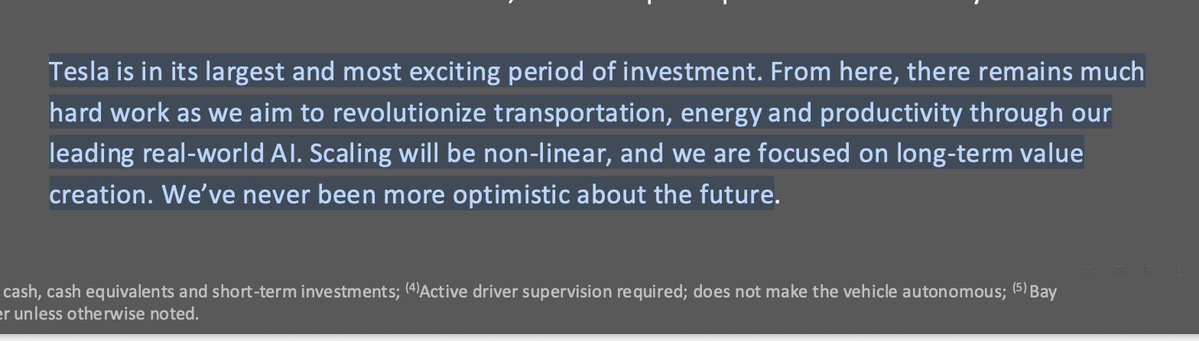
Tesla released its Q2 2026 financial results on July 22, and the headline framing from the company itself is unusually candid: this is its 'largest and most exciting period of investment.' Record deliveries and revenue sit alongside compressed margins and negative free cash flow — a combination that demands context. Here's what the numbers actually say, and what they mean for where Tesla is headed.

1. Revenue Hit a Q2 Record — But Earnings Missed
Tesla posted $28.24 billion in total revenue for Q2 2026, a 26% increase year-over-year and a record for any second quarter in the company's history. That's the good news. The less comfortable number: non-GAAP EPS came in at $0.33, an 18% decline year-over-year, missing analyst expectations. GAAP operating income was $0.4 billion on an operating margin of just 1.4%. Growth is accelerating; profitability per dollar of revenue is not — at least not yet.
2. Deliveries Set a Q2 Record Too
Tesla delivered 480,126 vehicles in Q2 2026, another quarterly record for the period. Production came in at 451,758 vehicles. The delivery figure outpacing production suggests Tesla is drawing down inventory rather than building it — a healthy sign for near-term demand. For owners and prospective buyers, strong delivery numbers typically correlate with stable pricing, since Tesla has less incentive to discount when vehicles are moving.
3. Free Cash Flow Went Negative
Despite record revenue, Tesla reported negative free cash flow of $1.1 billion for the quarter. This is the direct consequence of the investment cycle the company is describing. Capital is being deployed faster than it's being generated from operations right now — which is exactly what heavy infrastructure build-outs look like in their early stages. It's not a distress signal on its own, but it does mean Tesla is currently spending more than it earns on a cash basis.
4. Energy Storage Had Its Best Q2 Ever
Tesla's Energy Generation and Storage segment deployed 13.5 GWh in Q2 2026 — a record for the second quarter and more than 40% growth year-over-year. Megapack demand continues to outpace expectations as grid-scale battery storage becomes a mainstream infrastructure investment globally. This segment is increasingly significant to Tesla's overall revenue mix and, importantly, tends to carry better margins than the automotive business at current scale.
5. Over $25 Billion in CapEx Is Planned for 2026
CFO Vaibhav Taneja has guided for 'over $25 billion of CapEx' in 2026, earmarked for six new factories, AI infrastructure, and Terafab — Tesla's next-generation manufacturing platform for Optimus. This is the concrete backbone of the 'non-linear scaling' language Tesla used in its shareholder communication. Non-linear means the company is betting that large upfront capital commitments will unlock step-change capacity increases, rather than incremental growth. Whether that bet pays off depends on execution timelines that remain, for now, aspirational.
What 'Non-Linear Scaling' Actually Means
Tesla's choice of words in its Q2 communication is deliberate. 'Non-linear scaling' is a signal to investors that they should not extrapolate current margin compression into the future as a permanent state — the argument being that once factories, AI systems, and Optimus production reach critical mass, output and efficiency improve in step-changes rather than gradual increments. It's the same logic that justified Gigafactory Nevada in 2014. Whether the current investment cycle delivers a similar inflection point is the central question hanging over Tesla's next several quarters.
Related Gear
Gear up your Tesla with tested, custom-fit BASENOR accessories — shop Tesla accessories →
Sources & reporting notes
The links below identify the material source records used for this report.
- @SawyerMerritt on X (2026-07-22T20:09:02.000Z) — Direct source
Source links are preserved as published or accessed. See our editorial standards and corrections policy.
The BASENOR Editorial Desk covers Tesla, SpaceX, and related technology, curating reporting from primary sources — official accounts, regulatory filings, and software release data. Every article passes source-record and fact-checking review before publication. About the newsroom.
This report was curated by the BASENOR Editorial Desk from the sources listed above. Read our editorial standards or email editorial@basenor.com to report an error.