📌 UPDATE — April 19, 2026
New details confirm that every unsupervised Model Y currently operating in Austin, Houston, and Dallas is running on AI4 hardware — a notable spec callout from analyst Sawyer Merritt. However, skepticism is mounting over the true scale of the deployment: Electrek's Fred Lambert argues that if Tesla were genuinely ready to scale its robotaxi operation, all vehicles across the entire geo-fenced Austin area would be running unsupervised — not just a handful in select corridors. Lambert draws a direct parallel to Tesla's January "unsupervised" announcement ahead of Q4 earnings, suggesting the current rollout may similarly serve as a stock narrative ahead of a challenging earnings cycle rather than signaling broad commercial readiness. 🔍


📌 UPDATE — April 19, 2026
🔍 A significant new milestone appears to have been captured on video: a Tesla Robotaxi operating unsupervised on a highway — a major step beyond the urban and suburban environments where the fleet has primarily been documented so far. Prominent Tesla watcher Whole Mars Catalog flagged the footage with visible surprise, suggesting this may be an undocumented expansion of the unsupervised FSD operating domain. Highway operation introduces higher speeds and more complex merge/lane-change scenarios, making this a notable leap if confirmed at scale.

Tesla has not officially announced highway capability as part of the current unsupervised Robotaxi rollout. We are monitoring for further confirmation.
30-Second Brief
The News: Tesla's unsupervised autonomous vehicle fleet has already surpassed the total number of vehicles it launched with in supervised mode less than a year ago.
Why It Matters: This milestone signals that Tesla's transition from supervised to fully unsupervised FSD is accelerating faster than most observers anticipated — a critical inflection point for the robotaxi business.
Source: @wholemars on X
Tesla's Unsupervised FSD Fleet Has Already Eclipsed Its Entire Launch-Day Vehicle Count
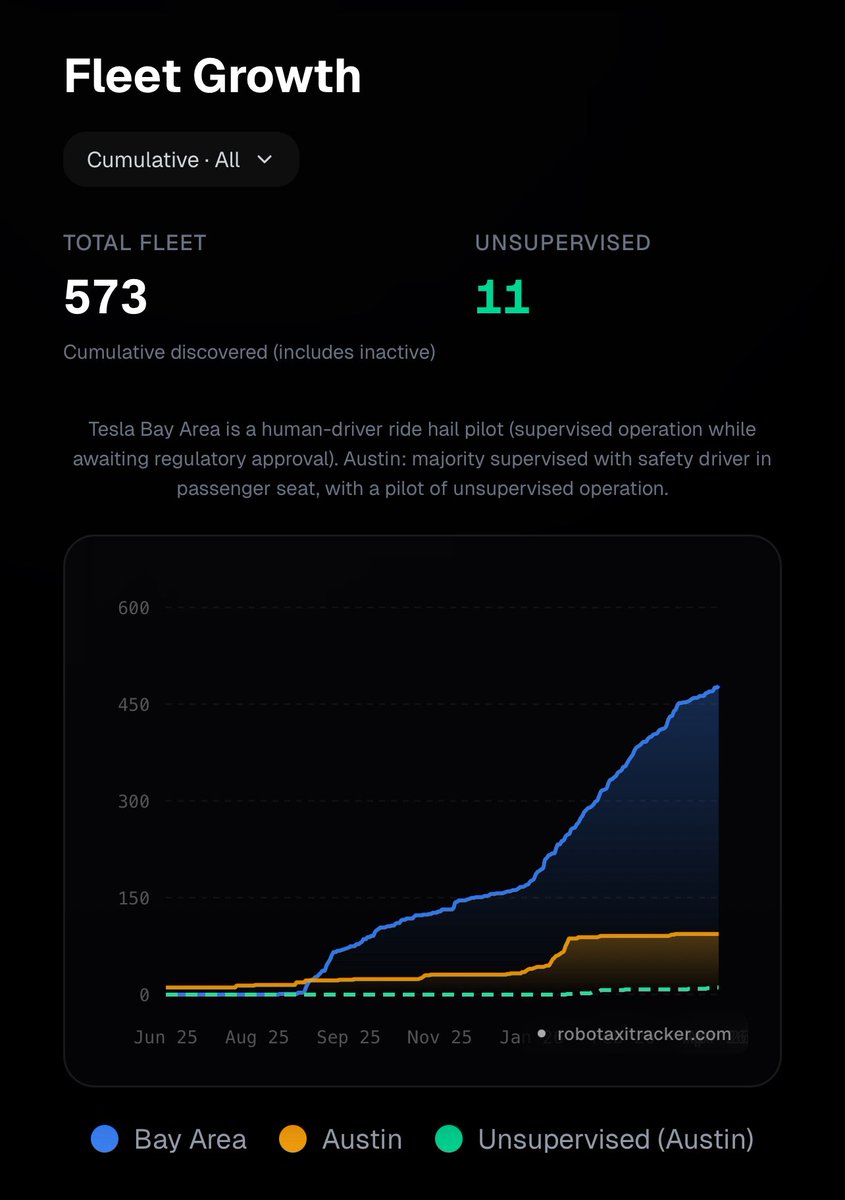
Less than a year ago, Tesla's autonomous driving program launched with just 11 supervised vehicles. Today, the number of vehicles operating in unsupervised mode has already exceeded that original total fleet size. It's a small number in absolute terms — but as a signal of trajectory, it's significant.

📊 Key Figures
| Metric | Value | Context |
|---|---|---|
| Supervised vehicles at launch | 11 | Less than 1 year ago |
| Unsupervised vehicles today | >11 | Exceeds full launch-day fleet |
| Time to cross this threshold | <12 months | Supervised → Unsupervised transition |
Why the Supervised-to-Unsupervised Shift Is the Real Story
The distinction between supervised and unsupervised FSD is not a software checkbox — it's a regulatory, safety, and commercial watershed. Supervised FSD requires a human driver ready to intervene at any moment. Unsupervised means the vehicle is operating as a true robotaxi: no safety driver, no human fallback.
When Tesla launched its initial autonomous program with 11 supervised vehicles, the goal was data collection and validation under controlled conditions. Crossing the threshold where unsupervised vehicles outnumber that original supervised fleet — in under a year — suggests Tesla's internal confidence in the system's reliability has grown substantially. Regulators don't grant unsupervised approvals lightly, and Tesla wouldn't expand that fleet if the safety metrics weren't supporting it.
For context on how Tesla's FSD program has evolved, see our FSD coverage.
🔭 The BASENOR Take
Timeline: Supervised launch → Unsupervised fleet exceeds launch-day total in under 12 months
Impact Level: 🔴 High — This is a commercial and regulatory milestone, not just a technical one
Confidence: High — Based on direct primary source data from @wholemars, consistent with Tesla's publicly stated expansion trajectory
The robotaxi economics only work at scale. Right now, Tesla is still in the early innings — a fleet of a few dozen unsupervised vehicles is a proof-of-concept, not a business. But the rate of change is what matters here. Going from 11 supervised vehicles to a larger unsupervised fleet in under a year is a steep curve. If that trajectory continues, the fleet size that actually moves the needle on Tesla's revenue — hundreds, then thousands of vehicles — could arrive sooner than Wall Street's current models assume.
There's also a competitive signal embedded in this milestone. Every unsupervised mile logged by Tesla's fleet is training data, safety validation, and regulatory precedent. The gap between supervised and unsupervised operation is where most autonomous programs have stalled. Tesla appears to be closing it faster than the industry expected.
For existing Tesla owners, the near-term implication is straightforward: the technology underpinning your FSD subscription is being stress-tested in real-world, driverless conditions at an accelerating pace. The feedback loop between the unsupervised fleet and over-the-air updates to the broader supervised fleet means your car is benefiting from every mile those robotaxis drive — even if you never set foot in one.
🚕 Following the Robotaxi rollout? See every operating city, launch date and announced market in our Tesla Robotaxi Tracker.
Related Gear
Gear up your Tesla with tested, custom-fit BASENOR accessories — shop Tesla accessories →
Sources & reporting notes
The links below identify the material source records used for this report.
- @wholemars on X (2026-04-13T22:10:29.000Z) — Direct source
- @wholemars on X (2026-04-19T03:14:31.000Z) — Direct source
- @SawyerMerritt on X (2026-04-19T18:40:03.000Z) — Direct source
- @FredLambert on X (2026-04-19T18:01:48.000Z) — Direct source
Source links are preserved as published or accessed. See our editorial standards and corrections policy.
The BASENOR Editorial Desk covers Tesla, SpaceX, and related technology, curating reporting from primary sources — official accounts, regulatory filings, and software release data. Every article passes source-record and fact-checking review before publication. About the newsroom.
This report was curated by the BASENOR Editorial Desk from the sources listed above. Read our editorial standards or email editorial@basenor.com to report an error.