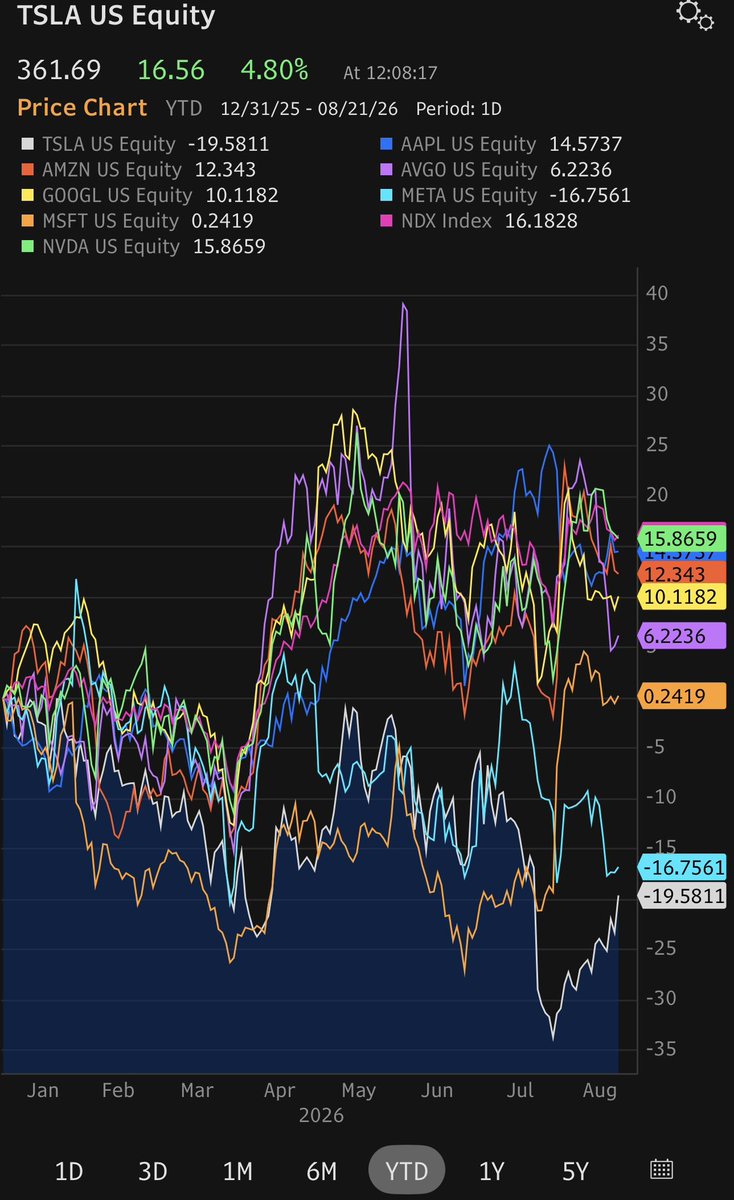
Tesla shareholders have had a rough 2026 on paper. While the broader tech market has powered higher, $TSLA sits at the bottom of the so-called 'Mag 8' leaderboard — the eight mega-cap technology and growth stocks that dominate index weightings. Financial analyst Gary Black flagged the gap on August 21, and the numbers are hard to ignore.

TSLA vs. the Mag 8, Explained in 5 Points
1. Tesla is the only Mag 8 stock down double digits
According to Gary Black's analysis, $TSLA is off roughly 20% year-to-date as of August 21 — the steepest decline in the group by a meaningful margin. Background data from financecharts.com puts the figure at -21.92% as of August 19. Either way, no other Mag 8 name comes close to that drawdown. For context, the Nasdaq-100 has returned approximately +15-16% over the same period, meaning Tesla has underperformed the broad tech index by roughly 35 percentage points.
2. Meta is the only other Mag 8 stock in the red — but for different reasons
$META is the one company keeping Tesla from being completely alone at the bottom, down roughly 15-17% YTD depending on the date measured. But Black notes Meta's headwind is specific: a $1.4 trillion consumer liability trial got underway this week, which he describes as an existential threat to its core business. Tesla's underperformance, by contrast, doesn't carry a single obvious courtroom catalyst — making the comparison instructive but imperfect.
3. The rest of the group is solidly positive
While Tesla and Meta are in the red, the remaining Mag 8 components are all in positive territory for 2026. The NDX overall is up around 16% YTD according to Black, driven by the stronger performers in the basket. That divergence is what makes Tesla's position notable — it isn't a case of the whole group struggling. The equal-weighted Roundhill Magnificent Seven ETF (MAGS) was up approximately 4.82% as of mid-August, according to financecharts.com, suggesting Tesla's drag has been significant enough to pull the basket well below the cap-weighted index.
4. Tesla is dragging the equal-weighted Mag 7 ETF
The MAGS ETF gives each of the Magnificent Seven an equal slice of the portfolio, which means Tesla's -20% return has real weight on the fund's overall performance. The roughly 5% YTD gain in MAGS versus the NDX's ~16% gain illustrates just how much the laggards — Tesla chief among them — have cost investors who chose equal-weighted exposure over cap-weighted index funds. It's a concrete way to see the cost of the underperformance beyond just the stock chart.
5. The gap to the index is historically wide
Tesla was one of the defining stories of the 2020-2021 bull run and has traded at premium multiples ever since on the expectation of future growth. A ~36-point gap to the NDX in a single year is a significant reset of that premium. Whether that gap reflects a genuine reassessment of Tesla's near-term business trajectory — deliveries, margins, the robotaxi timeline — or a temporary dislocation is the central question for TSLA holders heading into the back half of 2026.
What This Means for Tesla Owners Who Also Hold Shares
Stock performance doesn't change how your car drives, but it does reflect market sentiment about the company's near-term execution. The underperformance relative to peers will likely keep analyst scrutiny elevated heading into Q3 earnings. If Tesla's delivery numbers or margin profile surprises to the upside, the gap to the Mag 8 median could close quickly — the stock has historically been volatile in both directions. For now, Black's data puts the magnitude of the divergence in plain sight.
Related Gear
Gear up your Tesla with tested, custom-fit BASENOR accessories — shop Tesla accessories →
Sources & reporting notes
The links below identify the material source records used for this report.
- @garyblack00 on X (2026-08-21T16:48:54.000Z) — Direct source
Source links are preserved as published or accessed. See our editorial standards and corrections policy.
The BASENOR Editorial Desk covers Tesla, SpaceX, and related technology, curating reporting from primary sources — official accounts, regulatory filings, and software release data. Every article passes source-record and fact-checking review before publication. About the newsroom.
This report was curated by the BASENOR Editorial Desk from the sources listed above. Read our editorial standards or email editorial@basenor.com to report an error.