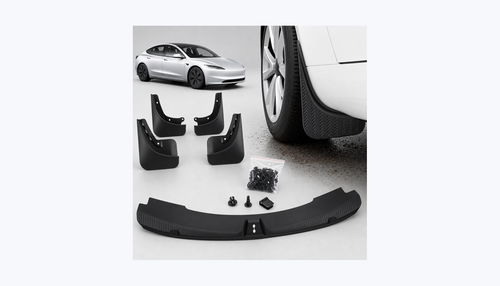
A Trunk Sill Guard That Follows Every Millimeter of the Edge
Universal sill guards are rectangles. Tesla's sill isn't — a raised latch in the center, two corner sweeps at different angles. We scanned the whole thing and molded one continuous TPE guard that matches every surface of it.
The Problem
Your Trunk Sill Is Getting Scratched by Your Groceries
Open the trunk of a 2024 Tesla Model 3 Highland after three months of ownership. Look at the painted lip where the trunk opening meets the bumper. It's already marked — scratches from suitcase wheels, scuffs from grocery bags, dings from anything with a hard edge that brushed the sill as it went in or out. The paint there is thin, the angle is exposed, and every loading trip adds another mark.
Aftermarket sill guards exist, but almost all of them are rectangular rubber or stainless strips. A rectangle covers the center of the sill fine. It gaps at the corners where the sill sweeps downward. It bridges over the raised latch housing (which sticks up 8mm above the surrounding sill) instead of wrapping it. The rectangle is a shape that doesn't match any Tesla has ever built — so the guard always leaves part of the sill exposed.
We traced the factory sill's full perimeter. It's not a rectangle, not a trapezoid, not a simple arc. It has three zones that meet at two crease lines, with an 8mm tall latch housing sitting in the middle zone. A guard that works has to be the same shape as the thing it covers — not a shape that's easier to manufacture.
So we scoped this as a one-piece problem: design a continuous guard that follows every surface of the factory sill in a single unbroken ribbon. No seams. No gaps at the corners. No bridging over the latch. Whatever TPE strip came out of the mold had to be the exact inverse of the sill from end to end.
Precision First
We Scanned the Entire Rear Opening in One Pass
The trunk sill on a 2024 Model 3 Highland has three continuous zones: a mostly-flat center section with an 8mm raised latch housing and rectangular striker hole, and two wings that sweep downward at roughly 12° to meet the rear bumper corners. Each transition between zones happens at a defined crease line. Miss any crease by 3mm and the guard either lifts off the surface or buckles at that point.
We brought a Scantech handheld structured-light scanner into a 2024 Model 3 Highland, opened the trunk, and captured the full rear opening at 0.02mm resolution in a single continuous scan. The scan covered the center sill, the latch housing, both corner wings, and the underlying bumper profile for about 40mm below the sill edge. Ten minutes of scanning produced the master geometry that defined the guard's inner contour from end to end.


The scan confirmed the non-symmetric part of the geometry: the left wing drops at 12.4°, the right wing at 12.1°. Tesla's own mold isn't perfectly symmetric — there's a 0.3° draft bias that no universal-fit guard accounts for. Our guard does, because the inner surface was built from the scan, not from an assumption about what the sill looks like.
The Concept
One Continuous Ribbon, Three Geometries, Zero Seams
The guard is a single molded TPE part that runs unbroken from the left bumper corner, across the center sill with a precise cutout around the factory latch striker, to the right bumper corner. Every zone change is built into the one-piece geometry — the center-to-left transition at 12.4° and the center-to-right at 12.1° are molded right into the shape. Install it and it reads as a continuous piece of factory trim, because that's what it is.
Latch Cutout Molded In
A precise rectangular opening wraps around the factory striker housing. The latch mechanism works exactly as it did from the factory — no interference, no modification.
Asymmetric Corner Sweeps
The left and right ends curve downward at the correct (non-symmetric) factory angles. The guard sits flush at the corners instead of lifting.
Full-Width Coverage
One continuous part covers every millimeter of the sill's top edge. Suitcase wheels, grocery bags, and cooler bottoms scrape the TPE instead of the paint.
Anti-Slip Top Surface
A molded rib pattern on the top face grips luggage instead of letting it slide across. Less scraping, less paint transfer, less mark-leaving on whatever's beneath the guard.
Trial & Error
Four Iterations on the Inner Contour
The individual cross-section geometries were straightforward once we had the scan. The hard part was the inner contour — the surface that sits against the factory sill. If the inner surface is 0.5mm off in any direction, the guard sits proud of the sill in one zone and compresses against it in another, which creates visible puckering. Every iteration was about getting that inner surface exactly right.
Side note on the prototypes: the guard is roughly 1.2 meters end-to-end, which is longer than our Bambu Lab print bed. Prototype runs were printed in segments (CA384-1, CA384-2) for 3D testing, but the production mold produces a single continuous piece — the part you actually install is one TPE ribbon, not a multi-part set.

Gen 1 — Scan-Exact Inner Contour
Printed at exact scan dimensions. Inner surface matched the factory sill perfectly on the jig. On the actual car, the guard lifted 1.2mm at the right corner because we hadn't compensated for TPE's 2.1% injection shrinkage.
Gen 2 — Uniform Shrinkage Compensation
Scaled the inner surface up 2.1%. Right corner seated. Center zone now too tight — it puckered visibly around the latch cutout. TPE shrinkage isn't uniform; thinner sections shrink more than thicker ones.
Gen 3 — Non-Uniform Compensation Map
Applied different scale factors per cross-section based on wall thickness. Center (thick) +1.7%, wings (thinner) +2.4%. Visual puckering disappeared. Test-fit clean across every zone.
Gen 4 — Production Geometry
Final production mold with the non-uniform compensation baked in. First-shot production parts seated flush from corner to corner on five consecutive test vehicles. Zero lift, zero pucker, zero gap at the corners.
Verification
Caliper-Verified, Luggage-Tested
A sill guard has two failure modes: it doesn't fit (gaps or puckering), or it fits but doesn't protect (slides, lifts, or peels when something heavy drags across). Every prototype batch ran through both tests: caliper measurement on twelve points along the guard's length, then a suitcase test — drag a loaded 30kg suitcase across the installed guard 50 times and check for any displacement, lift, or wear on the adhesive underneath.


The test that told us we were done: load the trunk with actual groceries, close the door, drive, come back the next day, unload. Look at the sill. No new scratches. Guard still flush where we put it. Nothing to re-seat. That's when we shipped.
Materials
Why TPE, Not Stainless Steel or Rubber
| Component | Material | Why |
|---|---|---|
| Guard body | Injection-molded TPE (thermoplastic elastomer) | Absorbs impact instead of transmitting it to the paint. Flexes to match the corner sweeps without cracking. Doesn't scratch the paint beneath when a suitcase drags. |
| Top anti-slip ribs | Integrated molded pattern | One-piece with the shell. Grips luggage bottoms at roughly 0.4 coefficient of friction — enough to reduce sliding, not so much that bags snag. |
| Underside adhesive | Automotive-grade Velcro-style tape | Secure attachment that doesn't damage factory paint. Removable any time without residue. Won't soften in summer heat like 3M acrylic tape. |
| Finish | Matte black, UV-stabilized | Doesn't fade after a summer. Matches the factory rear bumper matte finish — the guard reads as OEM trim, not aftermarket. |
Stainless steel was tempting (premium look, durable), but rejected: a metal guard scratches the paint under it if anything slides between the guard and the sill, and the weight stresses the adhesive over time. Rubber works but looks cheap after three months. TPE was the only material that handles the physics (impact, slide, temperature) while also looking like factory trim.
The Result
What You Actually Get
| Feature | What It Means for You |
|---|---|
| Single continuous guard | One piece, end to end. No seams, no multi-part alignment, no gaps between segments. |
| 3D-scan-derived inner contour | Matches the factory sill's full geometry. Seats flush through center, both corners, and the latch housing. |
| Latch cutout molded in | Wraps around the factory striker. No interference with how the trunk closes. |
| Anti-slip rib top surface | Suitcases and grocery bags grip the guard instead of sliding and scraping the sill beneath. |
| Automotive Velcro install | Secure without residue. Removable any time. Doesn't soften in summer heat. |
| Soft-flex TPE | Absorbs impact from whatever you load. Doesn't crack. Doesn't scratch factory paint. |
| Matte finish matching factory bumper | Reads as OEM trim when installed. |
| Fits 2024+ Model 3 Highland | Scan-derived for this specific rear-opening geometry. Not for older Model 3 or other vehicles. |
Common Questions
Frequently Asked Questions
Is this one piece or multiple pieces?
Does it fit the 2020-2023 Model 3 or the Model Y?
Does it interfere with the trunk latching?
How is it attached? Will it damage my paint?
Will it hold up to heavy loads?
How long does installation take?
Will it lift or peel at the corners over time?
Can I remove it if I sell the car?
Ready to Stop Scratching Your Trunk Sill?
One Continuous Guard, Every Angle Matched
Single-piece scan-derived TPE. Latch cutout molded in. Asymmetric corner sweeps. Automotive Velcro install. For Model 3 Highland owners tired of seeing wheel marks on the painted lip of their trunk opening.
Shop NowFits 2024+ Tesla Model 3 Highland · Free US Shipping