Boring Company Confirms Orlando Partnership for Universal Parks Loop
⚡ 30-Second Brief
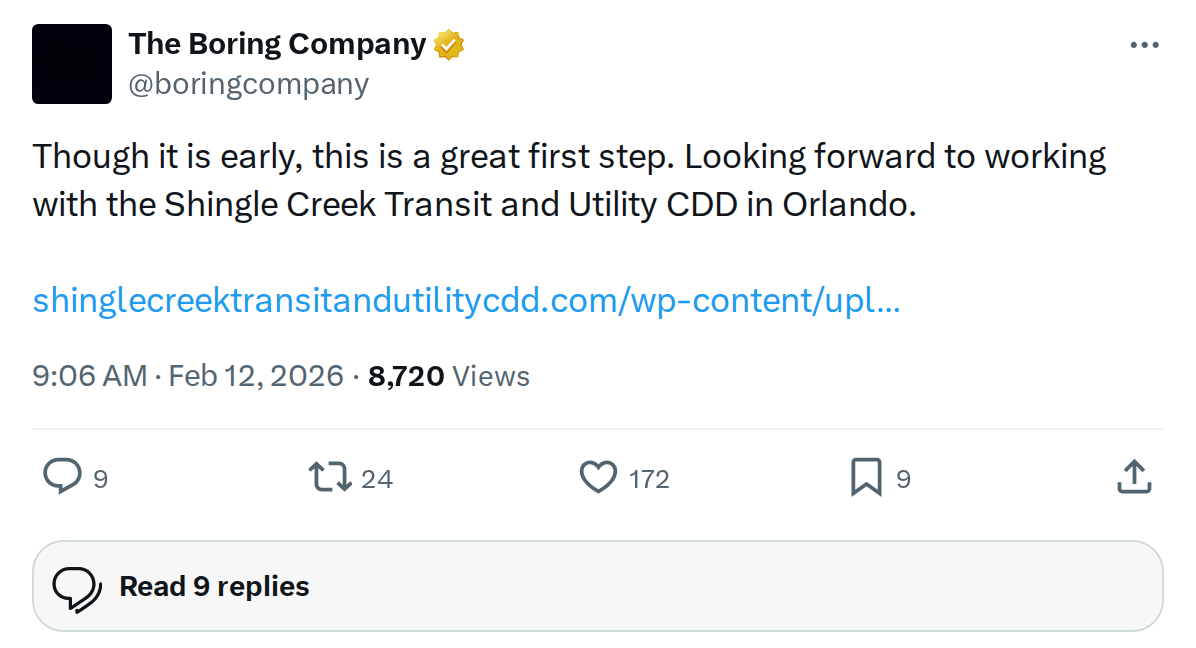
The News: The Boring Company has officially confirmed its partnership with the Shingle Creek Transit and Utility Community Development District in Orlando to develop underground transportation infrastructure.
Why It Matters: This marks The Boring Company's first confirmed Florida project and could bring Vegas Loop-style underground transit to one of America's busiest tourism corridors, potentially easing traffic between Universal's parks and Epic Universe.
Source: @boringcompany on X

The Boring Company dropped a significant announcement Wednesday evening, confirming negotiations with Orlando's Shingle Creek Transit and Utility Community Development District (CDD) for an underground transportation system. While Elon Musk's tunneling venture describes this as "a great first step," the implications for Central Florida's tourism infrastructure are substantial.
This partnership follows a competitive selection process where The Boring Company's proposal beat out two other respondents to the District's Request for Qualifications. According to the CDD Board's decision on February 11, The Boring Company's approach "best addressed the District's request for an innovative, future-ready, point-to-point solution."
📊 Key Figures
| Metric | Details | Context |
|---|---|---|
| District Size | 722.180 acres | Encompasses Epic Universe and surrounding development zone |
| Proposals Received | 3 respondents | Boring Company selected as best fit |
| Potential Route Length | 4-5 miles (phased) | Based on previous Universal RFQ documents outlining three-phase expansion |
| CDD Established | October 16, 2023 | Orange County Ordinance No. 2023-40 |
🔭 The BASENOR Take
Timeline: Early negotiations stage. Contract requires final Board approval after operational and financial feasibility studies.
Impact Level: 🔥🔥🔥 HIGH — First Boring Company project in Florida's tourism corridor. Success could accelerate similar projects in Tampa, Miami, and other congested metro areas.
Confidence: 85% this moves to construction phase. The CDD has legal authority to levy assessments for funding, Universal has clear traffic pain points, and Vegas Loop provides proven operational model.
What Makes This Different
Unlike speculative Hyperloop concepts or vague "future mobility" partnerships, this announcement comes with institutional backing. The Shingle Creek Transit and Utility CDD is an independent special district established by Orange County specifically to handle infrastructure for the Epic Universe development area. It has legal authority to impose assessments on properties within its boundaries to fund construction and operations.
Translation: There's a real funding mechanism, not just hopeful venture capital.
The project scope appears modeled on The Boring Company's operational Vegas Loop system, which uses Tesla vehicles in underground tunnels to transport passengers between stations. Previous bid documents from Universal's Request for Qualifications outlined a three-phase approach:
- Phase 1: Epic Universe and nearby hotels
- Phase 2: Extension to Universal Studios, CityWalk, and International Drive corridor
- Phase 3: Hard Rock Hotel and surrounding retail areas
If fully realized, this would create an underground bypass for one of Orlando's most congested tourism zones, potentially moving thousands of visitors per hour without adding surface traffic.
The Tesla Owner Angle
While this isn't a direct Tesla product announcement, the connection matters for owners. The Boring Company's Loop systems exclusively use Tesla vehicles — predominantly Model 3s and Model Xs in Las Vegas. If Orlando moves forward, it would represent the largest East Coast deployment of Tesla vehicles in fixed-route service.
More broadly, projects like this validate the "Tesla as platform" thesis. Your Model 3 isn't just a consumer product; variations of it are becoming public infrastructure in major cities. That has implications for resale value, parts availability, and the long-term viability of Tesla's service network in markets where Loop systems operate.
What Happens Next
According to the District's announcement, staff will now collaborate with local stakeholders to evaluate operational and financial feasibility before bringing a final contract to the Board for approval. The Boring Company's tweet notably says "looking forward to working with" the CDD — future tense, suggesting contracts haven't been signed yet.
Expect several months of engineering studies, environmental reviews, and financial modeling before groundbreaking. The Vegas Loop took approximately 18 months from announcement to first operational tunnel, though that was a smaller initial scope.
For Tesla owners in Florida, this is a watch-and-wait situation. If construction begins in 2026, operational service likely wouldn't start until 2027-2028 at the earliest.
📰 Deep Dive
The strategic timing of this partnership is worth examining. Universal's Epic Universe is scheduled to open in 2025, representing the company's largest single park investment in decades. But the location — south of Sand Lake Road, several miles from Universal's existing parks — creates a transportation problem. Shuttling guests between Epic Universe and the original Universal Studios/Islands of Adventure complex via surface roads means navigating International Drive, one of Orlando's most congested corridors.
The Boring Company's proposal solves this by going under the congestion entirely. In Las Vegas, the Convention Center Loop moves passengers at approximately 40 mph through 1.7 miles of tunnel. Applied to Orlando's 4-5 mile potential route, that's roughly 6-8 minute travel times between parks — competitive with surface transit even in ideal traffic conditions, and dramatically faster during peak hours.
The financial model is likely similar to Vegas: The Boring Company builds and operates the system, the District provides right-of-way access and potentially some infrastructure funding via property assessments. Unlike traditional public transit that requires ongoing operational subsidies, Loop systems generate revenue through fares, potentially making them more attractive to fiscally conservative local governments.
For the broader Tesla ecosystem, this represents another proof point for electric vehicles in high-utilization commercial service. The Vegas Loop vehicles reportedly accumulate miles at rates far exceeding typical consumer use, yet maintain operational availability above 95%. If Orlando's system reaches similar scale, it becomes a real-world durability demonstration that benefits all Tesla owners through proven reliability data.
The "early" qualifier in The Boring Company's tweet is important. This is a first step, not a done deal. But between the formal CDD structure, Universal's clear need, and The Boring Company's proven Vegas model, the pieces are aligned in a way that previous Boring Company announcements (looking at you, Chicago Express Loop) never were. Orlando's tourism economy runs on moving people efficiently. If underground Teslas can do that faster and cheaper than buses and monorails, this project has legs.
Sources & reporting notes
The links below identify the material source records used for this report.
- @boringcompany on X (2026-02-12T01:06:14.000Z) — Direct source
Source links are preserved as published or accessed. See our editorial standards and corrections policy.
The BASENOR Editorial Desk covers Tesla, SpaceX, and related technology, curating reporting from primary sources — official accounts, regulatory filings, and software release data. Every article passes source-record and fact-checking review before publication. About the newsroom.
This report was curated by the BASENOR Editorial Desk from the sources listed above. Read our editorial standards or email editorial@basenor.com to report an error.