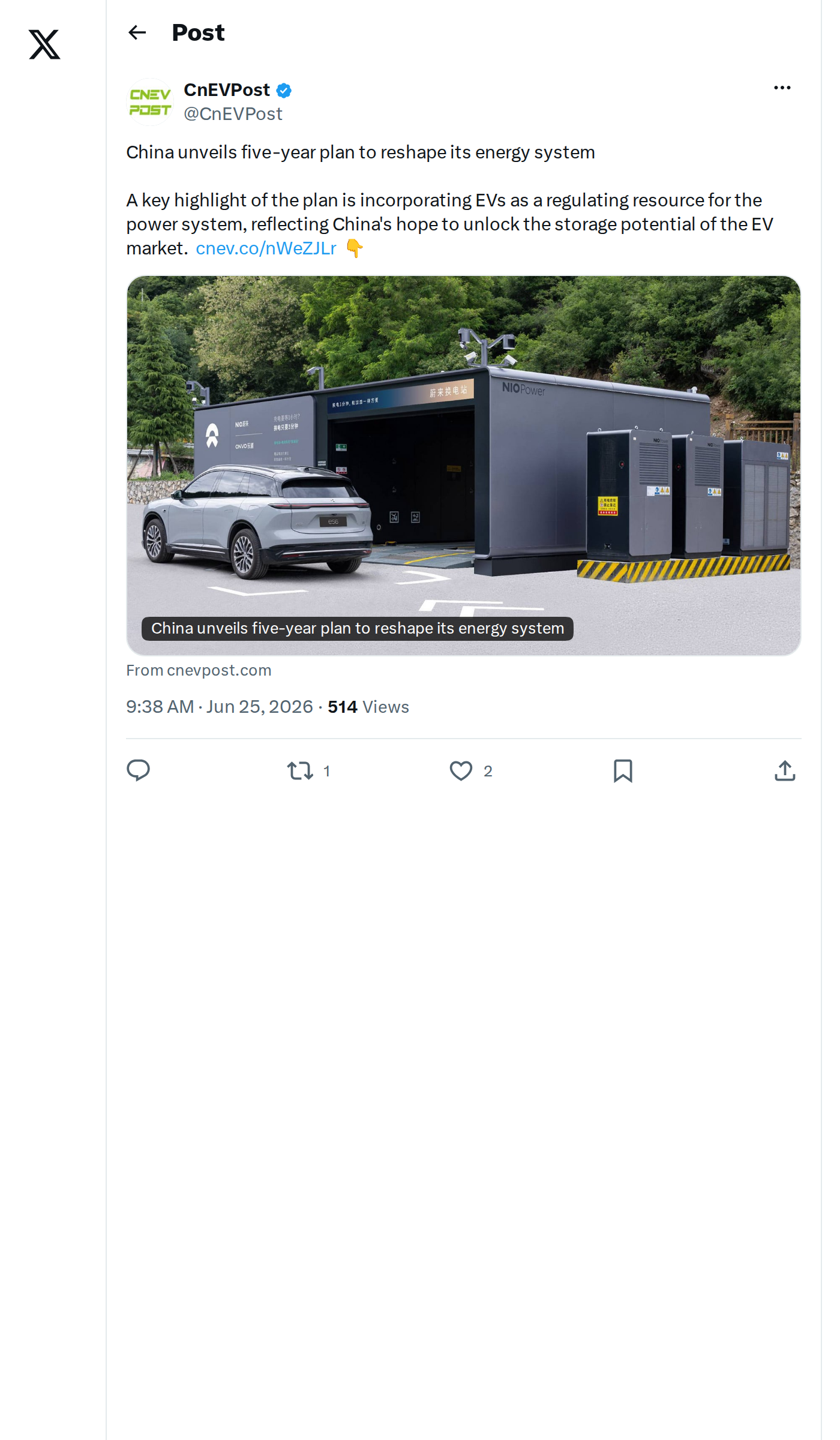
China has unveiled its 15th Five-Year Plan (2026-2030), and buried inside one of the world's most consequential policy documents is a signal that could reshape how every electric vehicle on the planet is valued — not just as transportation, but as a distributed energy asset. The plan formally designates EVs as a regulating resource for the national power grid, a move that unlocks the latent storage potential of China's massive and still-growing EV fleet.

What the Plan Actually Says
The 15th Five-Year Plan was formally adopted by China's National People's Congress on March 13, 2026. At its core, it calls for the development of a "new energy system that is clean, low-carbon, safe and efficient" by 2030 — and EVs are now a structural component of that system, not just a beneficiary of it.
The plan sets two headline energy targets: cut carbon intensity by 17% over the five-year period, and raise the share of non-fossil energy in total consumption to 25% by 2030, up from approximately 21.7% in 2025. Hitting those numbers requires more than building solar farms and wind turbines — it requires managing the intermittency problem that renewable energy creates. That's where EVs come in.
By designating EV batteries as grid-regulating resources, China is essentially treating millions of parked vehicles as a distributed network of storage units that can absorb excess generation during off-peak hours and feed power back during demand spikes. The technical term is vehicle-to-grid (V2G), and China is now embedding it into national policy rather than leaving it to pilot programs.
The Strategic Logic
China's EV market is the largest in the world by volume, which means the storage potential sitting in driveways and parking lots across the country is genuinely significant at a grid scale. According to the plan's framing, this isn't a side benefit — it's a deliberate design choice. The 15th FYP explicitly positions connected and intelligent electric vehicles as a strategic industry, emphasizing the integration of vehicles, infrastructure, and cloud platforms.
That cloud-platform integration piece matters. For V2G to function as a real grid-balancing tool rather than a marketing concept, you need bidirectional charging hardware, real-time communication between vehicles and grid operators, and software capable of aggregating millions of individual decisions into coordinated grid responses. China is signaling it intends to build all three layers simultaneously.
The infrastructure commitment backs this up. The plan targets over 10,000 km of low- or zero-carbon transport corridors — road and waterway — with associated charging, refueling, and logistics facilities. That's not just range-anxiety mitigation; it's the physical backbone a V2G network requires.
What This Means for the Global EV Industry
China's 15th Five-Year Plan — Key Energy Targets
| Metric | Target | Baseline |
|---|---|---|
| Non-fossil energy share | 25% by 2030 | ~21.7% (2025) |
| Carbon intensity reduction | -17% (2026–2030) | 2025 baseline |
| Low/zero-carbon transport corridors | >10,000 km | — |
| EVs as grid resource | Formal policy designation | Pilot programs only |
For automakers operating in China — Tesla included — this policy shift carries real product implications. Vehicles sold into the Chinese market will increasingly be evaluated on their V2G capability, not just their range or performance. Tesla's current China lineup does not support bidirectional charging, a gap that has drawn attention as competitors like BYD and NIO have moved faster on V2G-compatible hardware.
The 15th FYP doesn't mandate V2G for all EVs immediately, but by embedding it in national energy strategy, Beijing is creating the regulatory and infrastructure conditions that will make bidirectional capability a competitive necessity rather than a premium feature. Automakers that treat V2G as optional are reading the policy direction incorrectly.
Beyond China's borders, this plan carries weight as a template. When the world's largest EV market formally integrates its vehicle fleet into grid management, it accelerates the global conversation about whether EVs should be designed primarily as transportation or as mobile energy infrastructure. That's a question every major automaker — and every energy regulator — will be forced to answer over the next five years.
Sources & reporting notes
The links below identify the material source records used for this report.
- @CnEVPost on X (2026-06-25T09:38:50.000Z) — Direct source
Source links are preserved as published or accessed. See our editorial standards and corrections policy.
The BASENOR Editorial Desk covers Tesla, SpaceX, and related technology, curating reporting from primary sources — official accounts, regulatory filings, and software release data. Every article passes source-record and fact-checking review before publication. About the newsroom.
This report was curated by the BASENOR Editorial Desk from the sources listed above. Read our editorial standards or email editorial@basenor.com to report an error.