📌 UPDATE — July 21, 2026
Elon Musk confirmed this morning that Cybercab passengers will be able to watch 4K streaming video during rides — a direct nod to the Starlink connectivity already confirmed via showroom infographics. The announcement, made on X, underscores that the onboard internet isn't just for navigation or FSD telemetry; it's designed to deliver high-bandwidth entertainment to riders. With Starlink capable of sustaining the throughput needed for 4K, this positions the Cybercab's passenger experience well above a typical rideshare. No display specs or supported streaming services have been officially detailed yet.

📌 UPDATE — July 21, 2026
Tesla has now officially confirmed the specific connectivity stack inside the Cybercab: Starlink V5 paired with 5G. Going beyond the showroom infographics covered in this article, Tesla's VP of AI clarified that this dual connectivity is not required for the vehicle to operate safely — the Cybercab can drive and complete trips without it. Instead, Starlink V5 and 5G serve three supporting roles: real-time navigation, customer service interactions, and back-end fleet management. This is a meaningful distinction for regulators and fleet operators, as it confirms the autonomy stack itself remains independent of satellite or cellular uptime.

📌 UPDATE — July 21, 2026
Tesla's Director of Autopilot, Ashok Elluswamy, has officially clarified that Starlink satellite connectivity is not required for the safe operation of the Cybercab's autonomous driving system. According to Elluswamy, Starlink's role in Tesla vehicles is specifically limited to navigation, customer service, and fleet management functions — meaning FSD can operate safely without an active satellite link. This is an important distinction for fleet operators and future Cybercab owners who may have assumed Starlink was a core safety dependency rather than a value-added connectivity layer.

📌 UPDATE — July 20, 2026
Tesla has officially confirmed that the Cybercab will feature Starlink V5 directly integrated — upgrading what was previously described via showroom infographics to a full official announcement. The specific generation (V5) is newly confirmed, representing a notable detail beyond earlier reporting. Starlink's own account echoed the news, framing it as "high-speed internet from space for the future of autonomous vehicles," signaling active cross-company coordination between Tesla and SpaceX on the rollout.


| Detail | Previous | Now Confirmed |
|---|---|---|
| Starlink Generation | Unspecified | V5 |
| Source | Showroom infographic | Official @Tesla + @Starlink tweets |
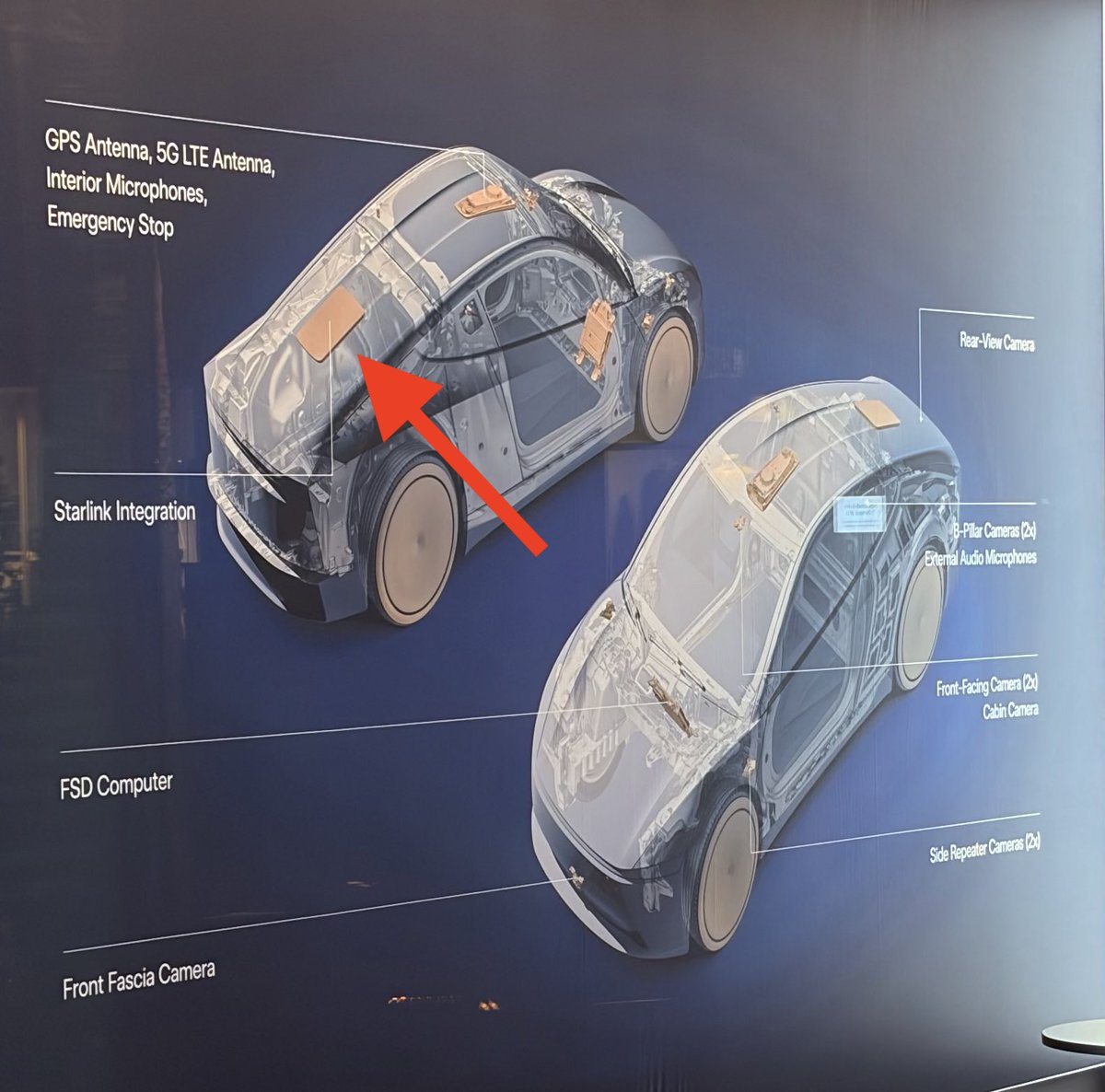
Tesla has quietly confirmed Starlink integration in the Cybercab — not through a press release or product page update, but via new infographics spotted inside a Tesla showroom. Automotive journalist Sawyer Merritt flagged the discovery on July 20, calling it the first time Tesla has directly acknowledged the feature in official materials. Here are the five details that actually matter.

1. This Is the First Official Confirmation From Tesla
Until now, Starlink in the Cybercab was discussed territory, not confirmed territory. Tesla VP Lars Moravy had previously mentioned Starlink connectivity in the context of rural deployment — useful for areas where cellular coverage is thin — but that was a verbal reference in a public forum, not a product specification. These showroom infographics represent Tesla putting the feature on the wall, literally. That shift from executive comment to branded in-store material is meaningful: it signals the feature is considered stable enough to market, not just explore.
2. The Prototype Evidence Has Been Building for Months
The showroom confirmation didn't come out of nowhere. Cybercab test prototypes have been repeatedly photographed on public roads with a Starlink Mini antenna mounted on the trunk lid throughout May, June, and July 2026. A Tesla patent filing (U.S. Publication No. 2025/0368267), published in December 2025, explicitly referenced Starlink integration for "uninterrupted connectivity" and "remote monitoring for Robotaxi" to support fleet management. The showroom infographic is the public-facing capstone on a trail of technical breadcrumbs that had been accumulating for over half a year.
3. Starlink Solves a Real Problem for Autonomous Fleet Operations
A robotaxi without a driver needs a rock-solid data link — not just for passenger convenience, but for the operational infrastructure behind it. Starlink provides high-bandwidth connectivity in cellular dead zones, supports faster OTA software updates across a distributed fleet, enables more precise GPS positioning, and allows remote human oversight when the vehicle encounters an edge case it can't resolve autonomously. For Tesla's planned late-2026 commercial deployment in Austin and Las Vegas, that last point is particularly relevant: FSD v15 is expected to handle the vast majority of trips, but remote monitoring capability is the safety net regulators and operators will want to see.
4. How It Gets Integrated Into Production Is Still an Open Question
The prototype hardware — a Starlink Mini antenna bolted to the trunk lid — is almost certainly not the production form factor. That external mount is a development tool, not a consumer-ready solution. The expectation, consistent with how Tesla typically handles hardware maturation, is that the antenna would be integrated directly into the vehicle's body or roof structure for production units. Whether that means an embedded flat-panel antenna, a flush-mounted solution, or something else entirely hasn't been confirmed. Volume production began at Gigafactory Texas in April 2026, with over 500 units reportedly active in testing as of this month — so the engineering answer to this question needs to come soon.
5. What It Means for the Sub-$30,000 Consumer Version
The Cybercab is expected to be priced under $30,000 for private buyers, with mass sales to consumers projected for 2027. Starlink connectivity — whether as standard equipment or an optional subscription tier — adds a cost variable that Tesla hasn't addressed publicly. For the commercial robotaxi fleet, Starlink is essentially an operational necessity and the economics work differently. For the consumer version, the calculus is less obvious: most owners in urban and suburban areas already have reliable LTE coverage, and adding Starlink hardware to a sub-$30K vehicle puts pressure on margins. Watch for Tesla to either bundle it as a fleet-only feature or introduce it as an optional connectivity upgrade, similar to how Premium Connectivity is handled on current models.
The showroom placement suggests Tesla is comfortable enough with Starlink integration to use it as a selling point — which means the engineering decisions are likely further along than the public record shows. With commercial fleet deployment targeted for late 2026, the remaining unknowns around hardware form factor and pricing structure should resolve within the next few months.
🚕 Following the Robotaxi rollout? See every operating city, launch date and announced market in our Tesla Robotaxi Tracker.
Related Gear
Gear up your Tesla with tested, custom-fit BASENOR accessories — shop Tesla accessories →
Sources & reporting notes
The links below identify the material source records used for this report.
- @SawyerMerritt on X (2026-07-20T15:05:50.000Z) — Direct source
Source links are preserved as published or accessed. See our editorial standards and corrections policy.
The BASENOR Editorial Desk covers Tesla, SpaceX, and related technology, curating reporting from primary sources — official accounts, regulatory filings, and software release data. Every article passes source-record and fact-checking review before publication. About the newsroom.
This report was curated by the BASENOR Editorial Desk from the sources listed above. Read our editorial standards or email editorial@basenor.com to report an error.