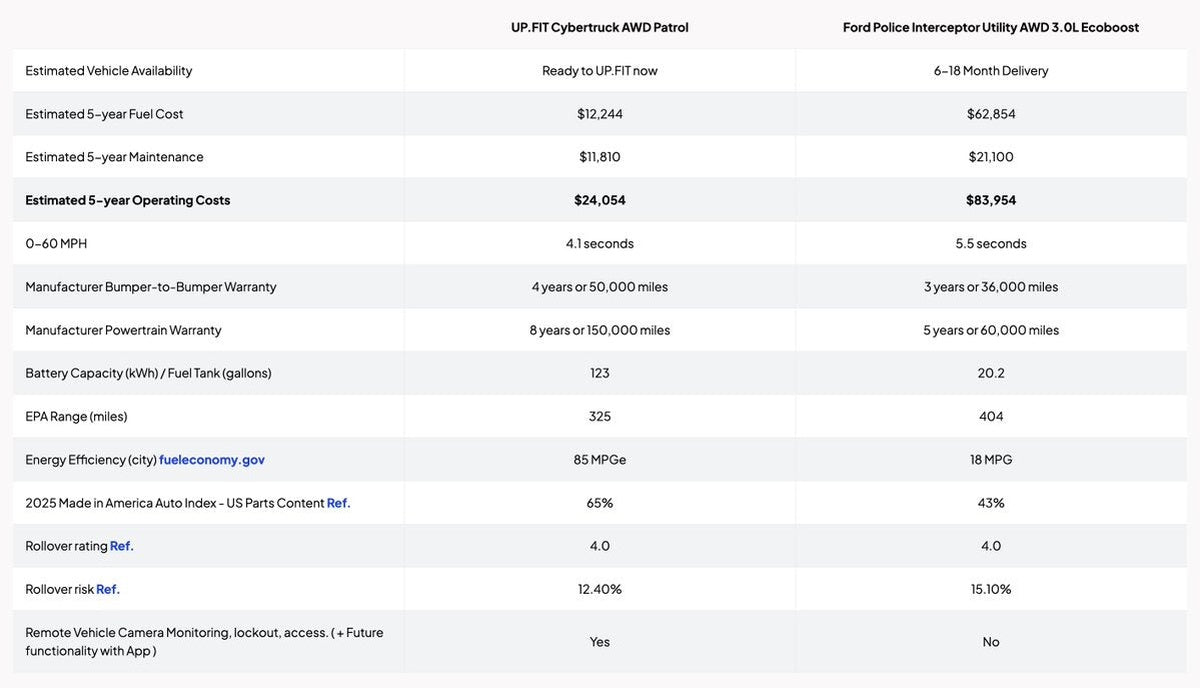
The News: The official Cybertruck account claims a 5-year operating cost of ~$24,000 for the Cybertruck patrol vehicle versus nearly $84,000 for a Ford Police Interceptor Utility — a $60,000 gap.
Why It Matters: If those numbers hold up at scale, the Cybertruck becomes a genuinely compelling fleet argument for municipalities — not just a novelty — and could accelerate law enforcement adoption across the U.S.
Source: @cybertruck on X

A $60,000 Operating Cost Advantage — Where Does It Come From?
The official Cybertruck account isn't just making a branding claim here. The math behind the $60,000 gap is grounded in two areas where electric vehicles structurally dominate internal combustion: fuel and maintenance.
According to verified data from the Las Vegas Metropolitan Police Department — which unveiled its fleet of UP.FIT patrol Cybertrucks in October 2025 — each unit is projected to save between $8,800 and $12,000 in annual fuel costs alone, plus approximately $3,540 in maintenance savings over a five-year service life. Multiply those fuel savings across five years and you're already looking at $44,000–$60,000 in fuel savings before you even factor in maintenance.
Third-party estimates from CarEdge (April 2026) put the Cybertruck's 5-year maintenance and repair costs at roughly $1,961, with electricity costs of approximately $3,210 assuming 15,000 miles driven annually. That's a combined operating cost of around $5,171 — well below what a traditional patrol vehicle spends on fuel alone in a single year.
📊 Key Figures
| Metric | Cybertruck | Ford Police Interceptor |
|---|---|---|
| 5-Year Operating Cost | ~$24,000 | ~$84,000 |
| Est. Annual Fuel Savings | $8,800–$12,000 | Baseline |
| 5-Year Maintenance (est.) | ~$1,961 | Significantly higher |
| 5-Year Electricity Cost (est.) | ~$3,210 | N/A |
| Expected Service Life | 10+ years (est.) | 3–4 years |
| Operating Cost Advantage | ~$60,000 over 5 years | |
Sources: @cybertruck (April 2026), Las Vegas Metro PD (October 2025), CarEdge (April 2026), Irvine PD (October 2024)
Real Departments Are Already Running the Numbers
This isn't theoretical. Multiple law enforcement agencies have already moved from evaluation to deployment. The Las Vegas Metropolitan Police Department's UP.FIT Cybertruck fleet is one of the most cited examples — a real-world validation of the cost projections Tesla is now amplifying publicly.
The Irvine Police Department offers an interesting counterpoint worth examining. They purchased a Cyberbeast model for over $150,000 including customization — compared to a standard Ford Police Interceptor at around $116,000. On acquisition cost alone, the Cybertruck loses. But Irvine PD's own reasoning flips the calculus: they anticipate the Cybertruck lasting at least 10 years, versus the Ford's 3–4 year service life. When you're replacing a Ford every 3–4 years, the acquisition cost comparison changes dramatically over a decade.
The operating cost figure Tesla is highlighting — $24,000 over five years — likely focuses on fuel and maintenance rather than the full total cost of ownership including acquisition. That's an important distinction. But for fleet managers evaluating year-over-year budget impact, operating costs are often the more relevant number, since capital expenditures are typically handled separately.
🔭 The BASENOR Take
Timeline: Las Vegas Metro PD fleet unveiled October 2025 → Irvine PD purchase October 2024 → Official cost comparison published April 17, 2026
Impact Level: 🟡 Medium-High — Fleet adoption is accelerating, but acquisition cost remains a barrier for smaller municipalities
Confidence: 🟢 High — Operating cost savings are backed by real department projections and third-party estimates, not just Tesla marketing
The timing of this tweet matters. Tesla isn't just sharing a stat — they're making a public case for Cybertruck as a serious fleet vehicle at a moment when municipal budget pressures are real. A $60,000 per-vehicle operating savings over five years is the kind of number that gets in front of city councils and procurement committees.
The fleet-to-consumer crossover effect is also worth watching. Every patrol Cybertruck on the road is a rolling advertisement for the platform's durability and practicality. Law enforcement use cases — high-mileage, demanding duty cycles, 24/7 operation — are exactly the conditions that skeptics point to when questioning EV reliability. If Cybertrucks hold up in those environments, it answers a lot of questions for commercial and consumer buyers simultaneously.
The one variable that could complicate the narrative: charging infrastructure. Patrol vehicles need to be ready around the clock. Departments adopting Cybertrucks need to invest in depot charging — and that infrastructure cost doesn't appear in the $24,000 operating figure. For agencies evaluating adoption, that's a real line item to account for. That said, for departments already building out EV infrastructure or those with access to Tesla's commercial charging solutions, the math still looks compelling.
Bottom line: the $60,000 operating cost gap is real, it's backed by verified department data, and Tesla is now actively marketing it. Expect more fleet announcements to follow — and expect the Ford Police Interceptor comparison to become a recurring theme in Tesla's B2B pitch.
Related Gear
Gear up your Cybertruck with tested, custom-fit BASENOR accessories — shop Cybertruck accessories →
Sources & reporting notes
The links below identify the material source records used for this report.
- @cybertruck on X (2026-04-17T23:11:48.000Z) — Direct source
Source links are preserved as published or accessed. See our editorial standards and corrections policy.
The BASENOR Editorial Desk covers Tesla, SpaceX, and related technology, curating reporting from primary sources — official accounts, regulatory filings, and software release data. Every article passes source-record and fact-checking review before publication. About the newsroom.
This report was curated by the BASENOR Editorial Desk from the sources listed above. Read our editorial standards or email editorial@basenor.com to report an error.