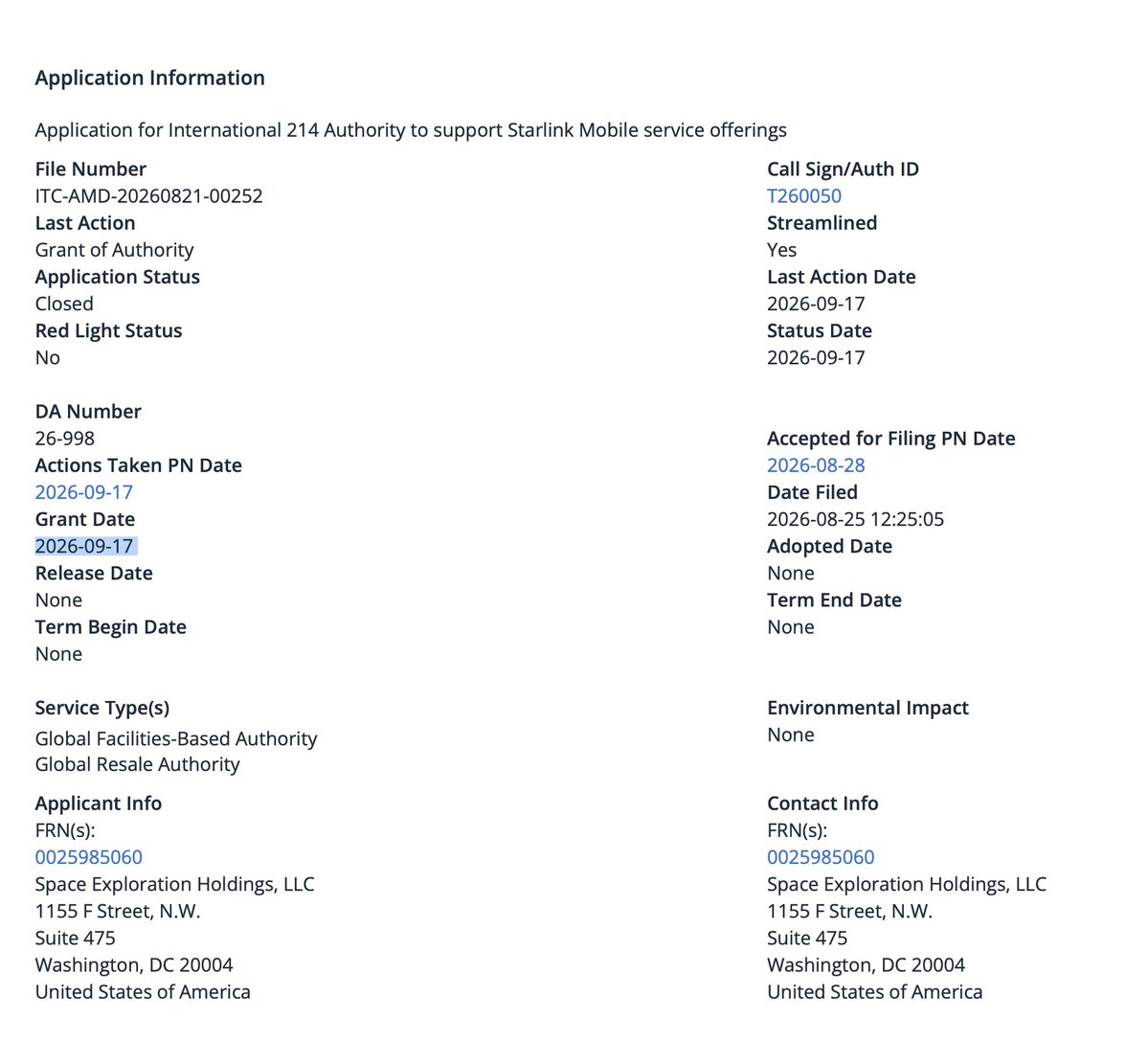
The Federal Communications Commission has granted SpaceX the U.S. regulatory authority to carry Starlink Mobile communications between the United States and other countries. Reported by Sawyer Merritt on September 17, the approval is a formal international telecommunications authorization — the kind of filing that turns a domestic satellite service into a globally licensed carrier. It's a procedural milestone, but a meaningful one: without it, Starlink Mobile's cross-border ambitions would have hit a hard regulatory wall.

What the FCC Actually Approved
This authorization is specifically an international Section 214 license — the FCC's mechanism for approving carriers that want to route traffic between the U.S. and foreign destinations. It's distinct from the domestic operating approvals SpaceX has accumulated over the past two years. Without this clearance, SpaceX could operate Starlink Mobile within U.S. borders but couldn't legally act as the carrier of record for calls or data crossing international boundaries. That gap is now closed.
The filing itself was linked by Merritt in a follow-up post, giving anyone who wants to dig into the regulatory language direct access to the FCC record. The approval doesn't set a commercial launch date on its own — it's an enabling authorization that has to exist before the service can operate internationally, not a signal that the service is live today.
How We Got Here
This approval is the latest in a sequence of FCC actions that have been steadily building Starlink Mobile's regulatory foundation. In November 2024, the FCC authorized SpaceX to begin commercial direct-to-cell operations for phones, initially focused on basic texting via the Gen2 Starlink network in partnership with T-Mobile. That was the starting gun for the consumer-facing service.
In January 2026, the commission approved an additional 7,500 Gen2 satellites — bringing the total approved Gen2 count to 15,000 — with explicit language about enabling direct-to-cell connectivity outside the U.S. SpaceX is required to have 50% of those newly approved satellites in orbit by December 1, 2028. Then in May 2026, the FCC approved SpaceX's acquisition of approximately 65 MHz of nationwide spectrum from EchoStar in a transaction valued at roughly $17 billion. That block — covering AWS-3, AWS-4, and H-Band frequencies — is the bandwidth backbone for Starlink Mobile's 5G direct-to-cell operations domestically.
The international Section 214 authorization announced today is the piece that stitches the domestic approvals to a global operating framework. Each FCC action has been additive, and the picture they collectively paint is a company that has been methodically checking every regulatory box required to run a global mobile carrier from space.
The 2028 Timeline
The commercial target for full-quality service hasn't shifted. According to SpaceX CFO Bret Johnsen's statement in September 2026, Starlink Mobile is aiming for "full 5G quality service" launching in the first half of 2028. That service is expected to be delivered via a new direct-to-device constellation of low-Earth orbit satellites, with deployment planned throughout 2027 using Starship as the launch vehicle.
That timeline matters for context. The FCC approvals — including today's international authorization — are infrastructure-layer work. The consumer experience of making a phone call from a remote location without any terrestrial cell tower is still roughly 18 months out from the stated target. What's being built right now is the legal and spectrum architecture that makes that experience possible at scale across borders.
For anyone following SpaceX's regulatory cadence, the pace has been notable. The company has moved from a domestic texting pilot to a globally authorized carrier framework in under two years — and it still has the satellite deployment and Starship launch cadence needed to actually fill the constellation before the 2028 window opens. Whether that schedule holds will depend as much on Starship's reliability as on any further regulatory steps. For our full SpaceX coverage, see SpaceX coverage.
🚀 Following the Starship program? See every test flight, official outcome and the next launch window in our SpaceX Starship Tracker.
Sources & reporting notes
The links below identify the material source records used for this report.
- @SawyerMerritt on X (2026-09-17T21:34:16.000Z) — Direct source
- @SawyerMerritt on X (2026-09-17T21:34:17.000Z) — Direct source
Source links are preserved as published or accessed. See our editorial standards and corrections policy.
The BASENOR Editorial Desk covers Tesla, SpaceX, and related technology, curating reporting from primary sources — official accounts, regulatory filings, and software release data. Every article passes source-record and fact-checking review before publication. About the newsroom.
This report was curated by the BASENOR Editorial Desk from the sources listed above. Read our editorial standards or email editorial@basenor.com to report an error.