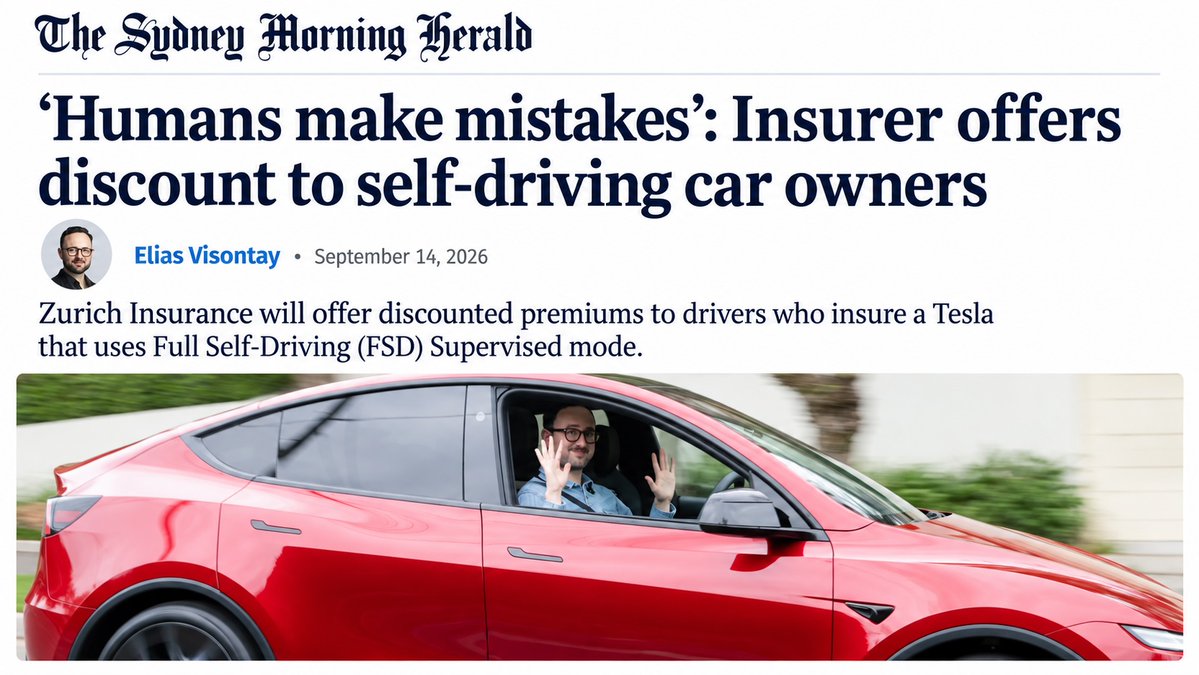
Insurance pricing is quietly shifting in favor of Tesla owners who drive with Full Self-Driving (Supervised) engaged. Lemonade made headlines with a bold 50% per-mile discount for FSD users, and Tesla Insurance has been building out its own discount structure for over a year. According to @wholemars, this is just the beginning — expect more carriers to follow.

Here are five things Tesla owners need to understand about how FSD engagement is starting to translate into real money off their premiums.
1. Lemonade Cut Per-Mile Rates in Half for FSD Users
Third-party insurer Lemonade launched what it calls an "Autonomous Car insurance" product that slices the per-mile usage charge by 50% whenever FSD (Supervised) is engaged. That discount applies specifically to the per-mile component of the policy — not the entire base premium — but for high-mileage drivers, it adds up fast. Lemonade's program connects directly to Tesla's Fleet API to automatically track which miles were FSD-driven versus human-driven, so there's no manual reporting required. The company says its analysis of Tesla fleet data shows FSD is approximately twice as safe as average human driving — and that's the actuarial justification behind the rate cut.
2. Tesla Insurance Offers Up to 10% Off Through Direct FSD Engagement
Tesla's own insurance product rewards FSD usage in two ways. First, there's a direct FSD (Supervised) Discount of up to 10% on certain coverages, calculated based on how much you use FSD over a rolling 30-day period. Second, under Safety Score version 3.0, every mile driven with FSD (Supervised) enabled is automatically assigned a perfect score of 100 — which pulls your average safety score upward and lowers your monthly premium as a result. The more consistently you engage FSD, the better your score, and the lower your bill.
3. Safety Score 3.0 Is Live in Six States — With More Rolling Out
Tesla's Safety Score 3.0 system, which incorporates FSD engagement into the scoring model, is currently available for new policies in Indiana, Tennessee, Texas, Arizona, Virginia, and Illinois. Rollout has been gradual: Arizona, for example, made the FSD (Supervised) Discount available to new policyholders starting February 1, 2025, with the Safety Score benefit following on April 14, 2026. If you're in one of these states and haven't checked whether your policy qualifies, it's worth a look in the Tesla app before your next renewal cycle.
4. Lemonade Requires Hardware 4.0 or Higher
Not every Tesla on the road qualifies for Lemonade's program. According to available details, eligible vehicles typically need Hardware 4.0 or higher and a minimum firmware version to participate. That means older vehicles running HW3 are likely excluded, at least for now. If you're unsure which hardware your car has, you can check under Controls → Software → Additional Vehicle Information in your Tesla's touchscreen. This hardware gate matters because it signals that insurers are specifically betting on the newer, more capable FSD stack — not just the ADAS features that have been around for years.
5. The Broader Industry Shift Is Just Getting Started
What Lemonade and Tesla Insurance have built so far are early proof points, not the ceiling. The core logic — that verified autonomous miles carry lower risk and should cost less to insure — is straightforward enough that other carriers can replicate it once they have access to reliable fleet data. Tesla's Fleet API is the key enabler here: it lets insurers distinguish FSD miles from human-driven miles automatically, removing the self-reporting problem that has historically made usage-based insurance messy. As that data pipeline becomes more established and FSD's safety record accumulates more miles, the actuarial case for discounts only gets stronger. @wholemars put it plainly: more companies are coming.
For Tesla owners, the practical takeaway is simple — if you're already using FSD regularly, make sure you're on an insurance product that actually credits you for it. The gap between a policy that rewards FSD engagement and one that ignores it is already measurable, and it's likely to widen as more carriers enter the space. Check your current policy's terms, verify your hardware generation, and revisit your options at renewal if your insurer isn't yet part of this trend.
Related Gear
Gear up your Tesla with tested, custom-fit BASENOR accessories — shop Tesla accessories →
Sources & reporting notes
The links below identify the material source records used for this report.
- @wholemars on X (2026-09-13T22:32:45.000Z) — Direct source
Source links are preserved as published or accessed. See our editorial standards and corrections policy.
The BASENOR Editorial Desk covers Tesla, SpaceX, and related technology, curating reporting from primary sources — official accounts, regulatory filings, and software release data. Every article passes source-record and fact-checking review before publication. About the newsroom.
This report was curated by the BASENOR Editorial Desk from the sources listed above. Read our editorial standards or email editorial@basenor.com to report an error.