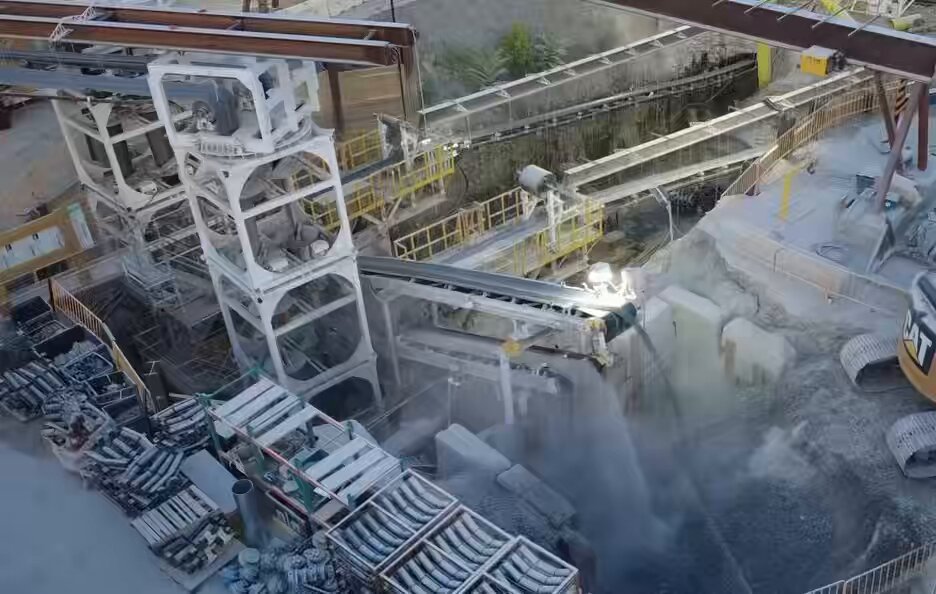
The Boring Company just dropped drone footage of its Prufrock-MB1 and Prufrock-MB2 machines tunneling side by side beneath Nashville — the clearest look yet at the Music City Loop project taking shape underground. If you've been following the project and have questions about what's actually happening down there, here's what the latest update tells us.

What exactly are Prufrock-MB1 and Prufrock-MB2 doing right now?
Both machines are actively boring parallel tunnels through Nashville's bedrock as part of the Music City Loop. According to The Boring Company, the limestone they're cutting through tests at compressive strengths around 14,000 psi — well above the 10,000+ psi threshold the company highlighted in its update. That's exceptionally hard rock, and having two machines running simultaneously marks a significant acceleration in the project's pace.
How does the excavated rock get out of the tunnel?
Each Prufrock machine feeds into a continuous conveyor belt system. Excavated limestone travels from the boring head back through the tunnel via that belt, then transfers onto two vertically stacked side belts — visible in the drone footage — which carry the material up to a surface rock pit. The system runs without interruption, which is the key to maintaining tunneling speed. Stopping to clear spoil is one of the biggest time-killers in conventional tunneling; the continuous belt eliminates that bottleneck.
Is anyone working inside the tunnel while the machines run?
No. According to The Boring Company, Prufrock machines operate with zero people inside the tunnel during normal mining operations. Everything is controlled remotely from a surface operations center. The machines also install tunnel liner segments simultaneously with excavation, meaning the finished bore is structurally lined as the machine advances — not as a separate follow-up operation.
What is the Music City Loop actually building?
The project is a roughly 13-mile underground transit system connecting downtown Nashville — including Lower Broadway and the State Capitol — to West End Avenue and Nashville International Airport (BNA). Tunnels will have a 12-foot internal diameter and run approximately 30 feet below the surface in parallel one-way bores. The initial phase, a ~10-mile segment from the State Capitol to BNA, is targeted for completion by late 2026. The full route is expected to be operational by 2029, according to The Boring Company's published timeline.
Who is paying for this, and does it require public permits?
The Music City Loop is 100% privately funded — no Tennessee taxpayer dollars are involved. The Boring Company secured all 37 permits and approvals required before tunneling began, including a TDOT tunnel permit authorizing up to 25 miles of tunnel and unanimous approval from the Nashville Airport Authority for a BNA station.
When does Prufrock-MB3 arrive, and why does it matter?
A third machine, Prufrock-MB3, is scheduled to arrive in Nashville in September 2026 — meaning it could be on-site within weeks of this update. MB3 is expected to incorporate lessons learned from MB1 and MB2 to improve efficiency further. Three simultaneous bores would meaningfully compress the timeline for the initial phase and give the project a buffer if one machine requires maintenance.
How fast are the Prufrock machines supposed to tunnel?
The Boring Company's stated operational target is greater than one mile per week per machine. Whether MB1 and MB2 are hitting that benchmark in Nashville's hard limestone hasn't been confirmed in this update, but the simultaneous dual-machine operation and the continuous conveyor system are both designed to push toward that goal. With MB3 joining soon, the combined theoretical throughput would exceed three miles of new tunnel per week.
Sources & reporting notes
The links below identify the material source records used for this report.
- @boringcompany on X (2026-09-08T03:55:25.000Z) — Direct source
Source links are preserved as published or accessed. See our editorial standards and corrections policy.
The BASENOR Editorial Desk covers Tesla, SpaceX, and related technology, curating reporting from primary sources — official accounts, regulatory filings, and software release data. Every article passes source-record and fact-checking review before publication. About the newsroom.
This report was curated by the BASENOR Editorial Desk from the sources listed above. Read our editorial standards or email editorial@basenor.com to report an error.